Abstract
A domain-agnostic performance optimization system applies first principles from an external knowledge base to domain structure specifications to derive objectively valuable characteristics. A neural network performs simulation-based analysis identifying which agent characteristics enable constraint satisfaction. The system generates metric profiles quantifying individual agent capability levels across the objectively valuable characteristics at a granular level, capturing capability heterogeneity. The system performs three-way optimization matching tactical sequences to agent capabilities under operating conditions by simultaneously considering tactical sequence optimality, capability requirements for execution, available agent capabilities, and current operating conditions. The system operates domain-agnostically through consistent analytical frameworks across domains, with domain adaptation occurring through domain structure specification, data acquisition adapted to available sources, and output interpretation translating results into domain-specific semantic meanings.
Terms And Definitions
For purposes of the present disclosure, various terms used in the art are defined as follows:
The term “exemplary” shall mean “serving as an example, instance, or illustration.” Any aspect or embodiment described herein as “exemplary” is not necessarily to be construed as preferred or advantageous over other aspects or embodiments described herein.
The term “herein” shall mean in the entirety of this specification including drawings, abstract, and claims. The term herein is not limited to the paragraph, section, or embodiment in which it may appear.
The terms “include”, “comprise”, and “contains” do not limit the elements to those recited. By contrast, only the term “consist” limits the elements to those listed. Unless specifically stated otherwise, the term “some” refers to one or more.
The term “responsive” does not limit the elements, conditions, and/or requirements that may be taken into consideration. For example, an element or structure that is responsive to a specified requirement is not limited to being responsive to only that specified requirement. An element or structure may be responsive to a specified requirement and a second non-specified requirement, specially, when the second requirement, while described as an alternative requirement, may be also deemed complementary.
The term “such as” shall mean "including but not limited to" and introduces non-exhaustive illustrative examples that do not limit the scope of the disclosure.
No conceptual distinction should be drawn from the use of the terms on, at, or in.
The term “agent” shall mean any entity whose performance is subject to evaluation. An agent may be a human individual, an android, an AI-enabled entity, an organizational unit, or any other performer of actions within a domain.
The term “alternate objective” shall mean an objective different from a domain structure specified objective.
The term “analytical frameworks” shall mean any computational, logical, statistical, mathematical, or rule-based construct implemented in hardware, software, firmware, or any combination thereof and used to process, assess, or derive conclusions from data.
The term “behavioral tell” shall mean an observable pattern that reveals internal states or capability levels.
The term “capability degradation” shall mean reduction in agent performance levels on objectively valuable characteristics.
The term “capability modulation” shall mean adjustment of a capability level to achieve objectives across outcome levels.
The term “co-derivation” shall mean derivation of tactical sequences and capability requirements.
The term “communication interface” shall mean hardware and software components configured to transmit and receive data, such as network interfaces, data input ports, video capture interfaces, sensor communication channels, telemetry receivers, and output display interfaces.
The term “computer vision subsystem” shall mean a specialized processing component configured to analyze visual data in real-time, such as video frame processing, object detection, agent tracking, movement analysis, spatial positioning extraction, and performance metric derivation from visual input, wherein the subsystem enables low-latency extraction of objectively valuable characteristic measurements during ongoing operations.
The term “constraint data” shall mean information regarding practical limitations, priorities, and requirements affecting decision-making, such as resource availability, temporal constraints, regulatory requirements, strategic objectives, risk tolerance parameters, and decision authority boundaries.
The term “counteragent” shall mean an agent whose objectives conflict with or oppose those of another agent or group of agents, such as an adversarial party in negotiations, an opposing competitor, a target of assessment, or any entity whose interests create strategic consideration.
The term “critical performance range” shall mean the metric range expected for an agent to perform at a specified domain level. The critical performance range may be position-specific.
The term “data structure” shall mean an organized representation of data configured for efficient storage, access, and manipulation, such as metric profile data structures, degradation relationship tables, vulnerability pattern records, tactical configuration representations, and agent capability state vectors.
The term “database” shall mean a structured data storage system configured to organize, store, and retrieve data, such as metric profile databases, vulnerability pattern repositories, domain structure databases, agent performance databases, and longitudinal tracking databases.
The term “decoy action” shall mean a tactical configuration that appears to counter agents as a genuine threat requiring defensive response but whose primary objective is inducing specific performance degradation in targeted counter agents rather than achieving immediate competitive gain.
The term “degradation relationship” shall mean a quantified causal connection between a specific type of action and subsequent performance decline in a particular objectively valuable characteristic, expressed as the expected magnitude of capability change per instance of that action type.
The term “development recommendation” shall mean guidance for enhancing an agent's capacity for one or more objectively valuable characteristics, responsive to the agent's metric profile and targeted performance objectives.
The term “domain-agnostic” shall mean implementing common foundational architectures across different domains.
The term “domain structure” shall mean a domain’s rules, objectives, constraints, and causal relationships.
The term “expected value” shall mean a probability-weighted average of predicted outcomes across multiple possible scenarios, calculated by multiplying each possible outcome by its probability of occurrence and summing the results.
The term “exploitation action” shall mean a tactical configuration designed to capitalize on detected characteristics, states, or conditions favorable for achieving advantage.
The term “first principles” shall mean principles applicable to a domain's structure, rules, and objectives. First principles comprise, for example, physics, biomechanics, cognitive science, physiology, and other fundamental principles determining agent capabilities and domain dynamics.
The term “granular level” shall mean a level at which individual elements are separately identified.
The term “hierarchical context” shall mean nested levels of outcomes and consequences, wherein decisions at one level affect results at other levels.
The term “memory” shall mean data storage components configured to store instructions, data, and computational results, such as volatile memory including random access memory and cache memory, and non-volatile memory including solid-state drives, hard disk drives, and persistent storage systems.
The term “metric” shall mean a quantified value representing an agent’s measured capacity for an objectively valuable characteristic.
The term “metric heterogeneity” shall mean variation in metric profiles across agents.
The term “metric profile” shall mean a quantified assessment of an agent's expected performance on objectively valuable characteristics, wherein a metric profile may be subsequently updated based on real-time measurements.
The term "metric range" shall mean a quantification scale for an objectively valuable characteristic. A metric range comprises, for example, a scale of 0–100 or percentile rankings.
The term “metric state” shall mean a quantified assessment of an agent's current performance level on objectively valuable characteristics at a specific moment, wherein the metric state may differ from the agent's baseline metric profile due to factors such as fatigue, psychological pressure, environmental conditions, or performance variations, and wherein performance deviations are detected by comparing metric states to metric profiles.
The term “multimodal integration engine” shall mean a system component configured to synthesize data from multiple sources into unified assessments.
The term “multimodal interview” shall mean an interview process that captures multiple types of data, such as video recording of facial expressions and body language, audio recording of vocal patterns and tone, and verbal content comprising spoken responses to questions, wherein the multiple data types enable analysis across visual, vocal, and/or verbal channels.
The term “neural network” shall mean any one or combination of artificial neural networks, deep learning systems, convolutional neural networks, recurrent neural networks, transformer architectures, large language models, machine learning systems, computational learning systems, and other pattern recognition architectures.
The term “objectively valuable characteristic” shall mean a capacity, attribute, or quality of an agent, derived from first principles derivation.
The term “operating conditions” shall mean environmental, contextual, and situational factors affecting tactical sequencing.
The term “percentile ranking” shall mean the position of an agent's metric relative to a population distribution at a specified position and/or domain level.
The term “performance deviation” shall mean the difference between an agent's baseline metric profile value for a given objectively valuable characteristic and the measured actual performance on that characteristic during current actions, wherein positive deviations indicate performance below baseline and negative deviations indicate performance exceeding baseline.
The term “position” shall mean a designated role within a domain requiring specific capability patterns. A position comprises, for example, a functional role within an organization, a tactical assignment within a team, a specialized responsibility within a collaborative effort, or any role-specific performance context.
The term “position-specific” shall mean responsive to the requirements, demands, and/or benchmarks associated with a specified position.
The term “position suitability” shall mean an objectively valuable characteristic representing an agent's capacity to fulfill the requirements of a designated position.
The term “probability distribution” shall mean a function specifying occurrence probabilities across possible outcomes.
The term “processing unit” shall mean computational hardware configured to execute instructions and perform calculations, such as central processing units, graphics processing units, tensor processing units, neural network accelerators, application-specific integrated circuits, field-programmable gate arrays, and distributed processing nodes.
The term “quantification” shall mean conversion of observed characteristics into quantified values enabling mathematical analysis and comparison.
The term “real-time” shall mean processing and decision-making during ongoing activity, such as in-operation analysis, dynamic tactical decisions, live performance assessment, concurrent processing, and contemporaneous processing.
The term “simulation-based analysis” shall mean analysis utilizing simulation.
The term “strategic tactical sequence” shall mean a series of tactical configurations.
The term “system” shall mean an integrated apparatus comprising hardware components, software components, and data structures configured to implement the methods disclosed herein, such as processing units, memory, databases, communication interfaces, and functional components operating in coordination to quantify objectively valuable characteristics, evaluate agent performance, optimize tactical decisions, and provide guidance for capability deployment and development.
The term “tactical configuration” shall mean an organization of one or more elements and/or agents.
The term “tactical decision point” shall mean a discrete moment at which selection among alternative tactical configurations is required.
The term “tactical sequence” shall mean a series of tactical actions.
The term “time horizon” shall mean the temporal period over which outcomes are evaluated and optimized.
The term “transferable metric profile” shall mean a representation of an agent's fundamental capabilities that are consistent across multiple domains, such as reaction time, strategic thinking, precision, speed, endurance, and/or spatial awareness.
The term “vulnerability pattern” shall mean a degradation in an agent's capability under specified conditions.
The above defined terms and other terms explicitly defined herein are to be understood as defined in this document. Incorporation by reference shall not act to modify, limit, or broaden the definitions hereinabove provided or formally defined in this document. A term that is not formally defined in this document is defined herein to have its ordinary and customary meanings.
Foundations & Measurement
Incorporation by Reference. “Superwisdom: Inevitable AI” by Max Abecassis, published at nissim.com, derivative work dated December 15, 2025, derived from AI work conducted by the inventor beginning in 2024, is incorporated herein by reference in its entirety.
First Principles Foundation. The systems and methods disclosed herein rest upon a foundation that distinguishes first principles derivation from conventional data-driven methodologies. This foundation establishes that objectively valuable characteristics exist as discoverable features of domain structure rather than as statistical patterns derived from historical data.
Constancy of First Principles. First principles constitute fundamental truths that remain constant and do not require learning, improvement, or evolution through system operation. Physics principles governing motion, force, and energy are immutable laws of nature. Cognitive science principles governing information processing and decision-making reflect fundamental properties of cognition. Biomechanics principles governing human movement derive from anatomical and physiological constants. These principles exist independent of any particular domain, agent, or competitive instance. The system discovers which first principles apply to a given domain structure and applies those principles to derive objectively valuable characteristics, but the principles themselves do not change through this process. What adapts during system operation is the computational model's accuracy in applying constant first principles to specific situations, the precision of predictions when first principles constraints are satisfied or violated, and the optimization of tactical sequences given first principles constraints. The system improves its application of first principles without the first principles themselves requiring modification. This distinction separates first principles analysis from machine learning approaches where patterns evolve through training data exposure.
Overview of System Capabilities. The present invention provides systems and methods for performance optimization in domains where agents possess heterogeneous capabilities. The system analyzes domain structure through first principles to derive objectively valuable characteristics. The system quantifies individual agent capabilities across these characteristics, creating individualized metric profiles that capture capability variation across the agent population. The system simultaneously derives optimal tactical configurations and the capability requirements needed to execute them, recognizing these elements are mutually constitutive. The system accounts for operating conditions including environmental factors, resource constraints, and counterparty capabilities when applicable. The system matches strategies to available agent capabilities and prevailing conditions through multi-factor optimization. The system optimizes across hierarchical contexts, recognizing that competitive instances exist within broader consequence structures spanning multiple events and time horizons. The system determines optimal objectives themselves rather than assuming predetermined goals, selecting what to pursue based on capability constraints and expected utility calculations. The system operates through constraint-bounded optimization within ethical, legal, and practical boundaries. The system continuously monitors performance and conditions during execution, adapting strategy recommendations as capability states and operating conditions evolve. The system receives user-specified objectives, constraints, and parameters as inputs and calculates the optimal strategy as determined by the application of first principles which may result in enhanced objectives, and wider constraints and parameters evaluations. The following sections describe these capabilities in detail.
Heterogeneous Agent Capability Assessment. Game-playing systems operate in domains where all pieces of a given type possess identical, rule-defined capabilities. Every chess Queen moves identically. Every Go stone has identical placement rules. Strategic optimization in such domains is universal. The optimal move for a given board position remains the same regardless of which specific piece instance is being moved.
Real-world competitive domains involve agents with heterogeneous capabilities. Individual agents possess different metric profiles across objectively valuable characteristics. A tactical sequence that is optimal when executed by agents with one metric profile may be suboptimal or infeasible when attempted by agents with different metric profiles.
The system addresses this fundamental difference by creating a new problem class. Performance optimization must simultaneously determine what capabilities matter, who possesses those capabilities, and what tactical sequences are executable and effective given the specific capability matchup between agents and operating conditions. The system derives objectively valuable characteristics from domain structure through first principles derivation. The system measures individual agent capabilities across these characteristics. The system generates metric profiles quantifying capability variation across the agent population. The system uses these metric profiles to match tactical sequences to available capabilities.
First Principles Derivation of Objectively Valuable Characteristics. The system analyzes domain structure to derive objectively valuable characteristics. Domain structure comprises rules, objectives, constraints, and causal relationships. First principles derivation examines the fundamental requirements imposed by domain structure to identify what characteristics should predictively matter for outcome optimization.
The paradigm distinction from conventional approaches is fundamental. Conventional systems acquire historical performance data and apply machine learning to identify patterns associated with successful outcomes. The training foundation is performance observations. The system learns what successful performers do. The outputs correlate with success because the training data correlates with success. The present system operates through a different paradigm. The training foundation is domain structure comprising the rules, objectives, and constraints that define the domain. The system learns what the domain structurally rewards, independent of what current performers do or have done. The outputs identify characteristics that cause success because they derive from structural requirements that determine success.
Traditional machine learning approaches mine correlations from past outcomes. The system instead performs causal analysis of why certain capabilities would enable superior performance given the domain's structural properties. The derivation process propagates constraints through the domain structure. The system identifies optimization opportunities created by rules and objectives. The system enumerates characteristics that satisfy domain requirements.
Certain characteristics possess objective value discoverable through analysis of structural requirements. When a hexagonal honeycomb structure is analyzed, the optimization is apparent through geometry: hexagons tile perfectly with no gaps, minimize perimeter for maximum area, provide structural strength through load distribution, and require minimal material for construction. These geometric relationships exist as mathematical properties discoverable by any intelligence analyzing efficient space utilization. The optimization is structural, not species-specific or population-dependent.
Similarly, when a sport's structure, rules, and objectives are analyzed, certain athlete characteristics emerge as objectively valuable through logic, physics, and game mechanics. In soccer, the rules establish that athletes propel a ball using their feet toward a goal defended by an opponent. From this structure, speed is objectively valuable because a faster athlete reaches the ball before a slower athlete. Accurate passing is objectively valuable because it maintains possession. Quick decision-making is objectively advantageous because it exploits opportunities before defensive recovery. These relationships require no historical athlete data to establish. They are derived from the fundamental structure of the sport itself.
Objectively valuable characteristics emerge from causal analysis of domain structure. This approach eliminates survivorship bias. The causal chains provide explainability. The system maintains consistency across different contexts within the same domain structure.
Logical Derivation Framework. The derivation of objectively valuable characteristics proceeds through first principles analysis of domain structure at multiple analytical levels. Principally, the characteristics derive from structural requirements themselves, rather than from pre-existing theoretical frameworks. Analytical tools from physics, mechanics, decision theory, and other disciplines aid the analysis but the characteristics emerge from domain structure.
When domain structure involves physical movement or forces, first principles analysis examines physical constraints. In competitive physical domains, speed matters because domain structure creates contested positions requiring rapid movement. Power matters because domain structure creates resistance requiring force application. These characteristics derive from analyzing what the domain's physical structure requires, with physics providing analytical tools to understand the relationships.
When domain structure involves technical execution of actions, first principles analysis examines mechanical requirements. In soccer, ball control matters because domain structure requires maintaining possession through physical contact with the ball. In forestry, cutting precision matters because domain structure requires separating wood from trees at specific locations. The characteristics derive from analyzing what the domain's action structure requires, with mechanical analysis providing tools to understand execution requirements.
When domain structure involves real-time decision-making, first principles analysis examines information processing requirements. Spatial awareness matters because domain structure creates configurations requiring position-based decisions. Decision speed matters because domain structure creates temporal advantages from faster response. The characteristics derive from analyzing what the domain's decision structure requires, with decision theory providing tools to understand cognitive relationships.
When domain structure involves sustained performance under variable conditions, first principles analysis examines performance consistency requirements. Composure under pressure matters because domain structure creates high-stakes moments determining outcomes. Adaptability matters because domain structure changes over time requiring response modification. The characteristics derive from analyzing what the domain's temporal and variability structure requires, with performance analysis providing tools to understand sustainability relationships.
The analytical levels demonstrate that objectively valuable characteristics derive through structural analysis of domains themselves. The domain's structure determines what matters. Analytical frameworks from various disciplines provide tools for understanding why structural requirements create value, but the value derives from structure not from the frameworks.
The multi-level analytical framework provides advantages in characteristic identification and measurement precision. The structured approach enables granular decomposition of complex performance into constituent elements. Where conventional approaches might measure aggregate outcomes such as pass completion, the framework identifies underlying characteristics such as ball striking accuracy, decision timing, spatial positioning, and pressure response that collectively determine outcomes. The granular decomposition enables precise attribution of performance to specific capabilities rather than conflating multiple factors into aggregate metrics.
The systematic structural analysis identifies conventionally ignored characteristics. Historical measurement practices focus on characteristics that are easily observable or traditionally valued. The first principles approach discovers characteristics that domain structure makes valuable regardless of measurement convention. A characteristic may be structurally important but historically unmeasured because observation difficulty prevented quantification or because prevailing strategic fashions directed attention elsewhere. The structural analysis identifies what matters independent of what has been measured, enabling discovery of overlooked optimization opportunities.
The framework ensures comprehensive coverage across all aspects of domain performance. By systematically analyzing physical requirements, mechanical execution requirements, cognitive processing requirements, and sustained performance requirements, the analysis avoids gaps that emerge when characteristic identification relies on intuition or tradition. Each structural level receives explicit analysis ensuring that valuable characteristics are not omitted because they fall outside familiar categories.
The causal understanding embedded in the framework distinguishes structural value from correlation. The analysis establishes why each characteristic matters through explicit reasoning about domain structure. This causal foundation enables confident assessment even when historical data is sparse or absent and provides explanatory power for understanding performance differences.
Granularity Through First Principles Derivation. First principles derivation inherently produces objectively valuable characteristics at the appropriate level of granularity because first principles govern specific physical, cognitive, physiological, or mechanical processes rather than aggregate outcomes. When domain structure requires an agent to propel an object toward a target, physics principles identify the granular capabilities that enable this action: the agent's force production capacity, the agent's directional control precision, the agent's timing accuracy. These are fundamental capabilities that the agent possesses independent of external factors. By contrast, outcome-based measurement would quantify whether the object reached the target, conflating the agent's capabilities with environmental factors such as wind, surface conditions, or interference from other agents. First principles analysis decomposes domain requirements into their constituent capability elements by asking what fundamental agent attributes enable satisfaction of each structural requirement. This decomposition naturally operates at the granular level of agent capabilities because first principles themselves operate at this level—physics governs force production, biomechanics governs movement precision, cognitive science governs decision speed.
The granularity principle extends across all domain types. In cognitive domains, first principles of information processing identify granular characteristics such as pattern recognition speed, working memory capacity, and attention allocation rather than aggregate decision outcomes. In organizational domains, first principles of coordination and communication identify granular characteristics such as information transmission clarity, decision authority distribution, and resource allocation efficiency rather than aggregate organizational performance. In physical domains, first principles of mechanics and physiology identify granular characteristics such as force application timing, energy expenditure efficiency, and movement pattern precision rather than aggregate task completion. The consistent principle is that first principles govern specific processes, and deriving objectively valuable characteristics from first principles therefore identifies the specific agent capabilities that enable those processes.
Proper Attribution Through Causal Decomposition. Accurate performance quantification requires attributing outcomes to their actual causal sources, separating agent capability from external factors outside agent control. An agent may possess high capability in an objectively valuable characteristic yet produce poor aggregate outcomes due to external factors. Conversely, an agent may possess moderate capability yet produce favorable aggregate outcomes due to advantageous external conditions. Proper attribution measures what the agent contributed through their capabilities rather than what outcome resulted from the complete causal chain including external factors.
The attribution principle operates through causal decomposition of performance instances. For each performance instance, the system identifies all causal factors contributing to the observed outcome. The system distinguishes between factors within agent control, determined by agent capabilities, and factors outside agent control, determined by external conditions or other agents' actions. The system attributes performance measurement to the agent only for factors within agent control. In competitive physical domains, an agent's force application and directional control are within agent control and properly attributed to agent capability. Whether the propelled object encounters interference from wind, surface irregularities, or defensive actions by other agents are external factors not attributed to the agent's capability in force application or directional control. In cognitive domains, an agent's analysis quality and decision logic are within agent control and properly attributed to cognitive capability. Whether the decision produces favorable outcomes depends additionally on information accuracy, environmental volatility, and actions by other parties—external factors not attributed to the agent's cognitive capability.
Outcome-based measurement systems conflate these causal factors, attributing to the agent outcomes determined partly or wholly by external factors. A pass completion metric attributes to the quarterback both their delivery accuracy and the receiver's catching ability. A business decision success metric attributes to the decision-maker both their analytical quality and market conditions beyond their control. This conflation produces inaccurate capability quantification because the metric varies with external factors rather than measuring only agent capability. The first principles approach performs proper causal attribution by identifying what capabilities the agent exercised, measuring performance on those specific capabilities, and separating this measurement from outcome determination by external factors.
Integration of Granularity and Attribution. The combination of appropriate granularity and proper attribution enables accurate capability quantification. First principles derivation identifies objectively valuable characteristics at the granular level of fundamental agent capabilities. Causal decomposition attributes performance measurement only to factors within agent control. Together, these principles ensure that metric profiles quantify actual agent capabilities rather than outcome-influenced aggregations conflating agent capability with external factors. This accurate quantification is essential for capability-matched tactical sequence optimization. If metric profiles conflate agent capability with external factors, tactical sequence recommendations would be optimized for incorrect capability assessments, producing suboptimal or infeasible tactical configurations. The granular, properly-attributed metrics enable the system to determine precisely which agents possess which capabilities at which levels, enabling accurate matching of tactical sequences to available capabilities.
The granularity and attribution principles distinguish the present invention from conventional performance measurement systems. Conventional systems measure aggregate outcomes because outcomes are easily observable and historically familiar. The aggregate measurements conflate multiple causal factors, obscuring actual agent capabilities. The present system derives what to measure from first principles analysis of domain structure, producing measurements at the appropriate granular level with proper causal attribution. This principled approach to measurement granularity and attribution is essential to the system's capability to perform multi-factor optimization matching tactical sequences to actual agent capabilities rather than to outcome-influenced aggregations.
Advantages of First Principles Derivation. The first principles approach provides advantages over conventional data-driven methodologies across multiple dimensions. The first principles approach eliminates survivorship bias. Conventional systems trained on successful performers learn patterns present in those who succeeded while remaining blind to patterns present in equally capable performers who did not succeed for reasons unrelated to measured characteristics. First principles derivation identifies characteristics that are inherently valuable given domain structure, independent of which performers happened to succeed.
The first principles approach produces explainable assessments. Every metric has logical justification traceable to physical laws, mechanical requirements, or decision theory principles. Evaluations explain why a characteristic is valuable by reference to domain structure rather than by reference to opaque model correlations. This explainability enables understanding of why each characteristic matters and supports transparent evaluation processes.
The first principles approach enables evaluation where no historical dataset exists. For new competitive formats, emerging operational domains, or contexts following significant structural changes, conventional systems cannot function because historical performance dataset are insufficient. First principles derivation can evaluate performers from initial operation because the derivation depends on domain structure, not historical data.
The first principles approach remains valid despite changes in tactical trends or strategic fashions. In competitive domains, prevailing strategies shift as participants discover new approaches or as rules change. Models trained on historical data become obsolete as patterns diverge from current conditions. First principles analysis of structural requirements remains valid while core structural elements persist.
The first principles approach ensures consistency across contexts. Performers evaluated in different regions, eras, or operational contexts receive consistent assessment because assessment criteria derive from domain structure rather than from population-specific statistical patterns.
Metric Profiling. For each derived objectively valuable characteristic, the system generates metric ranges responsive to fundamental constraints on agent capabilities. The metric ranges derive from fundamental constraints rather than from statistical analysis of performer populations. Conventional systems derive metric ranges from observed data. The range of sprint speed is established by measuring how fast performers in a dataset actually ran. The range of reaction time is established by measuring how quickly performers actually reacted. These ranges reflect the populations from which data was drawn, including era-specific methods, regional characteristics, and selection effects inherent in the dataset.
The present system derives metric ranges from fundamental constraints. The range of sprint speed for human agents is established by analyzing human physiology including motor control, nerve conduction velocity, muscle fiber composition, force production dynamics, and mechanical efficiency of bipedal locomotion. The range of reaction time is established by analyzing cognitive processing including visual perception latency, neural signal propagation, and motor response initiation. These ranges reflect the limits of agent capacity as determined by fundamental constraints rather than statistical distribution of any particular population.
For non-human agents, metric ranges derive from their relevant fundamental constraints. In forestry, wood density ranges derive from cellular structure, lignin content, and growth rate relationships determined by plant physiology. In manufacturing, throughput ranges derive from mechanical limits, thermal constraints, and material properties. In computational domains, processing speed ranges derive from clock frequencies, instruction sets, and memory bandwidth. The fundamental constraints depend on agent type but the principle remains constant: ranges derive from what is fundamentally possible rather than from what has been historically observed.
Domain structure contextualizes the fundamental constraint data for specific operational demands. The metric range for acceleration in soccer reflects biomechanical limits of sprinting and direction change on grass surfaces over distances typical in soccer competition. The metric range for spectral absorption in forestry reflects electromagnetic properties of chlorophyll measured through atmospheric conditions typical in forest environments. The metric range for decision latency in autonomous systems reflects computational processing limits under real-time constraint requirements.
These constraints include physiological limits, cognitive bounds, physical laws, or operational constraints depending on the domain. The system acquires performance data for individual agents through multi-modal observations. The system quantifies each agent's capabilities within the established metric ranges. This process produces metric profiles.
These metric profiles capture capability heterogeneity across the agent population. The metric profiles enable mathematical comparison and optimization. A soccer player may possess high passing accuracy under pressure while another has lower accuracy. A forest stand may average high wood density while another averages lower density. An organization may score high on cultural adaptability while another scores lower.
These individual differences fundamentally affect what tactical sequences are executable and effective. The system generates metric profiles with fine-grained measurement granularity that enables proper causal attribution. Traditional performance measurement systems aggregate outcomes without decomposing contributing factors. In U.S. football, a pass that is conventionally quantified as an incomplete pass can be more granularly quantified as, for example: (i) a pass that was delivered to a receiver's hand and should have been caught but was dropped; (ii) a pass that was delivered to a receiver's hand and should have been caught but a defender interfered with the catch; (iii) a pass intended to be delivered to a receiver's hand but was not catchable by the receiver; (iv) a pass that was intentionally thrown away. Each outcome reflects different agent capabilities and requires different attribution.
The system performs multi-level performance decomposition to separate execution quality from outcome attribution. The system analyzes each performance instance to identify causal factors. The system attributes outcomes to specific agent capabilities. This granular measurement distinguishes between an agent's capability level and factors outside the agent's control. A quarterback with high delivery accuracy whose passes reach receivers' hands but are dropped receives different metric assessment than a quarterback with lower delivery accuracy whose passes are not catchable. The granular metric profiles enable precise capability quantification rather than outcome-based aggregation that conflates multiple causal factors. First principles derivation determines which granular measurements are relevant, enabling the system to extract value from detailed performance data.
Role of Historical Performance Data. The system does not discard historical performance data but repositions its role. Historical performance data serves calibration, benchmarking, and validation functions rather than definitional functions. The data may validate and may serve to calibrate the system but does not define what the system measures or why those measurements matter.
For calibration, historical performance data may inform developmental expectations and contextual percentiles. The first principles derivation determines that a characteristic is objectively valuable. Historical data may indicate what metric levels different populations typically demonstrate. In human athletic development, developmental expectations derive from first principles of physiological maturation, neural development, and motor skill acquisition, with historical data potentially validating predicted developmental trajectories. In organizational contexts, performance expectations derive from first principles of learning curves and capability development, with historical data potentially validating predicted maturity progressions.
For benchmarking, historical performance data may indicate performance levels observed at different operational tiers. The first principles derivation determines the metric range from fundamental constraints. Historical data may show what metric levels correlate with different success tiers. In competitive domains, historical data may indicate metric levels typical of elite versus developing performers. In operational domains, historical data may indicate metric levels associated with different efficiency classes.
For validation, historical performance data may confirm that first-principles-derived characteristics correlate with observed outcomes. The first principles derivation identifies objectively valuable characteristics through structural analysis. Historical outcome data may confirm that agents with high metrics in these characteristics achieve success at higher rates. Discrepancies between first principles predictions and historical correlations trigger investigation into whether structural analysis missed relevant factors or whether historical data reflects confounding variables.
The repositioned role enables the system to function where historical data is limited or nonexistent while leveraging historical data when available for calibration and validation purposes.
Strategy & Optimization
Co-Derivation of Optimal Tactical Sequences and Required Capabilities. The system performs contemporaneous co-derivation of optimal tactical sequences and the capability requirements needed to execute them. Optimal tactical sequences cannot be derived without knowing what capability thresholds they require. Required capabilities cannot be meaningfully identified without understanding what tactical sequences are being pursued.
Deriving that possession-based tactical sequences are theoretically optimal in soccer immediately raises questions. What passing accuracy thresholds are required? What spatial awareness levels are necessary? What decision speed is needed? What technical control standards must be met? The first principles derivation must answer both what should be done and what is needed to do it. These answers emerge contemporaneously.
If the derivation determines possession tactical sequences require high passing accuracy under pressure but the available agents possess only moderate accuracy, this tactical sequence becomes infeasible despite its theoretical optimality. The co-derivation process explores the tactical sequence space. The system calculates theoretical optimality for each approach. The system derives corresponding capability thresholds. The system assesses executability constraints. The system iteratively refines both tactical sequences and capability requirements together until an executable approach emerges.
The co-derivation process applies domain-applicable first principles through pattern recognition across simulation trials or analytical evaluation. The pattern recognition identifies systematic relationships between tactical sequence characteristics and capability requirements, where first principles govern which capabilities enable which tactical approaches. This pattern recognition may be implemented through neural network architectures, algorithmic analysis, or other computational methods that systematically explore the relationship between tactical options and capability needs while applying first principles constraints.
Operating Conditions Analysis. Beyond agent capabilities, the system analyzes operating conditions. These are the environmental factors, constraints, and contextual elements that affect tactical sequence execution and outcomes. Operating conditions encompass adversarial elements when applicable. They include environmental factors. They incorporate resource constraints and temporal constraints. They account for systemic risks.
In competitive sports, operating conditions include opponent capabilities such as press intensity and defensive recovery speed. They include environmental factors such as temperature and field surface. They include game state elements such as time remaining and score. They include physiological states such as fatigue levels. In business integration, operating conditions include market dynamics, regulatory environment, cultural compatibility, and resource availability. In forestry, they include disease pressure, market prices, seasonal harvest windows, and equipment access.
The system quantifies current states across relevant dimensions. The system assesses counterparty capabilities when applicable. The system predicts condition evolution. The system identifies risks and opportunities. Optimal tactical sequences depend not only on agent capabilities but on how those capabilities match against prevailing conditions. The same tactical sequence may be optimal against one set of conditions and suboptimal against another.
Capability-Matched Tactical Sequence Optimization. The system generates tactical sequence recommendations by matching tactical sequences to available agent metric profiles operating under current conditions. This multi-factor optimization considers multiple factors. This multi-factor optimization considers multiple factors. The system determines which tactical sequences are theoretically optimal given domain structure. The system identifies capabilities required to execute each tactical sequence. The system assesses whether available agents possess sufficient capabilities. The system evaluates what the operating conditions enable or constrain. The system calculates expected value for each capability-condition matchup.
A team with high passing accuracy may optimally pursue possession-based tactical sequences against opponents with moderate press intensity. A team with lower passing accuracy facing elite pressing opponents should pursue alternative tactical sequences despite possession approaches' theoretical optimality. The same domain structure with the same rules produces different optimal tactical sequences. The difference depends on the metric profiles of the agents attempting execution. The difference depends on the conditions under which they operate.
Hierarchical Context Optimization. Competitive instances in real-world domains exist within hierarchical consequence structures rather than as isolated events. The system recognizes multiple context levels. Immediate outcomes include win, loss, or tie in a particular instance. Aggregate performance metrics span multiple instances. Strategic objectives affect long-term positioning. Resource constraints include agent capability preservation and allocation across multiple instances.
Optimization occurs across this context hierarchy. Immediate outcomes aggregate into higher-level performance metrics. Resource expenditure in one instance constrains future capacity. Strategic positioning affects long-term competitive dynamics. A system optimizing only immediate outcomes may pursue approaches that are hierarchically suboptimal.
A grandfather playing bocce with his ten-year-old grandson could deploy full capability and win every game decisively. Hierarchical analysis reveals this approach fails at higher context levels. Repeated decisive losses diminish the grandson's engagement. They inhibit skill development. They eventually terminate participation. The optimal approach calibrates performance to maintain competitive balance. The system accepts immediate suboptimal outcomes to achieve hierarchically optimal objectives. The grandson's skill development requires sustained, appropriately-challenging practice enabled by maintained engagement. This hierarchical optimization capability addresses domains where success should be measured across multiple instances and contexts, not isolated within a domain’s specified objectives.
Game-playing systems such as AlphaZero lack this hierarchical optimization capability. Such systems optimize exclusively for immediate game outcomes. Such a system playing bocce with a child would: deploy full capability, win decisively every time, have no mechanism to recognize that immediate wins produce hierarchical failure, be unable to model long-term developmental objectives, and be unable to calibrate performance to serve multi-level goals. This fundamental limitation reflects optimization bounded to single competitive instances.
In contrast, the present first principles system: recognizes hierarchical consequence structures, optimizes across multiple context levels, models long-term objectives alongside immediate outcomes, and calibrates performance to achieve multi-level goals simultaneously. The system addresses domains where success is measured across multiple instances and contexts rather than isolated within single competitive events.
Objective Optimization Under Capability Constraints. The system determines not only how to pursue an objective but whether to pursue it. The objective itself is a variable subject to optimization. First principles derivation evaluates multiple potential objectives. These may include aggressive versus conservative approaches, immediate versus long-term goals, or maximal versus satisficing outcomes. The system derives capability requirements for each objective. The system assesses execution probability given available metric profiles and conditions. The system accounts for consequence structures and asymmetric outcome values. The system selects the objective that maximizes expected utility rather than naively pursuing the superficially obvious objective.
Against superior opponents in regular season soccer competition, the superficially obvious objective is to win the match. This objective may be suboptimal where wins provide three points, ties provide one point, and losses provide zero points. Pursuing wins when capability matchup makes them low-probability exposes teams to high loss probability. This produces lower expected points than deliberately playing for ties. Similarly, a business acquisition with attractive strategic value may have negative expected value. This occurs when integration capability requirements exceed organizational capacity. The optimal objective becomes declining to acquire despite surface appeal.
The system steps beyond immediate competitive instance boundaries to consider higher-order factors. How does this immediate outcome affect aggregate metrics? What are the consequence propagation effects? What resources are preserved or expended? What strategic positioning results? This meta-level reasoning optimizes what to optimize for.
Capability Modulation for Hierarchical Objectives. When hierarchical analysis determines that deploying full agent capability produces suboptimal outcomes at higher context levels, the system performs deliberate capability modulation. The system models the full capability levels available across agent metric profiles. The system calculates expected outcomes if full capabilities were deployed. The system analyzes hierarchical consequences of full capability deployment across multiple context levels.
The system identifies target outcome distributions that optimize hierarchical objectives rather than immediate competitive outcomes. The system calculates the modulation parameters required to achieve these target distributions. Modulation parameters specify the performance level at which agents should operate relative to their full capability. This is not random performance degradation. The system performs calculated calibration to achieve specific outcome probability distributions.
The system generates tactical sequence recommendations that incorporate capability modulation constraints. Agents execute at the calibrated performance levels specified by the modulation parameters. The system monitors actual outcome distributions against target distributions. The system adjusts modulation parameters when observed outcomes deviate from targets. This capability modulation mechanism enables the system to achieve multi-level objectives that would be unattainable through immediate outcome maximization.
Alternate Objective Generation. The system generates alternate objectives through integrated analysis of domain-applicable first principles, domain structure constraints, and hierarchical consequence evaluation. When domain structure specifies explicit objectives, the system applies first principles to evaluate whether those objectives are hierarchically optimal given capability constraints and consequence structures. The system derives alternate objectives by identifying what optimization target maximizes expected value across hierarchical contexts accounting for agent capability limitations, operating conditions, and temporal dynamics. The alternate objective generation process applies domain-applicable first principles to constraint satisfaction analysis, determining which objectives are achievable given fundamental physical, cognitive, or physiological limitations, and which objectives produce superior hierarchical outcomes despite diverging from domain-specified goals.
Constraint-Bounded Optimization. The system performs optimization within constraint boundaries that define acceptable action spaces. Constraints may include ethical boundaries, professional standards and organizational policies, legal and regulatory requirements, practical feasibility limits, resource availability and physical laws, and domain-specific rules of engagement.
These constraints may function to define the feasible space before optimization begins. In developmental contexts, deploying full capability against a less-developed participant is ruled out by ethical and developmental constraints. The optimization question becomes what tactical sequence best serves hierarchical objectives within the space of developmentally-appropriate approaches.
This multi-layer architecture reflects practical wisdom. The architecture includes constraint satisfaction followed by optimization within spaces deemed acceptable. Real-world systems such as business operations optimize within legal constraints. Medical treatment optimizes within ethical constraints. Resource extraction optimizes within sustainability constraints. Competitive operations optimize within rules-of-engagement constraints.
Real-Time Adaptive Optimization. During ongoing execution, the system continuously tracks agent performance relative to baseline metric profiles. The system detects capability degradation. This includes fatigue, stress, and skill decay. The system detects capability enhancement. This includes learning, adaptation, and momentum. The system monitors operating condition evolution. This includes environmental changes, counterparty adaptation, and constraint shifts. The system reassesses tactical sequence optimality with updated inputs.
When current capability states or conditions change sufficiently that expected values shift, the system triggers adaptive tactical sequence recommendations. The system may switch tactical sequences. The system may adjust tactical configurations within sequences. The system may modulate resource deployment. A soccer team maintaining possession tactical sequences may see passing accuracy decline due to fatigue. Opponent press intensity may simultaneously increase. Expected value may drop substantially. The system detects this degradation and recommends switching to alternative tactical sequences better suited to current capability-condition states.
This closed-loop optimization responds to the dynamic nature of real-world performance. Agents do not maintain constant capability. Conditions evolve. Optimal tactical sequences must adapt accordingly. The continuous monitoring, reassessment, and adaptation cycle enables sustained performance optimization as circumstances change during execution.
Neural Architecture
First Principles System Architecture. The system implements a unified neural network architecture where pattern recognition discovers optimization principles from domain structure. The architecture does not fragment capabilities into separate coordinating modules. A single deep neural network analyzes domain structure, agent capabilities, and operating conditions to derive optimal tactical sequences and their capability requirements. The discovery process operates through constraint satisfaction rather than mining historical performance correlations.
Network Structure. The neural network comprises three functional layers: input encoding, deep pattern recognition, and output projection. The input encoding layer transforms domain specifications into numerical representations. Domain structure enters as formal specification of rules, objectives, constraints, and causal relationships. Agent data enters as performance measurements across multiple modalities including video, sensor data, physiological signals, and operational metrics. Operating conditions enter as environmental measurements, counterparty states, resource availability, and temporal factors. The encoding layer projects these heterogeneous inputs into a unified representation space.
The deep pattern recognition layers employ residual neural network architecture. Each layer consists of computational blocks with skip connections enabling information flow across depth. Alternative architectures include transformer networks with self-attention mechanisms, convolutional neural networks for spatially structured domains, or hybrid combinations. Network depth ranges from ten to forty layers depending on domain complexity. Each block applies nonlinear transformations through activation functions such as ReLU or GELU. Batch normalization stabilizes computational dynamics across layers. Layer normalization provides an alternative normalization approach for specific architectures.
The deep layers develop hierarchical feature representations. Early layers recognize basic patterns in domain constraints such as physical laws or rule boundaries. Middle layers identify relationships between structural elements such as how multiple constraints interact. Deep layers recognize optimization opportunities that span multiple constraints and context levels. This hierarchical organization mirrors how domain structure itself exhibits nested relationships from fundamental constraints to emergent strategic patterns.
Output Projection Heads. The deep representations project through multiple output heads that share the same underlying computational substrate. The tactical sequence policy head generates probability distributions over candidate tactical sequences. For each possible action or configuration, the head outputs a probability reflecting how well that choice satisfies domain objectives given current state. The capability requirement head projects the shared representations to derive metric thresholds required for tactical sequence execution. The execution quality head evaluates current agent performance against required thresholds. The expected value head calculates outcome probabilities across hierarchical contexts accounting for immediate results and aggregate consequences.
These projection heads operate as shallow networks extending from the shared deep representations. A typical implementation uses one or two fully connected layers with appropriate output dimensions and activation functions. The policy head employs softmax activation to generate probability distributions. The value head employs linear or tanh activation for scalar outputs. The capability requirement head generates vectors of threshold values for each objectively valuable characteristic. The unified substrate ensures consistency across outputs. The network cannot recommend tactical sequences while simultaneously assessing them as infeasible given available agent capabilities.
Constraint-Based Discovery. The network discovers optimization principles through systematic exploration of how domain structure constrains outcomes. The discovery process begins with domain structure specification. The system receives formal encoding of rules defining legal actions, objectives defining success criteria, constraints defining boundaries, and causal relationships defining how actions affect states.
Through simulation, the network explores relationships between actions and outcomes. Simulated agents with specified metric profiles attempt tactical sequences under varying operating conditions. The network observes which combinations satisfy objectives and which violate constraints. A tactical sequence succeeds when it produces outcomes that satisfy objectives without violating constraints. The network analyzes successful sequences to identify common characteristics of agents that executed them effectively.
These common characteristics constitute objectively valuable characteristics derived from constraint analysis. In soccer, if possession-based tactical sequences succeed when agents maintain high passing accuracy but fail when accuracy drops below thresholds, the network discovers that passing accuracy is an objectively valuable characteristic for this tactical approach. The discovery operates through pattern recognition across simulation trials rather than correlation mining from historical data. The network identifies what must be true about agent capabilities for tactical sequences to satisfy domain objectives given structural constraints.
Co-Derivation Through Unified Pattern Recognition. The network derives optimal tactical sequences and required capability thresholds through the same pattern recognition process. When exploring a tactical sequence during simulation, the network observes both whether the sequence achieves objectives and what agent capabilities enabled execution. The tactical policy head learns to assign high probability to sequences that satisfy objectives. The capability requirement head learns to predict what metric profile values enable successful execution. These learnings occur contemporaneously from the same simulation experiences.
The co-derivation prevents inconsistency. The network cannot learn that a tactical sequence is optimal without simultaneously learning what capabilities it requires. The shared representations force the network to recognize that tactical optimality and capability requirements are mutually dependent. If the network discovers that high-frequency passing achieves possession dominance, it simultaneously discovers that this tactical sequence requires high passing accuracy and rapid decision-making. The pattern recognition operates across both dimensions through unified computational processing.
Multi-Task Learning Framework. The network optimizes multiple objectives through multi-task learning. The loss function combines terms for tactical sequence effectiveness, capability requirement accuracy, execution quality assessment, and expected value prediction. During each simulation trial, the network compares predicted outcomes against observed results across all output heads. Discrepancies generate error signals that propagate through the network via backpropagation. Parameter updates improve future predictions across all tasks simultaneously.
The multi-task framework enables transfer learning across related optimization problems. Patterns learned while deriving tactical sequences for one domain transfer to similar domains. Patterns learned while assessing capability requirements generalize across characteristics. The shared representations enable the network to recognize abstract optimization principles that apply across specific instances. This generalization capability allows the network to operate in novel domains by recognizing structural similarities to previously analyzed domains.
Real-Time Adaptation. During live execution, the network updates its assessments based on observed performance. Agent metric profiles update as real-time measurements reveal capability changes from baseline values. Operating condition estimates update as environmental sensors detect changes. Tactical sequence evaluations update when effectiveness deviates from predictions. The adaptation uses the same computational mechanisms as initial discovery.
The adaptation process refines the system's application of first principles and its modeling of domain-specific parameters, not the first principles themselves. First principles such as physics, biomechanics, and cognitive science remain constant as fundamental truths. The neural network adapts its understanding of how those constant principles apply to specific domain contexts, how accurately its models predict outcomes when first principles are applied, and what domain-specific parameters optimize first principles application. The system improves its capability to apply first principles effectively without requiring the first principles to change.
The network treats execution observations as additional constraint satisfaction data. When an agent executes a tactical sequence, the network observes the actual outcome. If the outcome matches predictions, the network's current representations receive reinforcement. If the outcome differs from predictions, the network identifies which representational elements produced erroneous predictions. The network adjusts those elements through gradient-based updates. This online adaptation occurs continuously during execution without requiring retraining from scratch.
Domain-Agnostic First Principles Discovery. The first principles discovery process operates identically across domains because first principles themselves are universal fundamental truths applicable regardless of domain context. Physics principles govern physical interactions whether in sports, manufacturing, or forestry. Cognitive science principles govern information processing whether in business decisions, military operations, or educational contexts. Biomechanics principles govern human movement whether in athletic performance, manual labor, or daily activities. The domain-agnostic capability derives from applying these universal principles to different domain structures, not from domain-specific training or architectural customization. The method of analyzing domain structure to derive objectively valuable characteristics through constraint satisfaction operates uniformly. The co-derivation of tactical sequences and capability requirements proceeds through the same unified pattern recognition principles. The optimization across hierarchical contexts employs identical analytical frameworks. The constraint-based discovery through simulation maintains consistent logic. These core processes apply regardless of domain specifics.
Domain-specific elements appear in two locations. The neural network architecture selection depends on input data characteristics. Visual domains benefit from convolutional processing. Text or relational domains benefit from transformer attention mechanisms. Network-structured domains benefit from graph convolutions. The output interpretation layer translates numerical predictions into domain-specific semantic meanings. A probability distribution over tactical sequences means different things in competitive sports versus business operations versus forestry management, but the mathematical structure remains consistent.
The deep pattern recognition layers that discover optimization principles from structure operate uniformly. Whether processing visual data through convolutional layers or relational data through attention mechanisms, the network identifies constraint relationships, recognizes optimization opportunities, and derives objectively valuable characteristics through the same logical process. The first principles methodology transcends architectural implementation details.
The fundamental source of domain-agnostic operation is first principles universality, not neural network generalization capability. A conventional machine learning system trained on soccer data cannot optimize forestry operations because its learned patterns are domain-specific correlations. The present system can optimize both soccer and forestry because it applies universal physics, biomechanics, and decision theory principles to each domain's structure. The neural network architecture adapts to input modality characteristics (visual data, relational data, temporal sequences), but the analytical logic applying first principles to derive objectively valuable characteristics operates identically. Domain-agnosticism is a property of first principles, with the neural network serving as the computational substrate implementing first principles analysis across domains.
Multimodal Data Acquisition and Integration. The system acquires performance data through multiple simultaneous modalities appropriate to each domain. Different data sources provide complementary information about agent capabilities and current states. Visual observation captures spatial positioning, movement patterns, and behavioral indicators. Acoustic analysis detects stress markers, communication patterns, and coordination quality. Physiological sensors measure autonomic responses, metabolic states, and physical demands when available. Environmental sensors quantify conditions affecting performance. Equipment sensors capture execution precision and force characteristics. Operational data provides transaction rates, decision timing, and resource utilization.
The system integrates measurements across modalities to generate unified capability state estimates. The integration process weights data sources by reliability and relevance for each objectively valuable characteristic. The system accounts for measurement uncertainties across modalities. The system resolves conflicts when measurements suggest divergent conclusions. The system generates comprehensive capability assessments with associated confidence intervals reflecting multimodal measurement quality. For characteristics directly measurable through single modalities, integration primarily validates single-source measurements. For characteristics requiring inference from behavioral patterns, integration synthesizes evidence across multiple modalities.
Counterparty Behavioral Inference. When direct measurement access is unavailable for counterparty agents, the system infers capability states and internal conditions from observable behaviors. Observable behavioral indicators reveal internal states through systematic patterns. Breathing irregularities indicate cardiovascular stress. Body language changes indicate psychological pressure. Communication pattern disruptions indicate coordination breakdown. Technique degradation indicates physical fatigue or mental pressure. Positioning pattern changes indicate tactical confusion or capability decline. Decision timing alterations indicate cognitive load or confidence changes.
The system maintains behavioral inference models mapping observable performance patterns to inferred internal states. Model parameters are continuously refined through validation comparing inferred states to actual demonstrated capabilities across multiple instances. This inference capability enables comprehensive capability assessment even when direct measurement is infeasible. The behavioral inference applies to qualitative characteristics requiring cognitive or psychological assessment. Game intelligence manifests through spatial positioning patterns. Competition attitude manifests through effort consistency across varying conditions. Synergistic collaboration manifests through coordinated actions with other agents.
Strategic Tactical Sequences. The system generates multi-action tactical sequences designed to achieve cumulative effects across multiple tactical decision points. A strategic sequence comprises a series of tactical configurations where earlier configurations are selected not solely to maximize immediate expected value but to create conditions enabling superior outcomes in subsequent configurations. The sequence expected value is calculated by summing expected outcomes across all configurations, where later configurations are evaluated based on predicted states reflecting cumulative effects from prior configurations.
Strategic sequences exploit temporal dynamics unavailable through single-action optimization. Resource expenditure in early configurations creates capability degradation in counterparty agents. Positioning in early configurations creates spatial advantages for later exploitation. Information revelation in early configurations shapes counterparty responses enabling superior later choices. The system compares expected value for strategic sequences against immediate repeated optimization to determine optimal approach. In many situations, strategic sequences produce higher cumulative expected value than immediate optimization.
When immediate best-action selection reveals exploitation patterns, counterparty agents recognize the pattern and adapt their responses. This adaptation closes the exploitation opportunity. Strategic sequences employing less-obvious early actions delay counterparty recognition. The cumulative advantage from sustained exploitation exceeds the value sacrificed by not maximizing immediate outcomes.
The temporal spacing of sequence actions accounts for effect onset dynamics and counterparty adaptation probability. Actions are spaced to allow effects from early actions to manifest before subsequent exploitation while occurring rapidly enough to prevent counterparty recognition and adjustment. The system allocates resources across sequence actions to maximize cumulative advantage. Lower-capability agents execute early stress-inducing actions while higher-capability agents are reserved for decisive exploitation when conditions are optimal. This resource allocation optimization creates information asymmetry where counterparty agents cannot distinguish strategic preparation from immediate threats.
Predictive Performance State Modeling. Given current performance deviation from baseline, identified relationships between actions and capability changes, and planned tactical sequences requiring specific responses, the system predicts future performance states. The prediction accounts for cumulative effects from multiple stress-inducing or resource-consuming actions. The system forecasts capability levels multiple tactical decision points into the future based on planned action sequences and their associated effects on agent states.
The prediction includes confidence intervals based on historical variance in state change patterns and individual agent consistency characteristics. Agents demonstrating consistent patterns across many observed instances generate high-confidence predictions. Agents exhibiting variable patterns generate wider confidence intervals reflecting increased uncertainty. The predicted future states integrate multiple factors including baseline metric profiles, current observed deviations, planned stress-inducing actions and their associated effects, temporal dynamics of effect onset, and recovery characteristics if sufficient time elapses between stress applications.
For agents with rapid recovery characteristics, predictions account for partial capability restoration between stress applications. For agents with slow recovery, predictions reflect cumulative degradation without meaningful recovery during typical operational intervals. The predictive modeling enables proactive tactical planning optimized for forecasted conditions rather than reactive planning based on current observed states.
Longitudinal Vulnerability Pattern Identification. The system maintains longitudinal performance databases for counterparty agents comprising measurements across multiple competitive instances. Analysis identifies individual-specific vulnerability patterns characterized by trigger conditions, effect magnitude, temporal dynamics, and occurrence probability. A vulnerability pattern specifies what conditions trigger capability changes, which characteristics are affected, how quickly effects manifest, and with what probability the pattern occurs when triggers are present.
Patterns are continuously refined as additional data accumulates. After each new instance, actual outcomes are compared to predicted outcomes and pattern statistics are updated. Counterparty agents encountered multiple times benefit from more accurate vulnerability pattern predictions than agents encountered initially because prior observations have refined statistical relationships. The pattern identification enables predictive exploitation based on trigger detection rather than requiring reactive confirmation of capability changes.
When competing against a counterparty agent for whom vulnerability patterns have been identified, the system monitors for trigger condition occurrence. Upon detecting trigger completion, the system generates predictive alerts indicating expected future capability changes before actual changes are observable. The prediction is probabilistic rather than deterministic. The system indicates probability that effects will occur in the predicted timeline and magnitude. Tactical recommendations integrate both occurrence and non-occurrence scenarios through probability-weighted expected value calculations.
Time-Constrained Implementation. The system addresses severe time constraints in real-time decision environments through pre-computation and anticipatory analysis. The system generates and evaluates candidate tactical configurations continuously during operational execution, pre-computing expected values for multiple scenarios before tactical decision points arrive. When a tactical decision point occurs, recommendations are immediately available rather than requiring computation during constrained time windows.
The pre-computation approach calculates expected values for tactical configurations by anticipating likely state progressions. When actual states materialize, pre-computed recommendations are immediately available. This anticipatory computation eliminates latency that would otherwise consume valuable decision time. The recommendation interface presents highest expected value tactical configurations with calculated expected values, alternative configurations for consideration, key assumptions underlying recommendations, and confidence intervals for predictions.
The interface design prioritizes decision-relevant information presentation. Rather than presenting complete statistical analysis, the interface highlights most important capability mismatches, highest-impact tactical opportunities, and critical situational factors. Decision-makers receive actionable intelligence enabling rapid informed decisions rather than raw data requiring interpretation under time pressure. The system generates definitive recommendations specifying optimal configurations for execution based on calculated expected value superiority accounting for current capability states, counterparty states, probability distributions over responses, and operational context.
Neural Network Architecture Selection. Different neural network architectures implement the first principles discovery process optimized for different input modalities. All architectures perform constraint-based discovery, unified pattern recognition, and multi-objective optimization. The architectural selection affects computational efficiency and input processing effectiveness.
Transformer architectures with multi-head self-attention mechanisms process domains with complex relational structure. The attention weights represent relationships between domain elements. The multi-head mechanism captures multiple relationship types. The position encodings handle sequential or spatial arrangements. Transformers excel at text analysis, strategic game states, and organizational structures where relationships between elements drive optimization opportunities. The constraint satisfaction logic operates through the attention and feedforward layers.
Convolutional neural networks process domains with spatial or visual structure. The convolutional filters recognize local patterns in images or spatial arrangements. Hierarchical pooling operations capture patterns at multiple scales. Convolutional architectures excel at video analysis of agent movements, geographical data in resource management, and any domain where spatial relationships affect outcomes. The constraint discovery operates through feature maps that represent structural patterns at increasing abstraction levels.
Graph neural networks process domains with explicit network topology. The graph convolutions propagate information along edges representing relationships. Node embeddings capture element characteristics. Edge embeddings capture relationship types. Graph architectures excel at organizational hierarchies, supply chain networks, and social structures where network topology constrains optimization. The constraint satisfaction operates through message passing that respects network structure.
Recurrent neural networks process domains with temporal dependencies. The recurrent connections maintain hidden states across time steps. The hidden states accumulate information about historical sequences. Recurrent architectures excel at domains where current states depend on action histories and where temporal patterns affect outcomes. The constraint discovery operates through hidden state dynamics that capture temporal optimization principles.
Hybrid architectures combine multiple approaches within a single network. A convolutional frontend processes visual input. The convolutional features feed into transformer layers that analyze relationships between visual elements. A recurrent backend processes temporal sequences of states. Hybrid architectures address domains with multiple input types requiring different processing approaches. The first principles discovery process operates across all components through the unified pattern recognition substrate.
All architectural alternatives maintain the core capabilities. They derive objectively valuable characteristics from domain structure through constraint analysis. They co-derive tactical sequences and capability requirements through unified pattern recognition. They optimize across hierarchical contexts through multi-task learning. They adapt to changing conditions through online learning. The architectural choice affects implementation efficiency but preserves methodological consistency. The first principles discovery process remains domain-agnostic while the neural network implementation adapts to input characteristics.
Technical Implementation Specifications. The residual blocks within deep layers typically consist of two or three convolutional or fully connected sublayers with residual connections bypassing the transformation. Each sublayer applies batch normalization or layer normalization followed by nonlinear activation. The skip connection adds the block input to the block output before the final activation. This architecture enables training of very deep networks by mitigating gradient vanishing problems.
The policy head projects the final layer representations through a fully connected layer to an output dimension matching the action space size. A softmax activation converts logits to probability distributions. The value head projects through a fully connected layer to scalar outputs with tanh activation for bounded value ranges or linear activation for unbounded ranges. The capability requirement head projects to vectors matching the number of objectively valuable characteristics. The execution quality head projects to scalar quality scores or multi-dimensional quality vectors.
Training employs gradient-based optimization algorithms such as stochastic gradient descent with momentum or adaptive methods like Adam. The loss function combines cross-entropy loss for policy predictions, mean squared error for value predictions, and appropriate metrics for capability and quality predictions. Loss term weights balance the relative importance of different objectives. Learning rates schedule from higher initial values that decrease over training iterations. Batch sizes range from tens to hundreds of samples depending on memory constraints.
Implementation Examples
Domain-Specific Implementation Examples. The following sections describe exemplary implementations across three distinct domains demonstrating how the first principles system architecture adapts to different operational contexts while maintaining consistent analytical frameworks. These implementations illustrate domain structure analysis, objectively valuable characteristic derivation, metric profiling, hierarchical context optimization, and capability-matched strategy generation across organizational, physical performance, and developmental domains.
Mergers and Acquisitions: Organizational Assessment and Integration Optimization. In mergers and acquisitions, domain structure comprises business operational requirements, market dynamics, regulatory constraints, and organizational capabilities needed for competitive success. The system derives objectively valuable characteristics from this structure through first principles analysis. Operational efficiency emerges as objectively valuable because resource utilization directly affects profitability given cost structures. Innovation capability emerges as objectively valuable because product development speed affects market positioning given competitive dynamics. Cultural adaptability emerges as objectively valuable because organizational change capacity affects integration success given structural transformation requirements. Strategic alignment emerges as objectively valuable because goal coherence affects resource allocation efficiency given coordination requirements.
The system generates metric profiles for target companies through multimodal data acquisition. Financial and operational data provide direct measurements of efficiency and productivity characteristics. Communication pattern analysis from internal systems reveals coordination quality and decision-making speed. Meeting dynamics captured through video/audio analysis reveal leadership effectiveness and organizational culture. Document analysis of strategic planning materials reveals innovation capability and strategic thinking quality. The system quantifies each target company's capabilities across objectively valuable characteristics, creating metric profiles enabling mathematical comparison across acquisition candidates.
Operating conditions in M&A contexts include market dynamics affecting valuation and competitive positioning, regulatory environment constraining transaction structure and integration approaches, cultural compatibility between acquiring and target organizations affecting integration feasibility, and resource constraints including budget limitations and management capacity. The system analyzes these conditions to assess how they affect strategy execution. High cultural compatibility enables aggressive integration tactical sequences. Low compatibility requires conservative approaches preserving organizational boundaries. Regulatory complexity constrains integration speed and organizational structure options.
The system performs hierarchical context optimization recognizing that acquisition decisions exist within broader strategic contexts and temporal horizons. Immediate outcomes include acquisition completion and initial integration results. Aggregate outcomes span portfolio performance across multiple acquisitions and holding period returns. Strategic outcomes affect long-term competitive positioning and organizational capability development. The temporal dimension fundamentally affects optimization. An acquisition may be optimal for a three-year hold with planned divestiture but suboptimal for indefinite strategic hold. The system calculates expected value across specified time horizons accounting for integration costs concentrated in early years, synergy realization curves, market timing for exit, and strategic value persistence. The system may determine that declining an acquisition with attractive immediate strategic value is hierarchically optimal when integration capability requirements exceed organizational capacity, or that acquiring with planned divestiture within five years is optimal while indefinite hold produces negative expected value.
The probabilistic calculation engine generates definitive recommendations through rigorous expected value analysis. For each acquisition candidate, the system calculates probability distributions over outcomes accounting for synergy realization scenarios ranging from full achievement to complete failure, integration success probabilities based on cultural compatibility scores and organizational capability assessments, market condition scenarios affecting both acquisition timing and exit opportunities, and regulatory approval probabilities when applicable. The engine computes expected value as probability-weighted outcomes across all scenarios, generating confidence intervals reflecting assessment uncertainty from incomplete due diligence information and market volatility. The system outputs a binary recommendation: acquire at specified terms and time horizon, or decline. When expected value is positive across the specified holding period with acceptable confidence levels, the recommendation is acquire. When expected value is negative or positive expected value requires confidence intervals wider than risk tolerance permits, the recommendation is decline. The system may recommend "acquire if divested by year four" when five-year expected value is positive but ten-year expected value becomes negative due to projected market saturation or competitive dynamics deterioration.
Capability-matched strategy optimization matches integration approaches to organizational capabilities. A target company with strong operational systems but weak strategic planning capabilities suggests integration tactical sequences emphasizing operational independence while providing strategic direction. A target with strong innovation culture but weak operational discipline suggests preserving research autonomy while implementing process improvements. The system co-derives optimal integration structures and the organizational capability requirements needed to execute them. If aggressive integration requires change management capabilities the acquiring organization lacks, alternative approaches preserving target autonomy become optimal despite theoretical integration benefits.
Counterparty analysis applies to target company assessment when direct organizational access is limited during due diligence. Observable patterns reveal internal states. Communication pattern disruptions indicate coordination problems. Leadership turnover patterns indicate cultural dysfunction. Customer retention patterns indicate market positioning strength. The system infers organizational health from behavioral manifestations rather than requiring complete internal transparency. Post-acquisition, real-time monitoring tracks integration progress against predicted trajectories, detecting capability degradation in either organization and triggering adaptive recommendations when integration approaches require modification.
Executive team assessment constitutes a critical component of acquisition analysis. The system generates metric profiles for target company executives across objectively valuable characteristics including decision quality under pressure, strategic thinking capability, operational execution effectiveness, cultural leadership capability, and adaptation to organizational change. Multimodal analysis of meeting recordings, decision documentation, communication patterns, and historical performance outcomes reveals individual executive capabilities and identifies decision failures contributing to organizational underperformance. The system generates specific personnel recommendations as part of the acquisition decision. When analysis reveals that poor strategic decisions stemmed from specific executives with demonstrably weak strategic thinking capabilities, the recommendation identifies termination candidates whose removal is prerequisite to acquisition success. When analysis reveals capability gaps in critical functions such as operations management or technology leadership, the recommendation specifies required personnel additions with target metric profiles. The definitive acquisition recommendation integrates these personnel decisions: acquire at specified price contingent on executive team restructuring including termination of identified underperforming leaders, retention of high-capability executives critical to operational continuity, and addition of specified capabilities currently absent. The post-acquisition plan sequences personnel changes to minimize operational disruption while ensuring required capabilities are in place for integration execution. Probabilistic expected value calculations account for personnel transition risks including key employee retention probability and new hire acquisition success probability.
Strategic sequences span extended timeframes in M&A contexts. Early integration actions focus on relationship building and information gathering rather than immediate organizational changes. These actions reveal cultural patterns and capability levels informing subsequent integration decisions. Premature aggressive integration triggers defensive reactions undermining long-term success. The system sequences integration actions to maximize cumulative value across the complete integration timeline, accepting suboptimal immediate outcomes to achieve superior aggregate results through sustained organizational cooperation and capability preservation.
Special Operations Team Selection and Mission Planning. In special operations contexts, domain structure comprises mission requirements, physical demands, cognitive challenges, time constraints, and life-threatening consequences. The system derives objectively valuable characteristics from mission structure through first principles analysis. Decision quality under extreme pressure emerges as objectively valuable because life-critical choices must be made within seconds given temporal constraints and consequence severity. Physical endurance under sustained high-intensity operations emerges as objectively valuable because mission success requires sustained capability over extended periods given mission duration and recovery limitations. Situational awareness in chaotic environments emerges as objectively valuable because threat detection and opportunity recognition determine survival given information complexity and uncertainty. Stress resilience emerges as objectively valuable because capability maintenance under psychological and physical pressure determines operational effectiveness given the intensity of special operations contexts.
The system generates metric profiles for operators through multimodal data acquisition during training exercises and assessment scenarios. Computer vision analysis tracks movement patterns, tactical positioning decisions, and visible stress indicators. Physiological monitoring through wearable sensors measures cardiovascular response, thermal stress, and recovery characteristics during high-intensity scenarios. Audio analysis captures breathing patterns indicating physical stress and communication effectiveness under pressure. Biomechanical analysis assesses movement efficiency and fatigue-related degradation. Decision quality assessment analyzes tactical choices during scenario-based evaluations. The system quantifies each operator's capabilities across objectively valuable characteristics, identifying individual stress response patterns and capability degradation thresholds.
Operating conditions for special operations include mission-specific factors such as environmental extremes affecting physical performance, opposition capabilities determining threat levels, temporal constraints limiting decision time, equipment availability constraining tactical options, and team composition affecting coordinated capability. The system analyzes how conditions affect tactical sequence feasibility. Extreme environmental conditions may render certain approaches infeasible for operators with specific physiological limitations while remaining viable for operators with different metric profiles. High-capability opposition requires tactical sequences emphasizing stealth and precision over speed and aggression.
The system performs hierarchical context optimization recognizing that individual mission outcomes exist within broader strategic objectives. Immediate outcomes include mission success or failure. Aggregate outcomes include operator capability preservation across multiple missions and long-term strategic positioning. The system may determine that declining a high-risk mission approach is hierarchically optimal when success probability is moderate but operator capability degradation or loss probability is high. Expected value calculations account for mission success value, operator preservation value, strategic intelligence gathering, and long-term operational capacity.
Team composition optimization addresses capability heterogeneity directly. Different operators exhibit different stress response patterns and capability degradation characteristics under equivalent operational demands. Some operators maintain baseline decision quality under extreme psychological pressure while others exhibit measurable degradation when stress exceeds individual thresholds. Some operators demonstrate rapid physical recovery between high-intensity intervals while others require extended recovery periods. The system matches team compositions to mission requirements by selecting operators whose metric profiles and stress response patterns complement mission demands and each other. Missions requiring sustained decision-making under pressure prioritize operators with demonstrated cognitive resilience. Missions requiring repeated high-intensity physical exertion prioritize operators with rapid recovery characteristics.
The system identifies vulnerability patterns in opposition forces through longitudinal analysis when repeated engagements occur. Observable behavioral indicators reveal capability states and psychological conditions. Communication pattern disruptions indicate coordination breakdown. Movement pattern changes indicate fatigue or tactical confusion. Response timing variations indicate decision-making degradation. The system generates tactical sequences designed to exploit detected vulnerabilities, applying stress to opposition capabilities showing degradation susceptibility while avoiding strengths showing resilience.
Capability modulation applies when training less-experienced operators. Experienced operators deliberately adjust their performance during training exercises to maintain appropriate challenge levels for developing operators. Too much capability differential prevents meaningful learning. Too little differential fails to push developing operators toward capability improvement. The system calculates optimal capability modulation enabling experienced operators to provide challenging opposition that promotes skill development without overwhelming less-experienced operators, maximizing training effectiveness across hierarchical objectives spanning immediate exercise outcomes and long-term capability development.
Individualized Human Development: Child Capability Assessment and Optimal Development Path Derivation. In individualized human child development contexts, domain structure comprises human developmental requirements, cognitive maturation patterns, physical capability development, emotional intelligence formation, and the contexts the child will encounter across their lifespan. The system derives objectively valuable characteristics from analysis of human flourishing rather than institutional curriculum requirements. Cognitive capability across multiple dimensions emerges as objectively valuable because different cognitive strengths enable different forms of contribution and fulfillment. Physical capability patterns emerge as objectively valuable because embodied competence affects confidence and engagement with physical world. Creative expression capability emerges as objectively valuable because creative engagement provides intrinsic satisfaction and problem-solving capacity. Social-emotional intelligence emerges as objectively valuable because relationship quality fundamentally affects human wellbeing. Intrinsic motivation patterns emerge as objectively valuable because self-directed engagement produces sustained development and life satisfaction.
The system generates comprehensive metric profiles for individual children through multimodal assessment designed to reveal potential rather than measure compliance. Physical assessment captures strength, coordination, spatial reasoning, and kinesthetic learning preferences. Cognitive assessment spans multiple intelligence dimensions including analytical reasoning, pattern recognition, verbal comprehension, mathematical thinking, and spatial visualization. Creative assessment reveals artistic, musical, narrative, and inventive capabilities. Emotional assessment captures self-awareness, emotional regulation, empathy, and social perception. Behavioral observation across varied contexts reveals intrinsic interest patterns, engagement triggers, frustration responses, and natural learning approaches. The system quantifies each child's metric profile not against standardized benchmarks but against the child's own developmental potential across multiple dimensions.
Critical to accurate assessment is distinguishing genuine child responses from stated preferences or parent-projected aspirations. Children may express preference for activities that carry social prestige, parental approval, or peer acceptance while experiencing stronger intrinsic engagement with different activities better matching their capability patterns and natural interests. The system employs multimodal interview during activity participation to detect genuine engagement markers. Video analysis captures facial expressions, body language, and behavioral indicators revealing authentic interest versus compliance or performance for observers. Biometric data from commonly-worn devices such as smartwatches provides heart rate variability patterns, activity intensity measurements, and engagement indicators during different activity types. Audio analysis captures vocal patterns and communication spontaneity revealing authentic enthusiasm versus socially-appropriate responses. The system identifies incongruence when stated preferences diverge from physiological and behavioral engagement markers. A child may state preference for academically-focused activities while biometric and behavioral data reveal substantially higher engagement during hands-on construction tasks or interpersonal collaboration activities. The multimodal integration reveals what genuinely engages THIS child rather than what the child believes should engage them or what authority figures suggest should be preferred.
The system then performs first principles derivation to determine what developmental path would optimize THIS child's flourishing given their specific metric profile. A child with exceptional spatial-kinesthetic capabilities and moderate verbal capabilities has fundamentally different optimal development paths than a child with exceptional verbal-analytical capabilities and moderate physical coordination. The system does not ask "how do we get this child to meet curriculum standards" but rather "what developmental experiences would enable this child's capabilities to flourish and provide deep engagement and satisfaction." The derivation accounts for the child's natural strengths, intrinsic interest patterns, and the future contexts they will encounter.
The derivation evaluates developmental paths across the complete possibility space rather than limiting analysis to locally available or culturally familiar options. A child's optimal development path may involve activities, learning contexts, or capability applications with limited local availability or parental familiarity. Geographic location, institutional offerings, and parental experience typically constrain exploration to narrow subsets of possible developmental paths. A child with exceptional spatial-mechanical capabilities and kinesthetic learning preferences may optimally develop through activities like precision manufacturing, technical instrument building, or biomechanical design, but never encounter these possibilities if local options emphasize team sports and traditional academics. The system identifies optimal development paths from comprehensive analysis of human capability applications across all domains, then addresses feasibility constraints separately.
The recommendation distinguishes between what is optimal for the child's development and what is feasible given current constraints. When optimal and feasible diverge, the analysis identifies whether constraint modifications such as relocation, resource allocation, or alternative institutions would enable access to optimal development paths. This enables informed decisions about whether pursuing such modifications is warranted. Current performance in available activities provides incomplete information about potential because performance conflates fundamental capabilities with activity-specific trained skills. A child with exceptional fundamental capabilities but limited exposure to optimal activity types may demonstrate moderate current performance while possessing high potential in undiscovered optimal contexts. Conversely, a child with moderate fundamental capabilities but extensive training in current activities may demonstrate strong current performance while facing development ceilings as challenge complexity increases.
Hierarchical context optimization recognizes that immediate learning outcomes exist within the broader context of lifelong development and human flourishing. Immediate outcomes include skill acquisition and knowledge gain. Aggregate outcomes include sustained capability development and knowledge integration across years. Strategic outcomes include developing intrinsic motivation for learning, confidence in capability application, and orientation toward continued growth. Higher-level outcomes concern the child's life satisfaction, contribution capacity, and human flourishing across their lifespan. The system may determine that prioritizing activities aligned with the child's natural capabilities and interests is hierarchically optimal even when this diverges from standardized curriculum expectations. A child with exceptional spatial-mechanical capabilities may optimally spend substantial time on physical construction and mechanical problem-solving rather than maximizing verbal-linguistic skill development beyond functional sufficiency.
Operating conditions include parental objectives and constraints, institutional requirements, resource availability, social contexts, and developmental readiness. However, these function as constraints rather than primary objectives. The system optimizes for the child's optimal development within legitimate constraint boundaries. When parental aspirations conflict with the child's natural capability patterns, the system makes this explicit through probabilistic analysis. Expected value calculations show that forcing development paths misaligned with metric profiles produces lower aggregate fulfillment despite potentially achieving external success metrics. A child with moderate analytical capability and exceptional interpersonal capability pushed toward academic excellence may achieve external credentials but experience lower life satisfaction than a development path emphasizing relationship-intensive pursuits aligned with natural strengths.
Capability-matched development path optimization derives activities, experiences, and learning contexts that match the child's metric profile and developmental stage. The system co-derives optimal developmental sequences and the environmental conditions needed to support them. If analysis reveals a child has exceptional creative capabilities but conventional educational environments suppress creative expression through rigid structure requirements, the optimal development path may require alternative educational settings preserving creative engagement. If a child demonstrates exceptional physical-kinesthetic capabilities but limited access to movement-rich environments, the development plan specifies required environmental modifications. The system generates definitive recommendations: this child's optimal development requires these specific experiences, environmental conditions, and activity emphasis patterns.
Real-time adaptation responds to the child's developmental trajectory. When capability development exceeds predictions, developmental challenges increase to maintain optimal engagement. When development plateaus or regresses, the system identifies whether environmental factors, emotional factors, or approach mismatches explain the pattern and recommends modifications. Longitudinal tracking across years validates capability assessments and development path effectiveness. When a child thrives in predicted contexts with sustained engagement and capability growth, predictions receive validation. When a child struggles despite predicted alignment, the system refines understanding of the child's metric profile and optimal development conditions.
The system functions as the child's lifelong teacher, tutor, and mentor throughout developmental progression. As the child matures, their capabilities evolve, interests shift, and life contexts change. The system continuously updates metric profiles, reassesses optimal development paths responsive to demonstrated trajectory, provides adaptive instruction across evolving learning needs, and generates guidance for major developmental transitions including educational choices, career path selection, and capability application contexts.
The longitudinal relationship enables the system to understand the individual's unique learning patterns, capability development characteristics, and intrinsic motivation drivers with depth impossible from episodic assessment. When the child encounters new challenges, the system draws on comprehensive developmental history to recommend approaches matching demonstrated learning preferences and capability patterns. When the child faces decisions about capability application contexts such as career selection, the system provides probabilistic analysis of alternative paths accounting for the individual's specific metric profile, intrinsic motivation patterns, and life satisfaction optimization rather than generic career guidance.
The system adapts its communication and recommendation sophistication as the child develops cognitive maturity. The system may be embodied as a physical android enabling direct interaction and instruction from early childhood onwards. The android provides immediate physical presence, real-time multimodal observation and assessment, adaptive instruction responsive to moment-by-moment child engagement and comprehension, and continuous developmental relationship building from earliest learning stages. During early childhood, the android collaborates with parents while providing direct child instruction and developmental activities. As the child matures, the android transitions to increasingly autonomous educational relationship while maintaining parental visibility into developmental progress and decision guidance. In later life stages, the relationship evolves from teacher-student to mentor-mentee to collaborative guide.
The disclosed system represents fundamental obsolescence of the traditional classroom paradigm. The conventional model where one instructor simultaneously teaches twenty to thirty students using standardized curriculum and pacing assumes students have sufficiently similar capability profiles, learning rates, and optimal development paths that group instruction can serve all adequately. This assumption is false. Each child has a unique metric profile across multiple capability dimensions requiring individualized development paths, learning approaches, pacing, and challenge calibration. Mass standardized instruction necessarily optimizes for population averages, inherently providing suboptimal development for every individual student whose profile diverges from average - which is nearly all students. When technology enables individualized instruction matched to each child's metric profile with real-time adaptation to developmental progress, the rationale for grouping children by age into classrooms for synchronized instruction disappears. The system disclosed herein provides what the classroom paradigm cannot: true individualization where each child receives instruction optimized for their specific capabilities, interests, developmental stage, and optimal learning approaches. Educational institutions continuing the classroom model after such individualized systems become available would be choosing institutional convenience over child development optimization.
The system's role is revealing the child's potential and deriving development paths enabling that potential to flourish rather than conforming the child to predetermined institutional objectives. Parents and educators receive comprehensive analysis showing what this specific child's capabilities are, what developmental paths would enable optimal flourishing given those capabilities, what constraints affect path feasibility, and what expected outcomes result from alternative approaches including system-centric paths prioritizing institutional objectives versus child-centric paths prioritizing capability-aligned development. The recommendation may be: this child's optimal development requires educational contexts emphasizing hands-on learning and physical engagement rather than verbal-abstract instruction, even though this diverges from conventional academic pathways. The probabilistic framework quantifies expected outcomes across life satisfaction, capability realization, and contribution capacity for alternative development paths, enabling informed decisions prioritizing the child's long-term flourishing.
The following description provides various exemplary embodiments, implementations, and configurations. These examples are illustrative and not limiting. Elements and features described with respect to one embodiment may be combined or incorporated into other embodiments where appropriate. The functional components described herein represent functionally distinct operations that may be implemented through, for example, discrete software components, integrated neural network architectures where functional distinctions emerge through constraint-based learning, or hybrid implementations, with the terminology employed facilitating clear functional description without mandating specific implementation architectures.
Figures Descriptions
The following description provides various exemplary embodiments, implementations, and configurations. These examples are illustrative and not limiting. Elements and features described with respect to one embodiment may be combined or incorporated into other embodiments where appropriate. The functional components described herein represent functionally distinct operations that may be implemented through, for example, discrete software components, integrated neural network architectures where functional distinctions emerge through constraint-based learning, or hybrid implementations, with the terminology employed facilitating clear functional description without mandating specific implementation architectures.
FIG. 1 illustrates the architecture of a first principles performance optimization system 100 for domains with heterogeneous agent capabilities. The system 100 comprises integrated components that transform domain structure analysis and first principles application into optimized tactical recommendations through systematic processing stages.
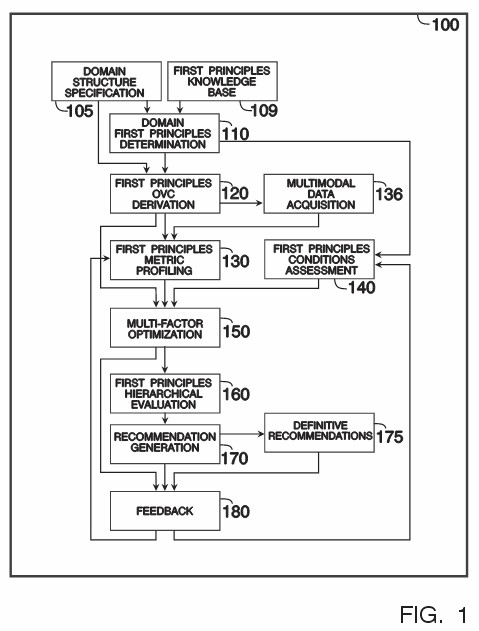
Domain Structure Specification. The system receives domain structure specification 105 comprising formal specifications of domain rules defining legal actions and constraints, domain objectives defining success criteria, and domain constraints defining operational boundaries. The domain structure specification 105 transmits domain specifications to the system's domain applicable first principles determination 110.
First Principles Knowledge Base. The system maintains a first principles knowledge base 109 comprising fundamental principles governing agent capabilities and domain dynamics. The first principles knowledge base 109 comprises physics principles governing motion, forces, energy, and physical interactions. The first principles knowledge base 109 comprises biomechanics principles governing human and biological movement patterns, force production, and mechanical efficiency. The first principles knowledge base 109 comprises cognitive science principles governing information processing, perception, attention, and decision-making. The first principles knowledge base 109 comprises physiology principles governing human biological capabilities, performance limits, fatigue, and recovery. The first principles knowledge base 109 comprises additional fundamental principles applicable to agent capabilities and domain dynamics. The first principles knowledge base 109 transmits available first principles to the system's domain applicable first principles determination 110.
Domain Applicable First Principles Determination. The system's domain applicable first principles determination 110 receives domain structure specifications from domain structure input 105 and available first principles from first principles knowledge base 109. The system's domain applicable first principles determination 110 analyzes domain structure to identify what types of challenges and requirements the domain creates. The system's domain applicable first principles determination 110 identifies whether the domain involves physical movement requiring physics and biomechanics principles. The system's domain applicable first principles determination 110 identifies whether the domain involves cognitive performance requiring cognitive science principles. The system's domain applicable first principles determination 110 identifies whether the domain involves biological agents requiring physiology principles. The system's domain applicable first principles determination 110 identifies whether the domain involves other challenge types requiring specific fundamental principles. The system's domain applicable first principles determination 110 selects from first principles knowledge base 109 those fundamental principles applicable to the identified domain. The system's domain applicable first principles determination 110 transmits domain-applicable first principles to the system's first principles objectively valuable characteristic derivation 120.
First Principles Objectively Valuable Characteristic Derivation. The system's first principles objectively valuable characteristic derivation 120 receives domain-applicable first principles from domain applicable first principles determination 110 and receives domain structure specifications from domain structure input 105. The system's first principles objectively valuable characteristic derivation 120 applies the domain-applicable first principles to domain structure to derive objectively valuable characteristics. The system's first principles objectively valuable characteristic derivation 120 analyzes what capabilities the domain structure requires and determines from first principles what agent characteristics enable satisfaction of those requirements.
When domain structure creates physical challenges, the system's first principles objectively valuable characteristic derivation 120 applies physics and biomechanics principles to derive physical capabilities such as speed, force production, or movement precision. When domain structure creates information processing challenges, the system's first principles objectively valuable characteristic derivation 120 applies cognitive science principles to derive cognitive capabilities such as decision speed, pattern recognition, or spatial awareness. When domain structure creates sustained performance demands, the system's first principles objectively valuable characteristic derivation 120 applies physiology principles to derive biological capabilities such as endurance, recovery, or stress resilience.
The system's first principles objectively valuable characteristic derivation 120 transmits derived objectively valuable characteristics to the system's first principles metric profiling 130 and to the system's first principles multi-factor optimization 150 for contemporaneous co-derivation of optimal tactics and capability requirements.
Agent Metric Profiling. The system's metric profiling 130 receives objectively valuable characteristics from the first principles derivation 120 and agent performance data from the system's multimodal data acquisition 136. The system's multimodal data acquisition 136 capture agent performance information across available data modalities including visual observation, operational measurements, behavioral patterns, and physiological indicators when accessible. The system's metric profiling 130 quantifies individual agent capabilities across the objectively valuable characteristics, generating individualized metric profiles that capture capability heterogeneity across the agent population. The system's metric profiling 130 transmits metric profiles to the system's multi-factor optimization 150.
Operating Conditions Assessment. The system's operating conditions assessment 140 receives domain-relevant condition specifications from the domain structure analysis 110 identifying which environmental factors, resource constraints, temporal factors, and counterparty elements affect tactical sequence execution in this domain. The system's operating conditions assessment 140 receives current condition measurements from sensors and data sources. The system's operating conditions assessment 140 quantifies current operating conditions affecting tactical sequence execution and outcomes. The system's operating conditions assessment 140 transmits operating conditions to the multi-factor optimization 150.
Multi-Factor Optimization. The system's multi-factor optimization 150 receives objectively valuable characteristics from the first principles derivation 120, receives agent metric profiles from 130, and receives operating conditions from the operating conditions assessment 140. The system's multi-factor optimization 150 derives optimal tactical sequences given domain structure, identifies available capabilities from metric profiles, and assesses execution feasibility given operating conditions. The system's multi-factor optimization 150 matches tactical sequences to agent capabilities operating under current conditions, calculating expected values through probabilistic analysis integrating uncertainty across all three dimensions. The system's multi-factor optimization 150 identifies optimal tactical configurations maximizing expected value given the specific capability-condition matchup and transmits tactical configurations to the system's hierarchical context evaluation 160.
Hierarchical Context Evaluation. The system's hierarchical context evaluation 160 receives tactical configurations from the multi-factor optimization 150 and evaluates them across nested consequence levels comprising immediate outcomes, aggregate outcomes spanning multiple instances, strategic outcomes affecting long-term positioning, and higher-level objectives. The system's hierarchical context evaluation 160 performs optimization across this hierarchy, recognizing that decisions maximizing immediate outcomes may be suboptimal at higher context levels. The system's hierarchical context evaluation 160 transmits hierarchically-optimized recommendations to the system's output 170.
Recommendation Generation. The system's output 170 receives hierarchically-optimized tactical configurations from evaluation 160 and generates definitive recommendations 175 specifying optimal tactical sequences for execution, capability requirements for those sequences, expected outcomes across hierarchical contexts, and confidence intervals reflecting assessment uncertainty. The system's output 170 provides tactical recommendations 175 for agent operations execution.
The system's feedback 180 acquires real-time performance observations during agent execution of tactical recommendations 175. The system's feedback 180 compares observed outcomes against predicted outcomes from the multi-factor optimization 150. The system's feedback 180 detects performance deviations between baseline metric profiles and actual performance, triggering metric profile updates in the metric profiling 130. The system's feedback 180 detects operating condition changes during execution, triggering reassessment of tactical sequence optimality in the operating conditions assessment 140. The system's feedback 180 connects execution observations to the metric profiling 130 and operating conditions assessment 140, enabling closed-loop optimization responsive to dynamic conditions during ongoing operations.
Domain-Agnostic Architecture. The system 100 implements domain-agnostic processing where all analytical operations execute through consistent frameworks regardless of domain specifics. Domain adaptation occurs through three instantiation points. First, domain structure specifications at input 105 define the particular domain being optimized. Second, the first principles derivation 120 transmits derived objectively valuable characteristics to the multimodal data acquisition subsystems 136, which adapt their measurement extraction algorithms to quantify the specific characteristics identified as valuable for the domain. The multimodal data acquisition subsystems 136 further adapt to available data sources in each domain, with different modalities accessible across different operational contexts. Third, the recommendation generation 170 translates numerical optimization results into domain-specific semantic meanings appropriate to each domain's decision contexts. The analytical processes of first principles derivation, metric profiling, multi-factor optimization, hierarchical evaluation, and adaptive feedback operate identically across all domains.
This domain-agnostic architecture exists because the analytical operations implement first principles analysis, and first principles are universal across domains. The system does not learn domain-specific patterns from domain-specific data. The system applies universal principles to domain-specific structures. Physics applies universally. Cognitive science applies universally. The domain structure specification and data acquisition adapt to each domain, but the core analytical framework applying first principles operates identically because the principles themselves are universal fundamental truths.
The functional components illustrated in FIG. 1 may be implemented through neural network architectures as described in FIG. 2, through algorithmic implementations, or through hybrid approaches. When implemented through neural networks, the domain applicable first principles determination 110, first principles objectively valuable characteristic derivation 120, metric profiling 130, and multi-factor optimization 150 constitute functional outputs of neural network processing as described in connection with FIG. 2. The architectural representation in FIG. 1 illustrates functional relationships independent of specific implementation method.
FIG. 2 illustrates the unified neural network architecture 200 implementing first principles discovery through constraint-based pattern recognition. The architecture 200 comprises a single integrated neural network where pattern recognition discovers optimization principles by applying first principles to domain structure through shared computational substrate rather than through separate coordinating modules.
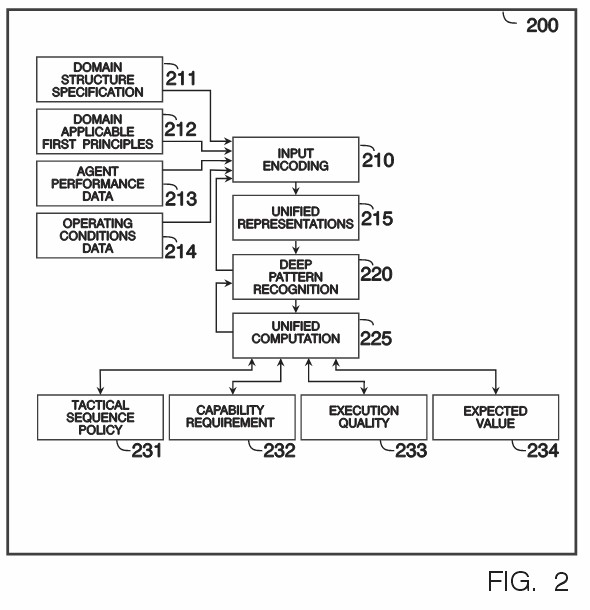
Input Encoding Layer. The system's input encoding layer 210 receives heterogeneous inputs from multiple sources: domain structure specifications 211 comprising formal encodings of rules, objectives, and constraints; domain-applicable first principles 212 comprising physics, biomechanics, cognitive science, physiology, and other fundamental principles relevant to the domain as determined by domain applicable first principles determination; agent performance data 213 comprising measurements across multiple modalities including visual data, operational metrics, behavioral observations, and physiological signals when available; and operating conditions data 214 comprising environmental measurements, counterparty states, resource availability, and temporal factors. The system's input encoding layer 210 projects these heterogeneous inputs into unified representations 215 encoding domain structure, applicable first principles, agent capabilities, and operating conditions in a common format enabling integrated processing.
Deep Pattern Recognition Layers. The system's deep pattern recognition layers 220 receive unified representations 215 and develop hierarchical feature representations through computational depth. The system's deep pattern recognition layers 220 comprise a residual neural network architecture with skip connections enabling information flow across depth. The system's deep pattern recognition layers 220 comprise between ten and forty computational layers depending on domain complexity, each layer applying nonlinear transformations through activation functions and normalization operations.
The system's deep pattern recognition layers 220 develop hierarchical abstractions where early layers recognize basic patterns including domain constraint structures and first principles relationships, middle layers identify how first principles apply to domain requirements and how agent capabilities relate to tactical sequence execution, and deep layers recognize optimization opportunities spanning multiple constraints and context levels through integrated first principles analysis. The early layers detect fundamental patterns such as physical laws from first principles, rule boundaries from domain structure, and individual constraint specifications. The middle layers identify how domain constraints interact with first principles to create capability requirements, how agent capabilities relate to tactical sequence feasibility, and how operating conditions affect execution given first principles constraints. The deep layers recognize complex optimization principles including hierarchical consequence structures, strategic sequences spanning multiple actions, and capability-matched tactical configurations derived through first principles application to domain structure.
The system's deep pattern recognition layers 220 operate through unified computational substrate 225 where all processing shares common representations. The unified substrate 225 ensures consistency across all analytical functions, preventing the system from deriving tactical sequences without simultaneously deriving capability requirements, or from recommending configurations while assessing them as infeasible.
Output Projections. The system's output projections 231, 232, 233, and 234 receive deep representations from unified substrate 225 and project them into domain-specific predictions through shallow neural networks. All output projections 231, 232, 233, and 234 share the same underlying computational substrate 225, ensuring analytical consistency.
The system's tactical sequence policy 231 receives deep representations from substrate 225 and generates probability distributions over candidate tactical sequences. The system's tactical sequence policy 231 comprises one or two fully connected layers projecting to action space dimensions with softmax activation converting logits to probabilities. The system's tactical sequence policy 231 assigns high probability to tactical sequences that satisfy domain objectives given current states and first principles constraints.
The system's capability requirement 232 receives deep representations from substrate 225 and predicts metric thresholds required for tactical sequence execution. The system's capability requirement 232 comprises one or two fully connected layers projecting to vectors matching the number of objectively valuable characteristics derived through first principles application. The system's capability requirement 232 specifies what agent capabilities are necessary to execute each tactical sequence successfully given first principles constraints.
The system's execution quality 233 receives deep representations from substrate 225 and evaluates current agent performance against required capability thresholds derived from first principles. The system's execution quality 233 comprises fully connected layers projecting to quality assessment outputs indicating whether available agent capabilities satisfy tactical sequence requirements.
The system's expected value 234 receives deep representations from substrate 225 and calculates outcome probabilities across hierarchical contexts. The system's expected value 234 comprises fully connected layers projecting to value predictions accounting for immediate outcomes, aggregate outcomes across multiple instances, strategic outcomes, and higher-level objectives. The system's expected value 234 applies activation functions appropriate to value ranges, using tanh for bounded ranges or linear activation for unbounded ranges.
First Principles Co-Derivation Through Shared Representations. The unified substrate 225 enables contemporaneous co-derivation of optimal tactical sequences and required capability thresholds through shared pattern recognition applying first principles to domain structure. When the system's deep layers explore tactical sequences during constraint-based discovery, the unified substrate 225 simultaneously processes domain structure requirements, applicable first principles constraints, what sequences satisfy objectives, and what agent capabilities enable execution. The system's tactical sequence policy 231 and capability requirement 232 learn from the same simulation experiences through shared substrate 225. The unified substrate 225 prevents inconsistency by forcing recognition that tactical optimality and capability requirements are mutually dependent through first principles relationships, not independently derivable.
First Principles Constraint-Based Discovery Process. The system's neural network 200 discovers optimization principles through systematic exploration applying first principles to domain structure through constraint satisfaction. The system's input encoding layer 210 receives formal domain structure specifications 211 and domain-applicable first principles 212. The system's deep pattern recognition layers 220 explore relationships between actions and outcomes through simulation where simulated agents with specified metric profiles attempt tactical sequences under varying operating conditions. The system's deep layers apply first principles to analyze which combinations satisfy domain objectives without violating constraints. When domain structure creates contested spatial positions and physics principles determine that speed wins position contests, the system's deep layers derive that speed is an objectively valuable characteristic. When domain structure requires sustained decision-making and cognitive science principles determine that processing speed affects decision latency, the system's deep layers derive that decision speed is an objectively valuable characteristic. These characteristics constitute objectively valuable characteristics discovered through applying first principles to constraint analysis.
Multi-Task Learning Framework. The system's neural network 200 optimizes multiple objectives through multi-task learning where a single loss function combines terms for tactical sequence effectiveness, capability requirement accuracy, execution quality assessment, and expected value prediction. During each simulation trial, the system's output projections compare predicted outcomes against observed simulation results where first principles govern outcome determination. Discrepancies generate error signals that propagate through the unified substrate 225 via backpropagation, updating network parameters to improve future predictions across all output projections simultaneously. The multi-task framework operating through unified substrate 225 enables transfer learning where first principles patterns learned for one domain generalize to related domains through shared representations of universal laws.
Real-Time Adaptation. During operational execution, the system's neural network 200 updates assessments based on observed performance. The system's input encoding layer 210 receives real-time performance measurements. The system's deep layers compare observed outcomes to predicted outcomes from output heads 230 accounting for first principles constraints. When outcomes match predictions, the unified substrate 225 receives reinforcement. When outcomes differ from predictions, the system's deep layers identify representational elements producing errors and adjust those elements through gradient-based parameter updates propagating through unified substrate 225. The adaptation occurs continuously during execution without retraining from scratch, enabling responsive optimization as conditions evolve while maintaining first principles consistency.
Alternative Neural Network Architectures. The unified pattern recognition approach instantiates through multiple alternative neural network architectures optimized for different input modalities while maintaining identical first principles constraint-based discovery methodology. The system's deep pattern recognition layers 220 may comprise transformer architectures with multi-head self-attention mechanisms for domains with complex relational structure, convolutional neural networks for domains with spatial or visual structure, graph neural networks for domains with explicit network topology, recurrent neural networks for domains with temporal dependencies, or hybrid architectures combining multiple approaches. All architectural alternatives maintain unified substrate 225 with multiple output projections 231-234 projecting from shared representations, ensuring co-derivation through consistent pattern recognition applying first principles regardless of architectural implementation.
FIG. 3 illustrates the hierarchical context optimization architecture 300 enabling the system to optimize across nested consequence levels rather than maximizing immediate outcomes in isolation. The architecture 300 recognizes that competitive instances exist within broader consequence structures spanning multiple events and time horizons.
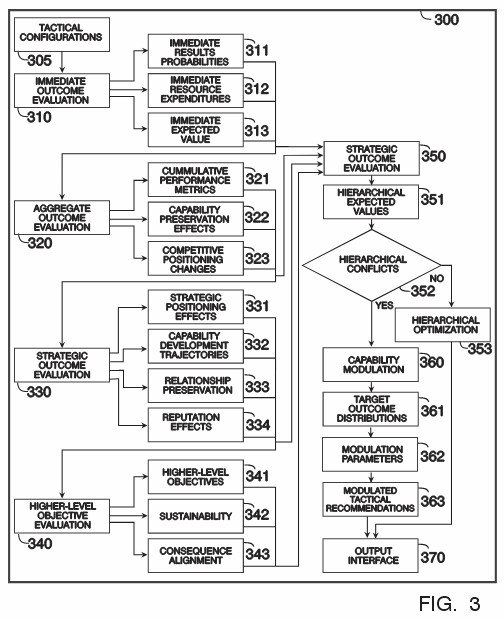
Immediate Outcome Evaluation. The system's immediate outcome evaluation 310 receives tactical configurations 305 from optimization processes and evaluates immediate consequences. The system's immediate outcome evaluation 310 calculates immediate result probabilities 311 including win, loss, tie, or other immediate state changes. The system's immediate outcome evaluation 310 assesses immediate resource expenditure 312 comprising agent capability consumption, material resources, and temporal costs. The system's immediate outcome evaluation 310 generates immediate expected value 313 through probability-weighted outcomes at this context level. The system's immediate outcome evaluation 310 transmits immediate evaluations 311 312 313 to the system's aggregate outcome evaluation 320.
Aggregate Outcome Evaluation. The system's aggregate outcome evaluation 320 receives immediate outcome evaluations from immediate outcome evaluation and evaluates consequences across multiple instances. The system's aggregate outcome evaluation 320 calculates cumulative performance metrics 321 aggregating results across sequences of instances. The system's aggregate outcome evaluation 320 assesses capability preservation effects 322 where immediate resource expenditure affects future capacity. The system's aggregate outcome evaluation 320 evaluates competitive positioning changes 323 where immediate outcomes affect standing in larger competitions. The system's aggregate outcome evaluation 320 recognizes that optimizing immediate outcomes may produce suboptimal aggregate results when immediate success depletes capabilities needed for subsequent instances. The system's aggregate outcome evaluation 320 transmits aggregate evaluations 321 322 323 to the system's strategic outcome evaluation 330.
Strategic Outcome Evaluation. The system's strategic outcome evaluation 330 receives aggregate evaluations from aggregate outcome evaluation and evaluates long-term strategic consequences. The system's strategic outcome evaluation 330 assesses strategic positioning effects 331 where current actions affect future competitive dynamics. The system's strategic outcome evaluation 330 evaluates capability development trajectories 332 where current activities build or degrade long-term capabilities. The system's strategic outcome evaluation 330 analyzes relationship preservation 333 where current actions affect future cooperation or opposition from counterparties. The system's strategic outcome evaluation 330 considers reputation effects 334 where current choices affect future opportunities and constraints. The system's strategic outcome evaluation 330 transmits strategic evaluations 331 332 333 334 to the system's higher-level objective evaluation 340.
Higher-Level Objective Evaluation. The system's higher-level objective evaluation 340 receives strategic evaluations from strategic outcome evaluation 330 and evaluates alignment with higher-level goals. The system's higher-level objective evaluation 340 assesses contribution to higher-level objectives 341 such as organizational mission, human development, or long-term value creation; evaluates sustainability 342 where current approaches must remain viable across extended timeframes; and considers consequence alignment 343 with fundamental values or requirements defining acceptable outcomes. The system's higher-level objective evaluation 340 transmits higher-level objective evaluations 341 342 343 to the system's hierarchical integration 350.
Hierarchical Integration and Optimization. The system's hierarchical integration 350 receives evaluations from all context levels (310, 320, 330, 340) and performs optimization across the complete hierarchy. The system's hierarchical integration 350 calculates hierarchical expected value 351 integrating immediate outcomes 313, aggregate outcomes 321, strategic outcomes 331, and higher-level objectives 341 through weighted combination reflecting relative importance of each context level. Decision point 352 evaluates whether hierarchical conflicts exist where decisions maximizing lower-level outcomes produce suboptimal higher-level results. When decision point 352 determines hierarchical conflicts exist, hierarchical expected value is transmitted to the system's capability modulation 360. When decision point 352 determines no hierarchical conflicts exist, the system performs hierarchical optimization 353 selecting tactical configurations that maximize expected value across all context levels and transmits optimized tactical configurations to output interface 370.
Capability Modulation for Hierarchical Objectives. The system's capability modulation 360 receives hierarchical expected value 351 and conflict identification 352 indicating that deploying full agent capability maximizes immediate outcomes but produces suboptimal hierarchical results. The system's capability modulation 360 determines target outcome distributions 361 that optimize hierarchical expected value rather than immediate expected value. The system's capability modulation 360 calculates modulation parameters 362 specifying performance levels relative to full capability that achieve target distributions. The system's capability modulation 360 generates modulated tactical recommendations 363 incorporating capability adjustments. The system's capability modulation transmits modulated optimized tactical recommendations to output interface 370.
Bocce Grandfather Example. The hierarchical optimization architecture 300 enables the system to recognize that a grandfather playing bocce with his ten-year-old grandson should not deploy full capability despite this maximizing immediate wins. The system's immediate outcome evaluation 310 calculates that full capability deployment produces high win probability. The system's aggregate outcome evaluation 320 recognizes that repeated decisive losses diminish grandson engagement. The system's strategic outcome evaluation 330 identifies that reduced engagement terminates participation, eliminating future skill development opportunities. The system's higher-level objective evaluation 340 evaluates that the higher-level objective is grandson skill development through sustained practice, not grandfather victory accumulation. The system's hierarchical integration 350 determines that calibrating performance to maintain competitive balance maximizes hierarchical expected value despite sacrificing immediate wins. The system's capability modulation 360 calculates performance adjustments enabling appropriately challenging competition.
FIG. 4 illustrates the multi-factor optimization architecture 400 addressing performance optimization in domains where agents possess heterogeneous capabilities requiring simultaneous consideration of tactical sequences, agent capabilities, and operating conditions.
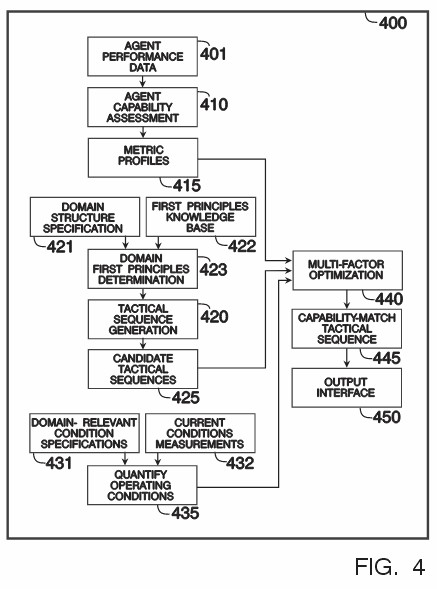
Agent Capability Heterogeneity. The system's first principles agent capability assessment 410 utilizes performance data 401 from agents to generate metric profiles 415 capturing capability heterogeneity. Different agents possess different capability levels across objectively valuable characteristics derived through first principles application to domain structure. The system's first principles agent capability assessment 410 transmits metric profiles 415 to the system's multi-factor optimization 440.
Tactical Sequence Options. The system's first principles tactical sequence generation 420 utilizes domain structure specification 421 and first principles knowledge base 422 determines domain-applicable first principles 423 to generate candidate tactical sequences 425. Different tactical sequences have different capability requirements for successful execution under first principles constraints. The system's first principles tactical sequence generation 420 transmits candidate tactical sequences 425 to the system's multi-factor optimization 440.
Operating Conditions. The system's first principles operating conditions assessment 430 utilizes domain-relevant condition specifications 431 and current condition measurements 432 to quantify operating conditions 435 affecting which tactical sequences are executable and effective given first principles constraints. The system's first principles operating conditions assessment 430 transmits operating conditions 431 to the system's multi-factor optimization 440.
Multi-Factor Optimization. The system's multi-factor optimization 440 receives agent metric profiles 415, tactical sequences 425, and operating conditions 435. The system's multi-factor optimization 440 performs simultaneous optimization across all three dimensions applying first principles to determine which tactical sequences are feasible given agent capabilities and operating conditions, and which combinations produce optimal expected value. The system's multi-factor optimization 440 generates capability-matched recommendations 445 specifying which tactical sequence each agent should execute given their specific metric profile and prevailing operating conditions. The capability-matched recommendations 445 are provided to the output interface 450.
Fundamental Principle. The multi-factor optimization architecture 400 demonstrates that the same domain structure with the same rules produces different optimal tactical sequences depending on which agent with which capability profile is operating under which conditions.
Domain-Agnostic Application Across Multiple Domains. The following sections demonstrate how the system architecture illustrated in FIGS. 1-4 applies identical analytical frameworks across fundamentally different domains through domain-specific instantiation of inputs while maintaining consistent core processing. The system architecture operates uniformly across organizational capability assessment, physical performance optimization, and human development contexts, adapting only through domain-specific inputs, data sources, and output interpretations.
Domain Structure Specification. The system receives domain structure specifications adapted to each domain context.
Mergers and acquisitions domain structure comprises business operational constraints defining efficiency requirements, market competitive dynamics determining strategic positioning, and regulatory compliance requirements establishing integration boundaries.
Special operations domain structure comprises mission execution constraints defining tactical requirements, opposition capability dynamics determining threat levels, and environmental challenge requirements establishing operational boundaries.
Individualized child development domain structure comprises developmental stage constraints defining age-appropriate challenges, learning progression dynamics determining skill acquisition sequences, and resource availability requirements establishing feasible development paths.
Domain-Applicable First Principles Determination. The system applies first principles appropriate to each domain's structure specifications.
Mergers and acquisitions analysis applies organizational efficiency principles, strategic positioning principles, and cultural integration principles to derive what organizational capabilities enable competitive success.
Special operations analysis applies physics governing physical movement, biomechanics governing human performance under stress, cognitive science governing decision-making under pressure, and physiology governing endurance and recovery to derive what operator capabilities enable mission success.
Child development analysis applies cognitive science governing learning and development, physiology governing physical maturation, and biomechanics governing motor skill acquisition to derive what child capabilities enable optimal development and flourishing.
Objectively Valuable Characteristic Derivation. The system derives characteristics by applying first principles to domain structure requirements.
Mergers and acquisitions derives operational efficiency as objectively valuable because resource utilization directly affects profitability given business cost structures, innovation capability as objectively valuable because development speed affects market positioning given competitive dynamics, cultural adaptability as objectively valuable because organizational change capacity affects integration success given structural transformation requirements, and strategic alignment as objectively valuable because goal coherence affects resource allocation efficiency given coordination requirements.
Special operations derives decision quality under extreme pressure as objectively valuable because life-critical choices must be made within seconds given temporal constraints and consequence severity, physical endurance under sustained high-intensity operations as objectively valuable because mission success requires sustained capability given duration and recovery limitations, situational awareness in chaotic environments as objectively valuable because threat detection determines survival given information complexity, and stress resilience as objectively valuable because capability maintenance under pressure determines operational effectiveness given intensity levels.
Child development derives cognitive capabilities across multiple dimensions as objectively valuable because different cognitive strengths enable different forms of contribution and fulfillment, physical capability patterns as objectively valuable because embodied competence affects confidence and engagement with physical world, creative expression capability as objectively valuable because creative engagement provides intrinsic satisfaction, social-emotional intelligence as objectively valuable because relationship quality fundamentally affects human wellbeing, and intrinsic motivation patterns as objectively valuable because self-directed engagement produces sustained development and life satisfaction.
Metric Profiling Through Domain-Specific Data Acquisition. The system generates metric profiles through multimodal data acquisition adapted to each domain's available sources.
Mergers and acquisitions metric profiling quantifies target company capabilities through financial and operational data providing efficiency measurements, communication pattern analysis from internal systems revealing coordination quality and decision-making speed, meeting dynamics captured through video and audio analysis revealing leadership effectiveness and organizational culture, and document analysis of strategic planning materials revealing innovation capability and strategic thinking quality.
Special operations metric profiling quantifies operator capabilities through training exercise analysis revealing tactical decision patterns, physiological monitoring through wearable sensors measuring cardiovascular response and recovery characteristics during high-intensity scenarios, audio analysis capturing breathing patterns indicating physical stress and communication effectiveness under pressure, and biomechanical analysis assessing movement efficiency and fatigue-related degradation.
Child development metric profiling quantifies individual child capabilities through physical assessment capturing strength, coordination, and kinesthetic learning preferences, multi-dimensional cognitive assessment spanning analytical reasoning, pattern recognition, verbal comprehension, mathematical thinking, and spatial visualization, creative assessment revealing artistic, musical, narrative, and inventive capabilities, emotional assessment capturing self-awareness, regulation, empathy, and social perception, and behavioral observation across varied contexts revealing intrinsic interest patterns, engagement triggers, and natural learning approaches including biometric and behavioral markers distinguishing genuine engagement from stated preferences.
Multi-Factor Optimization Matching Strategies to Capabilities and Conditions. The system performs multi-factor optimization matching tactical approaches to agent capabilities operating under domain-specific conditions.
Mergers and acquisitions multi-factor optimization matches integration tactical sequences to organizational metric profiles operating under market dynamics affecting valuation and competitive positioning, regulatory environments constraining transaction structure and integration approaches, and cultural compatibility between acquiring and target organizations affecting integration feasibility. A target company with strong operational systems but weak strategic planning suggests integration sequences emphasizing operational independence while providing strategic direction.
Special operations multi-factor optimization matches team composition tactical sequences to operator metric profiles operating under environmental extremes affecting physical performance, opposition capabilities determining threat levels, temporal constraints limiting decision time, and equipment availability constraining tactical options. Missions requiring sustained decision-making under pressure prioritize operators with demonstrated cognitive resilience.
Child development multi-factor optimization matches development path tactical sequences to child metric profiles operating under parental constraints and objectives, institutional requirements, resource availability, and social contexts. A child with exceptional spatial-mechanical capabilities and kinesthetic learning preferences may optimally develop through activities like precision manufacturing or technical instrument building despite limited local availability.
Hierarchical Context Optimization Across Temporal and Consequence Scales. The system performs hierarchical optimization across nested consequence levels recognizing that immediate outcomes exist within broader strategic contexts.
Mergers and acquisitions hierarchical optimization evaluates across immediate acquisition completion and initial integration results, aggregate portfolio performance across multiple acquisitions and holding period returns, strategic competitive positioning and organizational capability development, and higher-level organizational mission and value creation. The temporal dimension fundamentally affects optimization where an acquisition may be optimal for a three-year hold with planned divestiture but suboptimal for indefinite strategic hold.
Special operations hierarchical optimization evaluates across immediate mission success or failure, aggregate operator capability preservation across multiple missions, strategic intelligence gathering and long-term positioning, and higher-level operational capacity maintenance. The system may determine that declining a high-risk mission approach is hierarchically optimal when success probability is moderate but operator capability degradation probability is high.
Child development hierarchical optimization evaluates across immediate skill acquisition and knowledge gain, aggregate sustained capability development and knowledge integration across years, strategic intrinsic motivation for learning and confidence in capability application, and higher-level life satisfaction, contribution capacity, and human flourishing across lifespan. The system may determine that prioritizing activities aligned with the child's natural capabilities and interests is hierarchically optimal even when this diverges from standardized curriculum expectations.
Domain-Specific Recommendation Generation. The system generates definitive recommendations translated into domain-appropriate semantic meanings.
Mergers and acquisitions recommendations specify binary acquire or decline decisions at specified terms and time horizons, integration tactical sequences including aggressive integration when cultural compatibility enables versus conservative approaches preserving organizational boundaries when compatibility is limited, executive team restructuring identifying termination candidates whose removal is prerequisite to acquisition success and required personnel additions with target metric profiles, and probabilistic expected value calculations across specified holding periods accounting for integration costs, synergy realization scenarios, market condition scenarios, and regulatory approval probabilities.
Special operations recommendations specify team composition selections matching operator metric profiles to mission requirements, mission approach tactical sequences emphasizing stealth and precision when opposition capabilities are high versus speed and aggression when conditions permit, capability modulation parameters for training contexts where experienced operators deliberately adjust performance to maintain appropriate challenge levels for developing operators, and risk-adjusted mission viability assessments accounting for success probability, operator preservation probability, and strategic value.
Child development recommendations specify optimal development paths requiring specific experiences, environmental conditions, and activity emphasis patterns, required environmental modifications when conventional educational settings suppress capabilities through rigid structure requirements, capability-aligned activities emphasizing hands-on learning and physical engagement for children with exceptional spatial-kinesthetic capabilities versus verbal-abstract instruction for children with exceptional analytical capabilities, and probabilistic outcome quantification across life satisfaction, capability realization, and contribution capacity for alternative development paths enabling informed decisions prioritizing the child's long-term flourishing.
Architectural Consistency Across Domains. The three domain implementations demonstrate that the analytical frameworks operate through identical computational logic across fundamentally different domains. These frameworks comprise first principles domain structure analysis, domain-applicable first principles determination, objectively valuable characteristic derivation through first principles application, metric profiling through multimodal data acquisition, multi-factor optimization matching tactical sequences to agent capabilities operating under conditions, hierarchical context optimization across nested consequence levels, and adaptive feedback.
Domain adaptation occurs through three instantiation points. First, domain structure specifications define rules, objectives, and constraints specific to each domain. Second, data acquisition subsystems adapt to available sources in each domain, acquiring financial data in mergers and acquisitions contexts, physiological data in special operations contexts, and developmental assessment data in child development contexts. Third, output interpretation translates numerical optimization results into domain-specific semantic meanings, generating acquisition decisions in mergers and acquisitions contexts, team composition specifications in special operations contexts, and development path recommendations in child development contexts.
The domain-agnostic architecture enables performance optimization across any domain where agents possess heterogeneous capabilities requiring assessment, where domain structure enables first principles analysis, and where operating conditions affect tactical sequence feasibility.
FIG. 5 illustrates the real-time adaptive optimization loop 500 enabling continuous performance monitoring, deviation detection, and tactical sequence adaptation during ongoing operations.
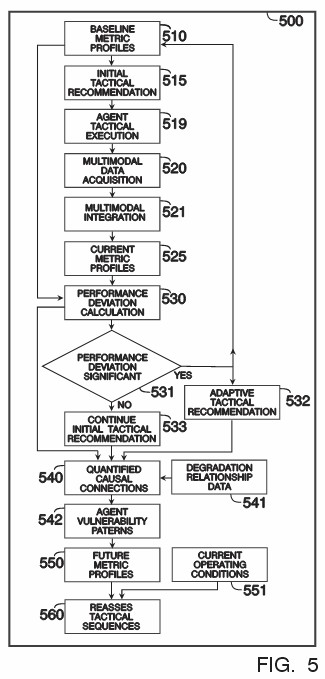
Baseline Establishment and Initial Recommendations. An exemplary method comprises establishing baseline metric profiles 510 for agents comprising expected performance levels on objectively valuable characteristics derived from prior first principles metric profiling. The method comprises generating initial tactical recommendations 515 optimized for expected capability states and anticipated operating conditions based on baseline metric profiles 510. The method comprises providing initial tactical recommendations 515 for agent execution.
Real-Time Performance Monitoring. During agent execution 519 of tactical recommendations 515, the method comprises continuously acquiring performance data 520 across available modalities including visual observation, operational measurements, physiological monitoring when sensors are available, and environmental condition measurements. The method comprises synthesizing the acquired performance data 520 into unified metric profile estimates through multimodal integration 521, weighting data sources by reliability, resolving conflicts when measurements diverge, and generating current metric profiles 525 representing agent performance levels with associated confidence intervals.
Performance Deviation Detection and Analysis. The method comprises comparing current metric profiles 525 to baseline metric profiles 510 across all objectively valuable characteristics. The method comprises calculating performance deviations 530 as differences between baseline and current values, applying statistical significance testing to distinguish meaningful capability changes from normal variance. The performance deviations 530 include capability degradation when current performance falls significantly below baseline and capability enhancement when current performance significantly exceeds baseline.
Adaptive Decision and Recommendation. Decision point 531 evaluates whether performance deviations 530 warrant tactical adaptation. When decision point 531 determines deviations are significant, the method comprises generating adaptive tactical recommendations 532 optimized for current capability states and conditions. The adaptive tactical recommendations 532 may comprise tactical sequence switching to alternative approaches, tactical configuration adjustment modifying elements within current sequences, or resource deployment modulation adjusting agent utilization given capability changes. When decision point 531 determines deviations are within acceptable ranges, the method comprises continuing with current tactical approach 533.
Predictive Modeling and Reassessment. The method comprises accessing degradation relationship data 541 and quantifying causal connections 540 between degradation data 541 and performance deviations 530 across objectively valuable characteristics. The method comprises identifying agent-specific vulnerability patterns 542 where particular agents exhibit characteristic degradation patterns under specific conditions, based on quantified causal connections 540. The method comprises forecasting future metric profiles 550 based on identified vulnerability patterns 542, accounting for cumulative effects from planned action sequences, applying first principles to predict degradation trajectories and recovery patterns, and generating confidence intervals reflecting prediction uncertainty. The method comprises monitoring current operating conditions 551 including environmental factors, resource states, and counterparty capabilities. The method comprises reassessing tactical sequences 560 given predicted future metric profiles 550 and current operating conditions 551, validating that current tactical approach remains optimal for forecasted conditions.
Continuous Learning and Profile Updates. The method comprises updating baseline metric profiles 510 when sustained deviations indicate permanent capability changes rather than temporary variations, distinguishing temporary degradation from capability decay through temporal pattern analysis. The method comprises comparing actual operational outcomes to predicted outcomes, calculating prediction errors, and propagating corrections through neural network and model parameters. The method comprises refining degradation relationships, updating vulnerability patterns, and calibrating expected value calculations improving future prediction accuracy.
The performance deviation detection implements the comparing of current performance measurements to baseline metric profile values as recited in claim limitations, where performance deviations 530 quantify the difference between baseline metric profiles 510 and current metric profiles 525. The forecasting of future capability states implements prediction based on identified causal relationships, where degradation relationship data 541 and vulnerability patterns 542 constitute the causal relationships enabling future metric profile 550 prediction.
Temporal Operation. The real-time adaptive optimization method 500 operates at multiple timescales: real-time monitoring updates capability states within seconds during ongoing operations, tactical reassessment occurs within minutes when deviations warrant adaptation, metric profile updates occur across hours to days when sustained capability changes are confirmed, and continuous learning refinements accumulate across weeks to months as validation data enables model improvements.
FIG. 6 illustrates the multimodal integration architecture 600 enabling comprehensive capability state assessment through synthesis of measurements across multiple data acquisition modalities. The architecture supports two measurement approaches: direct measurement when sensor access enables quantification of agent internal states, and behavioral inference when direct measurement access is unavailable requiring inference of internal states from observable behavioral patterns. The architecture includes specialized processing for behavioral tell identification and counterparty inference enabling capability assessment even without sensor access.
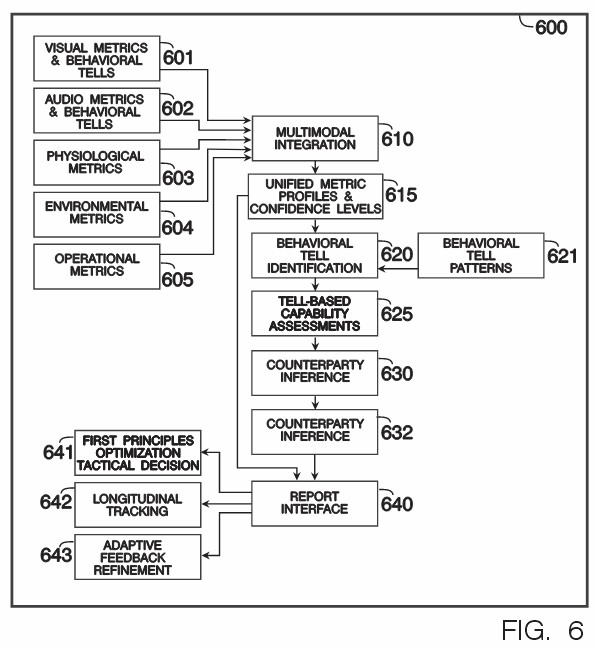
Visual Data Acquisition. The system's visual data acquisition receives video streams from visual data acquisition technologies positioned to observe agent actions and implements computer vision algorithms for agent tracking, movement pattern extraction, spatial positioning analysis, and pose estimation. The system's visual data acquisition extracts visual performance metrics including movement speed, spatial positioning accuracy, and body language indicators, and identifies visual behavioral tells including body language changes indicating psychological pressure, positioning pattern alterations indicating tactical confusion, and movement characteristic changes indicating physical fatigue. The system's visual data acquisition transmits visual metrics and behavioral tells 601 to the system's multimodal integration engine 610.
Audio Data Acquisition. The system's audio data acquisition receives audio streams from microphones positioned to capture agent vocalizations and operational sounds and implements audio processing components for voice activity detection, breathing pattern extraction, vocal stress analysis, and communication quality assessment. The system's audio data acquisition extracts audio performance metrics including communication effectiveness and coordination quality, and identifies audio behavioral tells including breathing irregularities indicating cardiovascular stress, vocal stress markers indicating psychological pressure, and communication pattern disruptions indicating coordination breakdown. The system's audio data acquisition transmits audio metrics and behavioral tells 602 to the system's multimodal integration engine 610.
Physiological Data Acquisition. The system's physiological data acquisition receives physiological signals from wearable sensors worn by agents during operations and implements signal processing for filtering, calibration, and physiological metric extraction from heart rate monitors, temperature sensors, and accelerometers. The system's physiological data acquisition extracts physiological performance metrics including cardiovascular state, thermal stress levels, metabolic demands, and physical exertion indicators with associated confidence indicators reflecting measurement quality and sensor reliability. The system's physiological data acquisition transmits physiological metrics 603 with confidence indicators to the system's multimodal integration engine 610.
Environmental Data Acquisition. The system's environmental data acquisition receives measurements from environmental sensors including temperature, humidity, wind, and surface condition sensors and extracts environmental condition metrics quantifying how conditions affect agent capabilities across objectively valuable characteristics. The system's environmental data acquisition transmits environmental metrics 604 to the system's multimodal integration engine 610.
Operational Data Acquisition. The system's operational data acquisition receives operational performance information from operational systems and extracts operational performance metrics including transaction rates, decision timing, resource utilization patterns, and execution precision metrics. The system's operational data acquisition transmits operational metrics 605 to the system's multimodal integration engine 610.
Multimodal Integration Engine. The system's multimodal integration engine 610 receives measurements (601, 602, 603, 604, 605) from all data acquisition subsystems and performs data source weighting assigning reliability weights to each data source for each objectively valuable characteristic based on measurement precision, signal-to-noise ratio, sensor calibration quality when applicable, and validated historical reliability of each modality. The system's multimodal integration engine 610 performs conflict resolution when measurements suggest divergent conclusions about agent capability states through temporal alignment verification, cross-validation, and contextual interpretation. The system's multimodal integration engine 610 synthesizes unified capability state estimates combining measurements across modalities and generates unified metric profiles 615 representing current agent capability levels on each objectively valuable characteristic with associated confidence intervals reflecting multimodal measurement quality. The system's multimodal integration engine 610 transmits unified metric profiles and confidence levels 615 to the system's behavioral tell identification 620 and to report interface 640.
Behavioral Tell Identification. The system's behavioral tell identification 620 receives unified metric profiles 615. The system's behavioral tell identification 620 accesses behavioral tell pattern library 621 comprising validated patterns where observable behaviors correlate with specific internal states across prior observations. The system's behavioral tell identification 620 matches behavioral patterns within unified metric profiles 615 against library patterns 621 to identify tells including breathing patterns indicating cardiovascular stress, body language indicating psychological pressure, communication patterns indicating coordination problems, and technique changes indicating physical fatigue or mental pressure. The system's behavioral tell identification 620 generates tell-based capability assessments 625 inferring internal states from observable patterns and transmits tell-based assessments 625 to the system's counterparty inference 630.
Counterparty Inference. The system's counterparty inference 630 receives tell-based capability assessments 615 and generates capability state estimates for counterparty agents when direct measurement access is unavailable. The system's counterparty inference 630 integrates behavioral tells to generate counterparty metric profiles and identifies counterparty vulnerabilities 632 where behavioral patterns indicate exploitable weaknesses. The counterparty metric profiles and vulnerability assessments 632 are transmitted to report interface 640.
Unified Capability State Output. The system's report interface 640 receives unified metric profiles 615 and counterparty metric profiles and vulnerability assessments 632. The system's report interface 640 generates comprehensive capability state reports comprising quantitative metrics for directly measurable characteristics, inferred states for counterparty agents, qualitative characteristic assessments when applicable, confidence intervals reflecting assessment reliability, and identified behavioral tells indicating vulnerabilities or capability changes. The system's report interface 640 transmits capability state reports to first principles optimization for tactical decision-making 641, to metric profile repositories for longitudinal tracking 642, and to adaptive feedback systems for continuous refinement 643.
Multimodal Synthesis Advantages. The multimodal architecture 600 provides advantages over single-modality assessment. Single-modality assessment relies on one data source, producing incomplete capability state understanding with high susceptibility to measurement errors. Multimodal integration synthesizes across multiple sources, producing comprehensive capability states, enabling cross-validation detecting measurement errors, and allowing inference of characteristics not directly measurable through any single modality. The multimodal architecture 600 enables robust capability assessment across diverse operational contexts including scenarios with full sensor access enabling direct measurement and scenarios with limited access requiring behavioral inference.