Abstract
Systems and methods for athletic performance analysis and tactical optimization through multi-modal data acquisition and quantified capability assessment. The system processes objectively valuable characteristics derived through first principles analysis or received from external sources, establishing metric ranges and generating individualized metric profiles. Multi-modal subsystems comprising computer vision, audio capture, physiological monitoring, environmental monitoring, and biomechanical analysis extract athlete metric states during sport. A multimodal integration engine synthesizes measurements across modalities. Real-time tracking detects performance deviations. Opponent analysis identifies behavioral tells revealing internal states analogous to poker tell recognition. Probabilistic calculation computes expected values for tactical configurations. Tactical optimization generates definitive recommendations exploiting detected vulnerabilities, environmental effects, and degradation patterns. Strategic tactical sequences comprising decoy actions and timed exploitation maximize cumulative expected value. Multi-sport guidance provides sport specialization recommendations through transferable capability analysis and multimodal preference assessment.
Terms Definitions
For purposes of the present disclosure, various terms used in the art are defined as follows:
The term "exemplary" shall mean "serving as an example, instance, or illustration." Any aspect or embodiment described herein as “exemplary” is not necessarily to be construed as preferred or advantageous over other aspects or embodiments described herein.
The term "herein" shall mean in the entirety of this specification including drawings, abstract, and claims. The term herein is not limited to the paragraph, section, or embodiment in which it may appear.
The terms "include", "comprise", and "contains" do not limit the elements to those recited. By contrast, only the term “consist” limits the elements to those listed. Unless specifically stated otherwise, the term “some” refers to one or more.
The term "responsive" does not limit the elements, conditions, and/or requirements that may be taken into consideration. For example, an element or structure that is responsive to a specified requirement is not limited to being responsive to only that specified requirement. An element or structure may be responsive to a specified requirement and a second non-specified requirement, specially, when the second requirement, while described as an alternative requirement, may be also deemed complementary.
The term "such as" shall mean "including but not limited to" and introduces non-exhaustive illustrative examples that do not limit the scope of the disclosure.
No conceptual distinction should be drawn from the use of the terms on, at, or in.
The term "athlete" shall mean an individual who participates in a sport. An athlete comprises, for example, a soccer player, a basketball player, a tennis player, a League of Legends player, or any other individual, such as human, android, or AI enabled entity, whose performance in a sport is subject to evaluation.
The term "athlete metric state" shall mean a quantified assessment of an athlete's current performance level on objectively valuable characteristics at a specific moment during sport, wherein the athlete metric state may differ from the athlete's baseline metric profile due to factors such as fatigue, psychological pressure, environmental conditions, or performance variations, and wherein performance deviations are detected by comparing athlete metric states to metric profiles.
The term "athlete's sport preferences" shall mean an athlete's inclinations, motivations, and affinities regarding participation in sports, such as enjoyment levels, satisfaction sources, desired characteristics of athletic activity, and/or preferences among multiple sports.
The term "behavioral tell" shall mean an observable behavioral pattern indicating an athlete's internal state, capability level, or tactical intention, such as breathing patterns, body language, vocal characteristics, postural indicators, movement patterns, communication behaviors, or other observable signals revealing information not directly stated or measured.
The term "benchmark" shall mean a reference value for a metric derived from a population of athletes at a specified position and/or sport level.
The term "communication interface" shall mean hardware and software components configured to transmit and receive data, such as network interfaces, data input ports, video capture interfaces, sensor communication channels, telemetry receivers, and output display interfaces.
The term "competition attitude" shall mean an objectively valuable characteristic, such as consistent effort and composure across game states, response to adversity, performance under pressure, and/or attitude maintenance during sport performance.
The term "composite score" shall mean an integrated numerical value combining multiple factors, such as predicted achievement potential, genuine motivation assessment, personality-sport fit evaluation, and/or constraint satisfaction, wherein each factor may be weighted according to specified priorities.
The term "computer vision subsystem" shall mean a specialized processing module configured to analyze visual data in real-time, such as video frame processing, object detection, athlete tracking, movement analysis, spatial positioning extraction, and performance metric derivation from visual input, wherein the subsystem enables low-latency extraction of objectively valuable characteristic measurements during ongoing competitive contests.
The term "congruence score" shall mean a quantitative measure indicating alignment between signals across multiple communication channels, wherein high congruence indicates similar emotional valence across visual, vocal, and verbal channels, and low congruence indicates conflicting signals between channels.
The term "critical performance range" shall mean the metric range expected for an athlete to perform at a specified sport level. The critical performance range may be position-specific.
The term "data structure" shall mean an organized representation of data configured for efficient storage, access, and manipulation, such as metric profile data structures, degradation relationship tables, vulnerability pattern records, tactical configuration representations, and athlete capability state vectors.
The term "database" shall mean a structured data storage system configured to organize, store, and retrieve data, such as metric profile databases, vulnerability pattern repositories, sport structure databases, athlete performance databases, and longitudinal tracking databases.
The term "decoy action" shall mean a tactical configuration that appears to opponent athletes as a genuine competitive threat requiring defensive response but whose primary objective is inducing specific performance degradation in targeted opponent athletes rather than achieving immediate competitive gain.
The term "definitive tactical recommendation" shall mean a tactical recommendation identifying a specific tactical configuration for execution.
The term "degradation relationship" shall mean a quantified causal connection between a specific type of competitive action and subsequent performance decline in a particular objectively valuable characteristic, expressed as the expected magnitude of capability change per instance of that action type.
The term "Duchenne smile patterns" shall mean facial expressions indicating genuine positive emotion, characterized by engagement of both the zygomatic major muscle raising the mouth corners and the orbicularis oculi muscle creating eye wrinkles, as distinguished from forced smile patterns involving only mouth muscles.
The term "eSport" shall mean an electronic sport comprising competitive video game play. An eSport comprises, for example, League of Legends, Dota 2, Counter-Strike, Valorant, or any other video game played competitively. Herein eSport is a subset of sport.
The term "expected value" shall mean a probability-weighted average of predicted outcomes across multiple possible competitive scenarios, calculated by multiplying each possible outcome by its probability of occurrence and summing the results.
The term "exploitation action" shall mean a tactical configuration designed to capitalize on detected athlete characteristics, states, or conditions favorable for achieving competitive advantage.
The term "first principles" shall mean fundamental requirements derived from the structure, rules, and objectives of a sport. First principles analysis identifies objectively valuable characteristics of a sport.
The term "game intelligence" shall mean an objectively valuable characteristic, such as spatial recognition, anticipation, risk calibration, and/or decision quality during sport performance.
The term "game telemetry log" shall mean a structured record of in-game events, athlete inputs, and game state data generated during eSport performance. A game telemetry log comprises, for example, event timestamps, player actions, resource states, position coordinates, and/or match outcome data.
The term "individualized metric profile" shall mean a metric profile generated for an individual athlete responsive to sport-specific performance data acquired for that individual athlete.
The term "memory" shall mean data storage components configured to store instructions, data, and computational results, such as volatile memory including random access memory and cache memory, and non-volatile memory including solid-state drives, hard disk drives, and persistent storage systems.
The term "metric" shall mean a quantified value representing an athlete’s measured capacity for an objectively valuable characteristic.
The term "metric profile" shall mean a quantified assessment of an athlete's expected performance on objectively valuable characteristics derived from sport structure, wherein metric profiles may be generated pre-competition or updated during competitive contest based on real-time performance measurements.
The term "metric range" shall mean a quantification scale for an objectively valuable characteristic. A metric range comprises, for example, a scale of 0–100 or percentile rankings.
The term "module" shall mean a functional subsystem component comprising hardware, software, or a combination thereof, configured to perform specific operations within the system, such as first principles analysis modules, metric generation modules, performance tracking modules, tactical optimization modules, and multi-sport recommendation modules.
The term "multimodal integration engine" shall mean a system component configured to synthesize data from multiple sources into unified assessments.
The term "multimodal interview" shall mean an interview process that captures multiple types of data, such as video recording of facial expressions and body language, audio recording of vocal patterns and tone, and verbal content comprising spoken responses to questions, wherein the multiple data types enable analysis across visual, vocal, and/or verbal channels.
The term "neural network" shall mean any one or combination of artificial neural networks, deep learning systems, convolutional neural networks, recurrent neural networks, transformer architectures, large language models, machine learning systems, and other computational learning systems.
The term "objectively valuable characteristic" shall mean a capacity, attribute, or quality of an athlete that is predictive of sport success, derived from first principles analysis of the sport. Objectively valuable characteristics include, for example, readily measured characteristics such as speed, reaction time, accuracy, and endurance, and deeper qualitative characteristics such as position suitability, game intelligence, synergistic team play, and competition attitude.
The term "opponent athlete" shall mean an athlete competing in opposition to another athlete or team during sport.
The term "parental constraint data" shall mean information regarding practical limitations and priorities for an athlete's sport participation, such as time availability, financial capacity, safety requirements, geographic accessibility, family scheduling constraints, and/or parental goals for athletic participation.
The term "percentile ranking" shall mean the position of an athlete's metric relative to a population distribution of athletes at a specified position and/or sport level.
The term "performance deviation" shall mean the difference between an athlete's baseline metric profile value for a given objectively valuable characteristic and the measured actual performance on that characteristic during current competitive contest, wherein positive deviations indicate performance below baseline and negative deviations indicate performance exceeding baseline.
The term "position" shall mean a designated role within a sport. A position comprises, for example, goalkeeper, defender, midfielder, and forward in soccer; or top lane, jungle, mid lane, bot lane, or support in League of Legends.
The term "position-specific" shall mean responsive to the requirements, demands, and/or benchmarks associated with a specified position.
The term "position suitability" shall mean an objectively valuable characteristic representing an athlete's capacity to fulfill the requirements of a designated position.
The term "position suitability analysis" shall mean the comparison of an athlete’s metric profile to a position’s metric requirements.
The term "position’s metric requirements" shall mean the minimum quantified values for each of a plurality of objectively valuable characteristics required by a position.
The term "processing unit" shall mean computational hardware configured to execute instructions and perform calculations, such as central processing units, graphics processing units, tensor processing units, neural network accelerators, application-specific integrated circuits, field-programmable gate arrays, and distributed processing nodes.
The term "quantification" shall mean conversion of observed characteristics into quantified values enabling mathematical analysis and comparison.
The term "real-time" shall mean processing and decision-making during ongoing sport, such as in-competition analysis, dynamic tactical decisions, live performance assessment, concurrent processing, and contemporaneous processing.
The term "recruiter" shall mean an individual or entity that evaluates athletes for selection, recruitment, advancement, and/or team composition. A recruiter comprises, for example, a coach, a scout, a team manager, a general manager, or a recruiting organization.
The term "recruiter required minimum metric profile" shall mean the minimum metric values specified by a recruiter for their particular recruitment requirements.
The term "sport" shall mean an athletic competition comprising physical athletic competition and/or electronic athletic competition. A sport comprises, for example, soccer, basketball, baseball, tennis, golf, League of Legends, Dota 2, Counter-Strike, Valorant, or any other athletic existing or contemplated physical athletic competition.
The term "sport database" shall mean a collection of information about multiple sports, comprising objectively valuable characteristic requirements, metric ranges, skill profiles, and/or sport-specific attributes for each sport, wherein the database may include sports currently practiced by an athlete and sports not currently practiced by the athlete.
The term "sport level" shall mean a tier of competition within a sport. A sport level comprises, for example, youth recreational, youth competitive, high school, collegiate, semi-professional, or professional. The term "eSport level" shall mean a sport level within an eSport.
The term "sport-specific performance data" shall mean data representing, for example, an athlete's actions, movements, decisions, and/or outputs during a sport performance. Sport-specific performance data comprises, for example, video recordings, game telemetry, sensor data, and/or audio recordings. The term "eSport-specific performance data" shall mean sport-specific performance data acquired from an eSport. eSport-specific performance data comprises, for example, game telemetry logs, input device data, screen recordings, and/or audio recordings of team communications.
The term "sport structure" shall mean the competitive framework of a sport comprising the objective, rules, constraints, and competitive dynamics that define how athletic competition is conducted and evaluated, such as competitive objective defining victory conditions, rules governing permissible actions and constraints, field or competitive environment specifications, player roles and positional requirements, scoring or evaluation systems, and temporal structure defining competitive duration and pacing.
The term "strategic tactical sequence" shall mean a series of tactical configurations across multiple tactical decision points, wherein tactical configurations are selected for cumulative effect across the sequence.
The term "synergistic team play" shall mean an objectively valuable characteristic, such as coordinated action with teammates, support positioning, communication, formation maintenance, and/or mutual reinforcement during sport performance.
The term "system" shall mean an integrated apparatus comprising hardware components, software components, and data structures configured to implement the methods disclosed herein, such as processing units, memory, databases, communication interfaces, and functional modules operating in coordination to quantify objectively valuable characteristics, evaluate athlete performance, optimize tactical decisions, and/or provide multi-sport guidance.
The term "tactical configuration" shall mean one or more competitive elements, such as personnel composition indicating which subset of athletes participates at a given tactical decision point, spatial positioning of said athletes relative to the competitive field and opponent athletes, tactical action specifying the maneuver, play, or strategy to be executed, and/or conditional adjustments defining responsive modifications based on opponent tactical response.
The term "tactical decision point" shall mean a discrete moment during competitive contest at which selection among alternative tactical configurations is required, such as play selection in football, offensive set selection in basketball, formation adjustment in soccer, move selection in chess, or strategic action selection in electronic sports.
The term “team analysis” shall mean the evaluation of a plurality of athletes as a group to identify complementary and/or deficient objectively valuable characteristics within the group.
The term "team athlete composition" shall mean a selection of individual athletes from a plurality of individual athletes for assignment to a team, wherein the selection is responsive to the athletes' respective individualized metric profiles and the team's positional requirements.
The term "training recommendation" shall mean guidance for developing an athlete’s capacity for one or more objectively valuable characteristics, responsive to the athlete’s metrics and a targeted critical performance range.
The term "transferable capability profile" shall mean a representation of an athlete's fundamental capabilities that are consistent across multiple sports, such as reaction time, strategic thinking, precision, speed, endurance, and/or spatial awareness, wherein the capabilities are distinguished from sport-specific learned skills.
The term "vulnerability pattern" shall mean an individual athlete's characteristic performance degradation pattern, such as trigger conditions representing specific competitive actions whose cumulative execution activates the pattern, degradation magnitude indicating expected decline in specific objectively valuable characteristics, temporal timeline specifying the interval from trigger completion to degradation peak, occurrence probability representing empirical frequency the pattern manifests across observed competitive contests, and/or variance characteristics quantifying consistency of the pattern.
The above defined terms and other terms explicitly defined herein are to be understood as defined in this document. Incorporation by reference shall not act to modify, limit, or broaden the definitions hereinabove provided or formally defined in this document. A term that is not formally defined in this document is defined herein to have its ordinary and customary meanings.
First Principles Analysis
The thesis "Superwisdom: Inevitable AI" by Max Abecassis, establishes the foundation for objectively valuable characteristics as discoverable features of reality rather than subjective preferences, and provides the conceptual basis for first principles analysis.
The systems and methods disclosed herein rest upon a foundation that distinguishes first principles analysis from conventional data-driven methodologies. This foundation establishes that objectively valuable characteristics exist as discoverable features of sport structure rather than as statistical patterns derived from athlete populations.
Objectively Valuable Characteristics as Discoverable Features. Certain characteristics possess objective value discoverable through analysis of structural requirements rather than through statistical correlation with outcomes. When a hexagonal honeycomb structure is analyzed, the optimization is apparent through geometry: hexagons tile perfectly with no gaps, minimize perimeter for maximum area, provide structural strength through load distribution, and require minimal material for construction. These geometric relationships exist as mathematical properties discoverable by any intelligence analyzing efficient space utilization. The optimization is structural, not species-specific or population-dependent.
Similarly, when a sport's structure, rules, and objectives are analyzed, certain athlete characteristics emerge as objectively valuable through logic, physics, and game mechanics. In soccer, the rules establish that athletes propel a ball using their feet toward a goal defended by an opponent. From this structure, speed is objectively valuable because a faster athlete reaches the ball before a slower athlete. Accurate passing is objectively valuable because it maintains possession. Quick decision-making is objectively advantageous because it exploits opportunities before defensive recovery. These relationships require no historical athlete data to establish. They are derived from the fundamental structure of the sport itself.
This establishes the crucial foundation: objectively valuable characteristics exist as discoverable features of sport structure rather than as projections from athlete population data.
The Paradigm Distinction. Conventional sports analytics systems acquire historical athlete performance data and apply machine learning to identify patterns associated with successful outcomes. The training foundation is athlete performance observations. The system learns what successful athletes do. The outputs correlate with success because the training data correlates with success.
The systems and methods disclosed herein operate through a fundamentally different paradigm. The training foundation is sport structure: the rules, objectives, and constraints that define the sport. The system learns what the sport structurally rewards, independent of what current athletes do or have done. The outputs identify characteristics that cause success because they are derived from the structural requirements that determine success.
This distinction parallels, but extends beyond, the paradigm demonstrated by AlphaGo Zero. AlphaGo Zero began with only the rules of Go and developed winning strategies through self-play reinforcement learning. The system optimized its own game-playing actions by engaging with the game's structural requirements rather than learning from human expert games. The output of AlphaGo Zero was optimized move selection for the AI system itself to execute.
The systems and methods disclosed herein are distinguished from the AlphaGo Zero paradigm by explicit extraction of objectively valuable characteristics, applied to a fundamentally different domain: evaluation of human athletes.
In one embodiment, the neural network may learn to play the sport as a method for deriving what the sport structurally rewards. Through simulated play, the neural network discovers optimization principles inherent to the sport's structure, rules, and objectives. The neural network then explicitly extracts and articulates these discoveries as objectively valuable characteristics.
The explicit extraction transforms implicit optimization knowledge into enumerated, defined characteristics suitable for human athlete evaluation. The explicit extraction of objectively valuable characteristics and their application distinguishes the systems and methods disclosed herein from game-playing AI systems. AlphaGo Zero's knowledge of what Go rewards remains implicit within neural network weights, inaccessible and inarticulate. The systems and methods disclosed herein generate objectively valuable characteristics as explicit, enumerated outputs with logical justifications traceable to sport structure. This explainability enables human understanding of why each characteristic is valuable and supports transparent athlete evaluation.
The application to human athlete evaluation requires integration of sport structure analysis with human performance sciences. A game-playing AI system optimizing its own computational processes requires only game rules. The systems and methods disclosed herein derive metric ranges from first principles of human physiology, motor control, and cognitive capabilities because the system evaluates human athletes constrained by human physiology. The neural network analyzes what the sport structurally rewards and analyzes what human physiology enables, then generates objectively valuable characteristics and metric ranges at the intersection of sport requirements and human capacity.
The combination of sport structure analysis, explicit extraction of objectively valuable characteristics, integration with human performance sciences, and application to athlete evaluation metrics represents an inventive contribution.
Logical Derivation Framework. The derivation of objectively valuable characteristics proceeds through multiple analytical levels, each grounded in established principles rather than statistical inference.
Level 1: Physical Laws. Certain characteristics are objectively valuable based on physics. Speed is objectively valuable because faster athletes reach contested positions first, create and close space more effectively, and recover from positional errors more quickly. Power is objectively valuable because more powerful shots provide less reaction time for goalkeepers, and greater strength prevails in physical contests. Endurance is objectively valuable because athletic competitions extend over time, and fatigue degrades all other attributes. These relationships derive from physical laws applicable to human movement within sport contexts.
Level 2: Technical Mastery. Certain characteristics are objectively valuable based on the mechanics of sport-specific skills. Ball control is objectively valuable because quality first touch creates time and space for subsequent actions, while poor control loses possession. Passing accuracy is objectively valuable because accurate passes maintain possession while inaccurate passes surrender it. Shooting accuracy is objectively valuable because goals require the ball to enter the goal, and accuracy determines conversion rate. These relationships derive from the mechanical requirements of sport-specific actions.
Level 3: Cognitive and Perceptual Capabilities. Certain characteristics are objectively valuable based on decision theory and information processing. Spatial awareness is objectively valuable because knowledge of teammate and opponent positions enables optimal decisions. Decision speed is objectively valuable because faster decisions give opponents less time to react and exploit momentary advantages before they close. Anticipation is objectively valuable because predicting opponent actions creates temporal advantages. Decision quality is objectively valuable because optimal decisions maximize outcome probability while suboptimal decisions waste opportunities. These relationships derive from the cognitive requirements of real-time competitive decision-making.
Level 4: Psychological and Behavioral Attributes. Certain characteristics are objectively valuable based on performance psychology. Composure under pressure is objectively valuable because high-pressure moments disproportionately determine outcomes, and composure enables skill execution when stakes are highest. Consistency is objectively valuable because reliable performance enables strategic planning while variance creates strategic uncertainty. Resilience is objectively valuable because mistakes and setbacks are inevitable, and response to adversity determines recovery. Work rate is objectively valuable because effort is within athlete control and high work rate supports teammates. These relationships derive from the psychological requirements of sustained competitive performance.
The four-level framework demonstrates that objectively valuable characteristics can be derived through logical analysis of sport structure without reference to historical athlete performance data. Physics establishes the value of physical attributes. Game mechanics establish the value of technical skills. Decision theory establishes the value of cognitive capabilities. Performance psychology establishes the value of behavioral attributes.
Metric Ranges from Human Performance Sciences. The systems and methods disclosed herein generate metric ranges from first principles of human physiology, motor control, and cognitive capabilities rather than from statistical analysis of athlete populations.
Conventional systems derive metric ranges from observed athlete data. The range of human sprint speed is established by measuring how fast athletes in a dataset actually ran. The range of reaction time is established by measuring how quickly athletes in a dataset actually reacted. These ranges reflect the populations from which the data was drawn, including era-specific training methods, regional talent pools, and selection effects inherent in the dataset.
The systems and methods disclosed herein derive metric ranges from human performance sciences. The range of human sprint speed is established by analyzing human physiology, motor control, nerve conduction velocity, muscle fiber composition, force production dynamics, and mechanical efficiency of bipedal locomotion. The range of reaction time is established by analyzing cognitive processing: visual perception latency, neural signal propagation, and motor response initiation. These ranges reflect the limits of human capacity as determined by physiology and physics rather than the statistical distribution of any particular athlete population.
The sport structure data contextualizes the human performance science data for the specific demands of each sport. The metric range for acceleration in soccer reflects the biomechanical limits of sprinting and direction change on grass surfaces over distances typical in soccer competition. The metric range for reaction time in eSports reflects the cognitive processing limits for visual stimulus response through input device interfaces.
Repositioning of Athlete Population Data. The systems and methods disclosed herein do not discard athlete population data but reposition its role. Athlete population data serves calibration, benchmarking, and validation functions rather than definitional functions.
For calibration, athlete population data establishes age-appropriate percentiles and developmental expectations. The first principles derivation determines that speed is objectively valuable; athlete population data establishes what speed percentile a fifteen-year-old athlete typically demonstrates.
For benchmarking, athlete population data establishes performance ceilings at each sport level. The first principles derivation determines the metric range for reaction time; athlete population data establishes the reaction time typically observed at professional, collegiate, and youth competitive levels.
For validation, athlete population data confirms that the first-principles-derived characteristics correlate with observed outcomes. The first principles derivation identifies objectively valuable characteristics through logical analysis; athlete outcome data confirms that athletes with high metrics in these characteristics achieve success at higher rates.
Athlete population data validates and calibrates the system. It does not define what the system measures or why those measurements matter.
Advantages of First Principles Derivation. The first principles approach provides advantages over conventional data-driven methodologies.
The first principles approach eliminates survivorship bias. Conventional systems trained on successful athletes learn patterns present in those who succeeded while remaining blind to patterns present in equally talented athletes who did not succeed for reasons unrelated to the measured characteristics. First principles derivation identifies characteristics that are inherently valuable given sport structure, independent of which athletes happened to succeed.
The first principles approach produces explainable assessments. Every metric has a logical justification traceable to physics, game mechanics, or decision theory. Evaluations explain why a characteristic is valuable by reference to sport structure rather than by reference to opaque model correlations.
The first principles approach enables evaluation where no historical dataset exists. For new eSports titles, emerging sports, or games following significant balance modifications, conventional systems cannot function because no historical performance dataset exists. First principles derivation can evaluate athletes from the first day of competition because the derivation depends on sport structure, not historical athlete data.
The first principles approach remains valid notwithstanding changes in strategic trends. In eSports, the competitive metagame shifts frequently as players discover new strategies and game developers modify balance. Models trained on historical data become obsolete as the patterns they learned diverge from current competitive conditions. First principles analysis of structural requirements remains valid while core game mechanics persist.
The first principles approach ensures consistency across contexts. Evaluations derive from principles rather than from which dataset trained the model. Athletes evaluated in different regions, eras, or competitive contexts receive consistent assessment because the assessment criteria derive from sport structure rather than from population-specific statistical patterns.
Transformation of the Neural Network's Role. Under the first principles approach, the neural network's role transforms from pattern discovery to precision measurement.
Conventional systems task the neural network with discovering what characteristics predict success by analyzing patterns in athlete population data. The neural network functions as a pattern discovery engine.
The systems and methods disclosed herein task the neural network with accurately measuring characteristics that are known to be valuable through first principles analysis. The neural network functions as a precision measurement instrument. The neural network measures speed, accuracy, decision quality, spatial awareness, and other objectively valuable characteristics that the first principles analysis has already established as valuable.
This transformation enables the neural network to focus computational resources on measurement accuracy rather than on discovering what to measure.
The first principles derivation determines what to measure. The neural network determines how accurately each characteristic can be quantified from available sport-specific performance data.
Real-Time Tactical Decisions
The system's capability to derive objectively valuable characteristics from sport structure, generate metric profiles for athletes, and track performance over time enables extension to real-time tactical decision-making during competitive contests. This section describes how the system applies temporal analysis and longitudinal tracking to optimize tactical configurations at tactical decision points during ongoing competitive contests, using the same objectively valuable characteristics derived from sport structure analysis. The real-time tactical application represents synergistic integration with athlete evaluation: where athlete evaluation identifies which athletes possess superior capabilities, tactical optimization determines how to deploy those capabilities for maximum competitive advantage. The following paragraphs detail the methods, processes, and enabling techniques through which the system performs real-time tactical decision optimization.
Extension to Real-Time Tactical Decision Optimization. The temporal analysis and longitudinal tracking capabilities described in the preceding paragraphs enable a further application of the system: real-time tactical decision optimization during competitive contests. Where the athlete evaluation system derives objectively valuable characteristics from sport structure and generates metric profiles representing expected athlete performance on those characteristics, the real-time tactical system uses those same objectively valuable characteristics to evaluate and optimize tactical configurations at tactical decision points during ongoing competitive contests.
The system evaluates tactical configurations by calculating expected performance outcomes based on the objectively valuable characteristics of all participating athletes (both friendly and opponent athletes), current competitive state, and probabilistic predictions of opponent athlete responses. The system generates multiple candidate tactical configurations for each tactical decision point, evaluates the expected value for each candidate based on current athlete capability states and predicted opponent athlete responses, and presents recommendations ranked by expected value to enable informed decision-making under time pressure. This real-time optimization extends the first-principles approach of deriving objectively valuable characteristics from sport structure to the domain of tactical decision-making during active competitive contests.
Tactical Configuration Evaluation Framework. The system evaluates each candidate tactical configuration by calculating its expected performance outcome based on the metric profiles of all participating athletes, the current competitive state, and predicted opponent athlete responses. The expected outcome for a tactical configuration accounts for uncertainty in opponent athlete response by considering multiple possible opponent athlete tactical approaches, estimating the probability of each opponent athlete response based on historical patterns and competitive context, calculating the predicted outcome if that opponent athlete response occurs, and combining these probability-weighted outcomes to determine overall expected value.
This expected value represents the most likely performance result if the tactical configuration is deployed, enabling comparison among multiple candidate tactical configurations to identify optimal tactical choices. The system evaluates alternative configurations by predicting opponent athlete response probabilities, simulating the competitive interaction based on athlete metric profiles, and calculating expected performance outcomes for each option. The configuration with highest expected value becomes the primary recommendation.
The evaluation process integrates the metric profiles of all participating athletes on both teams. If a tactical configuration deploys an athlete with superior capability on a relevant objectively valuable characteristic against an opponent athlete with degraded capability on that same characteristic (detected through real-time tracking), the predicted outcome reflects this capability mismatch. Conversely, if the opponent athlete maintains baseline capability levels, the predicted outcome accounts for a more balanced matchup. This integration of individual athlete capabilities, derived from objectively valuable characteristics, grounds tactical predictions in measurable performance attributes rather than historical pattern matching.
Multimodal Data Acquisition During Competitive Contests. The system implements comprehensive multimodal data acquisition during competitive contests, capturing athlete performance information across multiple simultaneous data streams. The multimodal approach recognizes that athlete capability states manifest through multiple observable channels such as visual behavior captured through video analysis, acoustic patterns captured through audio recording, physiological parameters measured through wearable sensors, environmental conditions measured through field monitoring systems, equipment performance measured through embedded sensors, and movement biomechanics assessed through motion analysis. The integration of measurements across these modalities enables more comprehensive and reliable capability state assessment than any single data source could provide.
Different data modalities provide complementary information. Computer vision analysis extracts spatial positioning, movement speed, body language indicators, and visible behavioral patterns. Audio capture detects breathing irregularities indicating cardiovascular stress, vocal stress markers revealing psychological pressure, and communication quality indicating coordination effectiveness. Physiological sensors measure heart rate revealing autonomic stress, body temperature indicating thermal load, and metabolic parameters reflecting physical demands. Environmental sensors measure field conditions such as temperature, surface moisture, and wind affecting performance capabilities. Equipment sensors capture impact forces, swing speeds, and technical execution precision. Biomechanical analysis assesses movement efficiency, joint mechanics, and force production quality. The system acquires data from all available modalities simultaneously, with the specific modalities available varying based on deployment configuration, sensor access for friendly versus opponent athletes, and sport-specific measurement feasibility.
Real-Time Performance Deviation Detection. During ongoing competitive contests, the system tracks actual athlete performance and compares it to metric profile expectations to detect performance deviations. For each athlete and each objectively valuable characteristic, the system maintains a real-time performance measurement representing current observed capability level. The system continuously tracks deviation patterns for all athletes, enabling identification of which specific capabilities have degraded or improved relative to baseline expectations.
Multimodal Integration Synthesizing Capability State Estimates. The system integrates measurements across multiple data modalities to generate unified athlete capability state estimates. The integration process weights data sources by reliability and relevance for each objectively valuable characteristic, accounts for measurement uncertainties across modalities, resolves conflicts when measurements suggest divergent conclusions, and generates comprehensive capability assessments with associated confidence intervals reflecting multimodal measurement quality. For characteristics directly measurable through single modalities such as sprint speed from video analysis, the integration primarily validates single-source measurements. For characteristics requiring inference from behavioral patterns such as game intelligence or competition attitude, the integration synthesizes evidence across multiple modalities to derive qualitative assessments.
Opponent Athlete Tell Identification Through Behavioral Pattern Analysis. The system implements opponent athlete analysis through identification of behavioral patterns and psychological tells analogous to recognizing tells in poker. For opponent athletes where direct physiological sensor access is unavailable, the system infers capability states and psychological conditions from observable behaviors captured through video and audio analysis. Observable behavioral indicators such as breathing pattern irregularities captured through audio indicate cardiovascular stress, body language changes visible through video indicate psychological pressure or frustration, communication pattern disruptions indicate coordination breakdown or morale degradation, technique degradation visible through movement analysis indicates physical fatigue or mental pressure, and positioning pattern changes indicate tactical confusion or capability decline.
The tell identification capability enables real-time assessment of opponent athlete internal states without direct measurement access. When the system detects breathing irregularity through audio analysis, altered body language through video analysis, and positioning errors through spatial tracking, the integrated pattern indicates psychological vulnerability and physical degradation. The system maintains opponent tell pattern libraries comprising validated behavioral indicators, their associated internal states, and reliability metrics quantifying how consistently each tell predicts the associated condition across different competitive contexts. During competitive contests, observed opponent behaviors are matched against validated tell patterns to generate opponent capability state estimates and vulnerability assessments, enabling tactical configurations designed to exploit detected weaknesses before recovery occurs.
The tell-based opponent evaluation provides decisive tactical advantages by enabling proactive exploitation of detected vulnerabilities. Traditional approaches require waiting for obvious performance failures before adjusting tactics, whereas tell identification detects early indicators of impending degradation before capability decline becomes competitively obvious. This temporal advantage enables the system to recommend tactical configurations timed to coincide with predicted degradation peaks, maximizing exploitation effectiveness. The approach mirrors poker tell analysis where skilled players identify behavioral patterns revealing opponents' internal states, enabling strategic decisions exploiting the information asymmetry between observable behaviors and hidden states.
Statistical significance of deviations is assessed through comparison to historical variance for each characteristic. Athletes exhibit natural performance fluctuation during competitive contests due to execution variance, environmental conditions, and normal competitive variation. The system distinguishes between normal fluctuation and meaningful capability changes by comparing observed deviations to historical variance patterns. Deviations exceeding typical performance fluctuation thresholds are flagged as significant for tactical consideration, while deviations within normal variance ranges are treated as standard competitive variation.
The system tracks deviation patterns for all athletes on both teams simultaneously. This enables comprehensive situational awareness: the system can identify that a friendly athlete has superior-to-expected performance (negative deviation, performing better than baseline) while an opponent athlete has degraded performance (positive deviation, performing worse than baseline), creating an optimal exploitation opportunity. Conversely, the system can identify when friendly athletes exhibit degradation requiring tactical adjustment through substitution or scheme modification to compensate for reduced capability.
Causal Degradation Relationship Identification. The system identifies causal relationships between specific competitive actions and subsequent performance degradation through longitudinal analysis. For a given athlete, objectively valuable characteristic, and action type, the system analyzes performance measurements across multiple instances to identify consistent degradation patterns. The degradation relationship is determined through analysis of multiple observed instances across prior competitive contests, identifying consistent patterns where specific actions correlate with measurable performance declines in specific characteristics.
The analysis accounts for temporal lag between action execution and observable degradation, typically spanning several tactical decision points depending on sport structure and action type. The identified degradation relationships are specific to individual athletes, acknowledging that different athletes exhibit different fatigue patterns, recovery rates, and stress responses to equivalent competitive demands. This individual variation enables targeted exploitation strategies.
The system maintains a comprehensive database of degradation relationships for each athlete across multiple characteristic-action pairs. A single athlete may exhibit different degradation patterns for different characteristics: high degradation in one characteristic following certain actions but low degradation in another characteristic following different actions. This multidimensional degradation profile enables surgical tactical planning that targets specific vulnerable characteristics while avoiding resilient characteristics.
Predictive Performance State Modeling. Given current performance deviation from baseline, identified degradation relationships for specific action types, and a planned sequence of tactical configurations that will require opponent athletes to execute specific responses, the system predicts future performance states for those opponent athletes. The prediction accounts for cumulative degradation from multiple stress-inducing actions, enabling the system to forecast opponent athlete capability levels several tactical decision points into the future.
The prediction includes confidence intervals based on historical variance in degradation patterns and the individual athlete's consistency characteristics. If the athlete has demonstrated consistent degradation patterns across many observed instances (low variance), the prediction carries high confidence. If the athlete exhibits variable degradation patterns (high variance), the prediction includes wider confidence intervals reflecting increased uncertainty. This probabilistic approach acknowledges that human performance prediction contains inherent uncertainty while still providing quantified expectations superior to qualitative assessment.
The predicted future states integrate multiple factors: baseline metric profile, current observed deviation, planned stress-inducing actions and their associated degradation relationships, temporal dynamics of degradation onset, and recovery characteristics if sufficient time elapses between stress applications. For athletes with rapid recovery characteristics, the prediction accounts for partial capability restoration between stress applications. For athletes with slow recovery, the prediction reflects cumulative degradation without meaningful recovery during typical competitive action intervals.
Strategic Capability Degradation Through Tactical Sequencing. The system generates multi-action tactical sequences designed to deliberately degrade specific opponent athlete capabilities before decisive exploitation. A strategic sequence comprises ordered tactical configurations where earlier configurations are selected not solely to maximize immediate expected value but rather to induce cumulative degradation in targeted opponent athletes, thereby maximizing expected value of the decisive final configuration.
The sequence expected value is calculated by summing expected outcomes for each configuration in the sequence, where later configurations are evaluated based on predicted opponent athlete capability states reflecting cumulative degradation from prior configurations. The system compares expected value for strategic degradation sequences against expected value for immediate repeated exploitation to determine optimal approach. In many competitive situations, strategic degradation sequences produce higher cumulative expected value than immediate exploitation because immediate exploitation triggers opponent athlete tactical adjustment, whereas strategic degradation through actions that appear as normal competitive play delays opponent athlete recognition of the targeted vulnerability.
The temporal spacing of sequence actions accounts for degradation onset dynamics and opponent athlete adaptation probability. Actions are spaced to allow degradation from early actions to manifest before decisive exploitation while occurring rapidly enough to prevent opponent athlete recognition and adjustment. The specific temporal dynamics vary based on sport structure, with faster-tempo sports requiring compressed sequence spacing and slower-tempo sports allowing extended sequence timing.
Decoy Action Resource Allocation. The system generates decoy actions by selecting lower-value friendly athletes to execute threatening actions (preserving higher-value athletes for later decisive exploitation), action types that maximally stress the targeted opponent athlete capability, and positioning that forces targeted opponent athlete to execute stress-inducing responses. The decoy action produces dual outcomes: positive immediate value from secondary objectives and strategic degradation of opponent athlete capability creating improved conditions for subsequent deployment of superior athletes in decisive actions.
The resource allocation optimization uses lower-value assets for degradation induction while preserving higher-value assets for decisive exploitation. If the team has athletes with different capability levels on relevant objectively valuable characteristics, the system allocates the lower-capability athlete to execute decoy actions and reserves the higher-capability athlete for exploitation when opponent athlete degradation is maximized. This maximizes the capability differential between friendly and opponent athletes at the decisive exploitation moment.
The opponent athletes cannot reliably distinguish decoy actions from genuine threats because both require full defensive effort to prevent competitive failure. This creates information asymmetry: the offensive system knows which actions are decoys serving strategic degradation purposes, while the opponent athletes must defend all threats equally, incurring the cumulative degradation cost without recognizing the strategic sequence pattern.
Environmental Condition Integration in Tactical Optimization. The system integrates environmental condition measurements into tactical optimization calculations, accounting for how field temperature, surface conditions, wind, humidity, and other environmental factors affect athlete performance capabilities. Environmental impacts vary across athletes based on physiological characteristics, technical adaptations, and conditioning levels. Temperature extremes may asymmetrically affect athletes with different thermal tolerance characteristics. Surface conditions affect speed and injury risk differently for athletes with different movement mechanics. Wind conditions affect precision capabilities based on technical skill levels and equipment characteristics. The system quantifies these differential environmental impacts on athlete performance across objectively valuable characteristics, enabling tactical configurations exploiting situations where environmental conditions favor friendly athletes or disadvantage opponent athletes. When environmental conditions change during competitive contests through weather transitions or field degradation, the system adjusts expected value calculations accounting for altered performance capabilities, maintaining tactical optimization responsive to current environmental state rather than pre-competition baseline conditions.
Cross-Game Longitudinal Vulnerability Pattern Identification. The system maintains a longitudinal performance database for each opponent athlete comprising performance measurements across multiple competitive contests. Analysis of this database identifies individual-specific vulnerability patterns characterized by trigger conditions, degradation magnitude, temporal dynamics, and occurrence probability. The vulnerability pattern provides actionable intelligence: upon detecting trigger completion, the system predicts with quantified probability that degradation will occur in the predicted timeline, enabling proactive exploitation planning.
The system identifies patterns across different characteristic-action combinations. An athlete may exhibit vulnerability patterns for certain characteristics but not others, or may exhibit different patterns under different conditions. The comprehensive pattern database enables precise targeting: the system identifies which athletes are vulnerable to which types of stress under which conditions, and designs tactical sequences to exploit those specific vulnerabilities.
Patterns are continuously refined as additional competitive data accumulates. After each new competitive contest against an opponent athlete, the system updates pattern statistics, improving prediction accuracy through larger sample sizes. An opponent athlete faced multiple times benefits from more accurate vulnerability pattern predictions than an opponent athlete faced for the first time, because prior observations have refined the statistical relationships.
Predictive Exploitation Based on Historical Vulnerability Signatures. When competing against an opponent athlete for whom a vulnerability pattern has been identified through prior longitudinal analysis, the system monitors for occurrence of trigger conditions during the current competitive contest. Upon detecting trigger completion, the system generates a predictive alert indicating expected future degradation even before actual performance degradation is observable in the current competitive contest.
The prediction is probabilistic rather than deterministic. The system indicates probability that degradation will occur in the predicted timeline and magnitude, with complementary probability the pattern fails to manifest in the current competitive contest. This probabilistic prediction enables expected value calculation that accounts for both pattern occurrence and non-occurrence scenarios.
The tactical recommendation integrates both scenarios: the expected value of an exploitation configuration equals the probability-weighted sum of the outcome if degradation occurs (high expected value due to capability mismatch) and the outcome if degradation does not occur (lower expected value against baseline capability). If this probability-weighted expected value exceeds the expected value of conservative configurations optimized for baseline opponent athlete capabilities, the system recommends exploitation despite incomplete certainty.
This predictive approach enables proactive tactical planning immediately upon trigger detection rather than waiting for reactive confirmation of degradation. The system can plan strategic worsening actions and decisive exploitation timing to coincide with predicted degradation peak. Waiting for observed degradation confirmation would delay exploitation and potentially miss the optimal degradation window.
The system tracks prediction accuracy by comparing predicted degradation to actual observed degradation when patterns activate, and by tracking pattern occurrence frequency relative to historical probability. Systematic deviations between predictions and outcomes trigger pattern model refinement, ensuring continuous improvement in prediction accuracy.
Individual Degradation Rate Variation and Personalized Targeting. Different athletes exhibit substantially different degradation characteristics even within equivalent positional roles and competitive contexts. The system maintains individualized degradation profiles for each athlete, enabling personalized exploitation strategies that target athletes with favorable degradation characteristics while avoiding resource expenditure on degradation-resistant athletes.
Analysis across multiple athletes in equivalent roles reveals substantial variance in degradation rates. Degradation rates may vary several-fold between degradation-vulnerable athletes and degradation-resistant athletes for the same characteristic and action type. Similarly, recovery characteristics vary substantially: some athletes exhibit rapid recovery with degradation reversing within few tactical decision points, while others show prolonged degradation persisting many tactical decision points before capability restoration.
The system exploits this individual variation through targeted athlete selection for strategic degradation sequences. When planning which opponent athlete to target with degradation tactics, the system prioritizes athletes with: (i) high degradation rates (large capability decline per stress application), (ii) slow recovery characteristics (degradation persists long enough for exploitation), (iii) positional importance (degrading a key player creates larger competitive advantage than degrading a secondary player), and (iv) limited opponent depth (opponent athletes cannot easily substitute without significant capability drop-off).
Conversely, the system avoids targeting degradation-resistant opponent athletes where historical data indicates minimal capability decline from stress applications. The personalized approach transforms strategic planning from generic approaches to surgical targeting based on individual athlete vulnerability characteristics.
The system also identifies athletes who exhibit performance improvement during competitive contests rather than degradation. Some athletes demonstrate warm-up effects where initial performance is below baseline but improves as the competitive contest progresses, or momentum effects where successful actions improve subsequent performance. These patterns are incorporated into tactical planning: athletes with warm-up effects are preferentially targeted early in competitive contests before performance improvement, while athletes with momentum effects may be avoided after they achieve successful outcomes to prevent positive performance cascade.
Probabilistic Expected Value Framework for Decision Optimization. All tactical decision recommendations are generated through expected value calculation under uncertainty rather than deterministic optimization. For each candidate tactical configuration, the system calculates expected value by considering multiple possible competitive outcome scenarios, assigning probability to each scenario based on historical data and competitive context, calculating the performance outcome in each scenario, and combining probability-weighted outcomes to determine overall expected value.
The probability distribution over scenarios is derived from multiple sources: (i) historical opponent athlete tactical tendencies indicating likely responses to specific friendly configurations and competitive situations, (ii) game-theoretic predictions of optimal opponent athlete responses in competitive situations with clear strategic structures, (iii) observed adaptation patterns if opponent athletes have adjusted tactics during current competitive contest in response to prior friendly configurations, and (iv) individual athlete capability states incorporating both baseline metric profiles and real-time performance deviations.
This probabilistic framework enables optimal decision-making under time pressure. The quantified expected value immediately clarifies optimal action by presenting the magnitude of expected advantage and the certainty level, enabling informed decision calibrated to appropriate risk tolerance. The expected value calculation explicitly represents uncertainty through probability distributions rather than collapsing to single point estimates. A tactical configuration might have high expected value but with high variance, while another configuration has similar expected value with low variance. The system presents both expected value and variance characteristics, enabling selection based on situational risk tolerance.
Precise Quantification Enabling Definitive Tactical Recommendations. The system's precise quantification of athlete capabilities through metric ranges and individualized metric profiles, combined with real-time multimodal tracking of current capability states, enables generation of definitive tactical recommendations specifying optimal configurations for execution rather than presenting ambiguous options requiring subjective selection among alternatives. Conventional tactical decision support systems provide qualitative assessments or present multiple tactical options without mathematical differentiation of expected outcomes, forcing decision-makers to select among options using subjective judgment under severe time pressure during competitive contests. The precise quantification framework enables the probabilistic calculation engine to compute expected values with sufficient mathematical rigor to definitively identify optimal configurations responsive to current competitive conditions.
Rather than presenting decision-makers with format such as "Option A with advantages X and disadvantages Y, Option B with advantages Z and disadvantages W, Option C with different tradeoffs," the system recommends format such as "execute configuration B at this tactical decision point" based on calculated expected value superiority accounting for current athlete capability states reflecting detected performance deviations, opponent athlete capability states including identified tells and degradation patterns, probability distributions over opponent responses derived from historical patterns and game-theoretic predictions, and competitive context including score state and situational necessity. The definitive recommendation capability is enabled by the precision of metric quantification combined with comprehensive multimodal capability state tracking providing continuous updates of all relevant factors during ongoing competition. The recommendation includes calculated expected value magnitude, confidence intervals reflecting prediction uncertainty, key assumptions underlying the recommendation, and alternative configurations for consideration if execution circumstances differ from predictions, but the primary recommendation clearly identifies the optimal tactical choice rather than delegating final selection to subjective judgment under time pressure.
Risk Calibration Based on Competitive Situation. The expected value optimization is calibrated to competitive situation through risk tolerance adjustment based on competitive state. In low-necessity situations (large score advantage, early in competitive contest, low-pressure moments), the system applies conservative risk preference, favoring tactical configurations with high success probability even if expected value is moderate. In high-necessity situations (must achieve specific outcome, late-game requirements, critical competitive moments), the system applies aggressive risk preference, favoring configurations with maximum expected value even if success probability is moderate.
The risk calibration recognizes that expected value maximization is not always optimal decision criterion. In a situation requiring specific minimum outcome, a configuration with high success probability but insufficient expected gain has zero probability of achieving the necessary outcome despite high success probability. A configuration with moderate success probability but sufficient expected gain has meaningful probability of achieving the necessary outcome despite lower overall success rate. In high-necessity situations, the aggressive configuration is superior despite lower success probability because the conservative option cannot satisfy the competitive requirement.
The system implements situation-dependent utility functions that balance expected value maximization with success probability considerations, with the balance shifting based on situational necessity. The competitive situation assessment incorporates multiple factors: score differential, time remaining, outcome requirements, momentum factors, and strategic situation. These factors combine to generate a situational necessity score that calibrates the risk tolerance parameter applied to tactical configuration selection.
Synergistic Integration with Athlete Evaluation System. The real-time tactical decision system achieves synergistic integration with the athlete evaluation system through consistent use of objectively valuable characteristics throughout both modules. The same OVCs derived from sport structure analysis for athlete evaluation are used for tactical configuration evaluation, creating systematic coherence. When personnel selection identifies athletes with superior metric profiles on specific OVCs, the tactical configuration module generates configurations that maximize exploitation of precisely those OVCs.
The integration produces advantages beyond either module in isolation. First, consistency: the athlete evaluation system identifies who has superior capabilities, and the tactical system determines how to exploit those capabilities, with both operating from the same objectively valuable characteristic framework. Second, adaptability: if sport structure changes through rule modifications, OVCs are automatically re-derived from the updated structure, and both evaluation and tactical systems adapt coherently because both rely on the same characteristic foundation. Third, explainability: all decisions trace to first-principles analysis of sport structure rather than pattern-matching historical data, enabling clear explanation of why specific athletes are selected and why specific tactics are recommended. Fourth, continuous improvement: as athletes' actual performance during competitive contests updates metric profiles, tactical recommendations automatically incorporate updated capability assessments through the real-time deviation detection system.
The feedback loop between athlete evaluation and tactical deployment creates continuous refinement. Athletes who perform consistently above their metric profile expectations in competitive deployment may have their metric profiles adjusted upward, reflecting superior actual capability relative to initial assessment. Athletes who consistently underperform metric profile expectations may have profiles adjusted downward. These adjustments flow back into tactical configuration evaluation, ensuring recommendations reflect actual demonstrated capability rather than outdated assessments. The integration creates a unified system where athlete assessment and tactical deployment inform each other continuously.
Behavioral Inference for Qualitative Objectively Valuable Characteristics. The system derives qualitative objectively valuable characteristics such as game intelligence, competition attitude, synergistic team play, and position suitability through integrated analysis of behavioral patterns across multiple data modalities rather than through direct measurement of cognitive or psychological states. While certain objectively valuable characteristics such as speed and power correspond directly to measurable physical parameters, qualitative characteristics require inference from their manifestation in observable performance patterns. Spatial positioning patterns reveal spatial awareness underlying game intelligence. Communication timing and content reveal anticipation and coordination capabilities. Physiological stress responses reveal composure under pressure underlying competition attitude. Effort consistency across varying game states reveals motivational characteristics. Coordinated actions with teammates reveal synergistic team play capabilities.
The behavioral inference methodology applies symmetrically to friendly athletes where comprehensive multimodal data including physiological sensors may be available, and to opponent athletes where inference relies primarily on video and audio observation without direct sensor access. For opponent athletes, the inference from observable behaviors to internal cognitive and psychological states mirrors the tell identification process, recognizing that mental attributes manifest through behavioral patterns that can be systematically analyzed even without direct psychological measurement. The system maintains behavioral inference models mapping observable performance patterns to inferred qualitative characteristics, with model parameters continuously refined through validation comparing inferred characteristics to actual demonstrated capabilities across multiple competitive contests. This inference capability enables comprehensive athlete evaluation across both directly measurable physical characteristics and indirectly inferred cognitive and psychological characteristics, providing complete capability assessment supporting tactical optimization accounting for all dimensions of athlete performance.
Temporal Feedback Loop Between Performance and Tactics. The system implements continuous feedback between real-time performance measurement and tactical recommendations. As actual performance during competitive contests deviates from metric profile expectations, these deviations immediately update the predicted outcome calculations for all tactical configurations. If a friendly athlete demonstrates superior-to-expected performance, tactical configurations utilizing that athlete receive increased expected value estimates, prompting increased deployment. Conversely, if a friendly athlete exhibits degraded performance, configurations depending heavily on that athlete receive reduced expected value estimates, prompting tactical adjustment through substitution or scheme modification.
Similarly, opponent athlete performance deviations trigger tactical reoptimization. When opponent athlete degradation is detected, exploitation opportunities are identified and configurations targeting the degraded athlete are elevated in recommendation priority. When opponent athlete superior performance is detected, configurations attacking that athlete are demoted in priority and alternative approaches avoiding the superior performer are recommended. This creates dynamic tactical adaptation responsive to actual competitive conditions rather than static pre-competition planning.
The feedback loop operates continuously throughout competitive contest duration. Initial tactical plans based on baseline metric profiles are continuously refined as real-time performance data accumulates. As the competitive contest progresses, the system accumulates substantial performance deviation data enabling increasingly accurate predictions of tactical configuration outcomes. This contrasts with traditional approaches where pre-competition scouting determines tactics that remain largely static regardless of actual performance during competitive contests.
The temporal feedback enables recovery detection as well as degradation detection. If an opponent athlete exhibits degradation that later reverses (capability restoration through rest, recovery, or substitution), the system detects the recovery and adjusts tactical recommendations accordingly. The continuous tracking ensures tactical recommendations always reflect current competitive state rather than historical state.
Multi-Sport Generalizability Through Sport Structure Responsiveness. The real-time tactical decision system applies to any sport with tactical decision points. The system adapts to different sport structures through sport-specific instantiation of the core components while maintaining consistent conceptual framework. The adaptation occurs through: (i) sport-specific OVC derivation from that sport's structure, (ii) sport-specific tactical configuration formulations, (iii) sport-specific degradation mechanisms, and (iv) sport-specific temporal dynamics.
The core framework - metric profiles representing expected capability on objectively valuable characteristics, real-time deviation detection comparing actual to expected performance, degradation relationships quantifying how actions cause capability changes, predictive performance state modeling forecasting future capabilities, expected value calculation under uncertainty for tactical decisions—remains consistent across sports. The sport-specific instantiation adapts this framework to each sport's unique structure, competitive dynamics, and tactical elements.
Continuous Learning and Pattern Refinement. The system continuously refines its predictions through accumulation of additional competitive data. After each competitive contest, actual outcomes are compared to predicted outcomes, and prediction models are updated to minimize prediction error. Degradation relationships are recalculated incorporating new observations, improving accuracy through larger sample sizes. Vulnerability patterns are updated with new occurrence data, refining probability estimates. Expected value calculations are validated against actual outcomes, with systematic errors indicating model refinements needed.
This continuous learning creates improving prediction accuracy over time. Competitive contests against a particular opponent athlete after many prior observations produce more accurate predictions than initial competitive contests because prior observations have refined the degradation relationships, vulnerability patterns, and tactical response predictions specific to that opponent athlete. The learning is athlete-specific (unique patterns for each opponent athlete), competition-context-specific (patterns may vary by conditions), and sport-evolution-responsive (adapts as training methods improve athlete conditioning, rule modifications affect tactical options, strategic innovation creates novel opponent approaches).
The learning process incorporates multiple feedback mechanisms. Direct feedback compares predicted outcomes to actual outcomes for tactical configurations that were executed, enabling calibration of prediction accuracy. Counterfactual feedback compares executed configurations to non-executed alternative configurations, informing whether optimal recommendations were followed. Adaptation feedback tracks how opponent athlete tactical responses evolve during competitive contests and across multiple competitive contests, informing game-theoretic predictions. Performance feedback updates athlete metric profiles based on demonstrated capability during actual competitive contests, refining the capability assessments underlying tactical predictions.
The system distinguishes between systematic prediction errors requiring model refinement and random variance inherent in competitive outcomes. If predicted outcomes consistently overestimate or underestimate actual outcomes in systematic patterns, the prediction models are adjusted. If prediction errors appear random without systematic bias, the models are maintained while variance estimates are updated to reflect observed outcome variability. This statistical approach prevents over-fitting to random variance while ensuring genuine systematic improvements are incorporated.
Implementation in Time-Constrained Decision Environments. The practical implementation addresses severe time constraints in real-time competitive decision-making. The system generates and evaluates candidate tactical configurations continuously during competitive action, pre-computing expected values for multiple scenarios before tactical decision points arrive. When a tactical decision point occurs, recommendations are immediately available rather than requiring computation during the constrained time window.
The recommendation interface presents: (i) highest expected value tactical configuration with calculated expected value, (ii) alternative configurations with their expected values for consideration, (iii) key assumptions underlying the recommendations (opponent athlete capability states, probability distributions, degradation predictions), and (iv) confidence intervals for predictions. This enables informed decision-making within time constraint by presenting both the magnitude of expected advantage and the certainty level for each option, enabling rapid selection optimized to risk tolerance appropriate for competitive situation.
The pre-computation approach calculates expected values for tactical configurations before they are needed by anticipating likely competitive state progressions. When actual competitive state materializes, the pre-computed recommendation is immediately available. This anticipatory computation eliminates latency that would otherwise consume valuable decision time.
The interface design prioritizes decision-relevant information presentation. Rather than presenting complete statistical analysis, the interface highlights: most important capability mismatches, highest-impact tactical opportunities, and critical situational factors. Decision-makers receive actionable intelligence enabling rapid informed decision rather than raw data requiring interpretation under time pressure.
Integration of Opponent Tactical Tendencies and Game-Theoretic Prediction. The expected value calculation for tactical configurations requires probability estimates for opponent athlete tactical responses. These probabilities are derived from multiple sources providing complementary information about likely opponent athlete behavior.
Historical tendency analysis examines opponent athlete typical responses to specific friendly configurations and competitive situations, calculated from prior competitive contest database. This historical tendency provides starting point for probability estimation. Game-theoretic equilibrium prediction supplements historical tendencies in competitive situations where optimal opponent athlete response is determinable through game theory. In some tactical situations, one response clearly dominates others given the friendly configuration and competitive state. The neural network calculates equilibrium strategies and weights probability toward equilibrium actions.
Adaptation pattern recognition accounts for opponent athlete tactical adjustments during current competitive contest in response to prior friendly configurations. If opponent athletes have shifted from baseline historical tendencies, the system predicts continued adaptation along observed trajectory. Information-theoretic signaling accounts for what information opponent athletes possess about friendly tactical intentions based on configuration signals and situational context.
The integrated probability distribution combines these sources with appropriate weighting. Historical tendencies provide baseline, game-theoretic predictions adjust for situational optimality, adaptation patterns reflect current competitive contest dynamics, and information signaling accounts for what opponent athletes can infer. The resulting probability distribution represents best estimate of opponent athlete response likelihood given all available information.
Exploitation of Information Asymmetry. A critical advantage of the strategic degradation approach is creation of information asymmetry between the system and opponent athlete coaches. When a tactical sequence comprising decoy actions followed by decisive exploitation is executed, opponent athlete coaches observe the competitive actions but cannot reliably infer the strategic intent behind them. Without access to the degradation analysis, they may attribute outcomes to random execution variance or individual performance variation rather than recognizing systematic degradation patterns.
This information asymmetry prevents opponent athlete adaptation to the strategic pattern. Traditional immediate exploitation approaches trigger obvious opponent athlete responses, whereas strategic degradation sequences appear as normal competitive variation rather than systematic exploitation pattern, delaying opponent athlete recognition until decisive exploitation has already succeeded.
The information asymmetry advantage compounds across multiple competitive contests against the same opponent athletes. Because opponent athlete coaches do not recognize the degradation pattern, they cannot implement countermeasures. The system can repeatedly execute strategic degradation sequences across multiple competitive contests against the same opponent athletes because the pattern remains undetected from opponent athlete perspective despite multiple instances.
The asymmetry is sustainable because the opponent athletes would require equivalent analytical capabilities to detect the pattern: longitudinal performance tracking to identify degradation onset, causal relationship identification linking specific actions to specific degradation, and sequential pattern recognition to identify that early actions serve strategic degradation purposes rather than genuine threats. Without these analytical capabilities, opponent athlete coaches cannot distinguish strategic degradation sequences from normal competitive variation, perpetuating the information advantage.
Exemplary First Principles Derivation
The following exemplary derivation was initially produced on or about December 21, 2025, by Claude Opus 4.5, a neural network comprising a large language model with transformer architecture, developed by Anthropic. The exemplary derivation was developed after the teachings of the inventions, and is presented here in paragraph form. The derivation demonstrates the first principles approach applied to soccer, proceeding through four analytical levels.
Level 1: Physical Laws. The neural network analyzes soccer's structure, rules, and objectives and derives that speed and acceleration are objectively valuable characteristics because faster athletes reach contested ball positions first, create and close space more effectively, and recover from positional errors more quickly. The neural network generates metrics for speed and acceleration comprising acceleration over short distances, top speed, deceleration capability, and speed endurance over match duration.
The neural network derives that agility and balance are objectively valuable characteristics because soccer requires constant direction changes, balance enables skill execution under defensive pressure, and agility creates space in congested areas. The neural network generates metrics for agility and balance comprising change of direction speed, center of mass control, and recovery time following perturbation.
The neural network derives that power and strength are objectively valuable characteristics because more powerful shots provide less reaction time for goalkeepers, strength prevails in physical contests, and jump height determines aerial duel outcomes. The neural network generates metrics for power and strength comprising shot velocity, jump height, and contact resistance.
The neural network derives that endurance is an objectively valuable characteristic because soccer matches extend beyond ninety minutes, fatigue degrades all other attributes, late-game performance disproportionately determines outcomes, and high work rate creates numerical advantages. The neural network generates metrics for endurance comprising total distance covered, high-intensity running distance, and performance decay rate across match duration.
Level 2: Technical Mastery. The neural network analyzes soccer's mechanics and derives that ball control is an objectively valuable characteristic because quality first touch creates time and space for subsequent actions, poor control results in possession loss, and controlled reception enables optimal next action selection. The neural network generates metrics for ball control comprising touch distance, touch direction relative to intent, control time, and control quality under defensive pressure.
The neural network derives that passing is an objectively valuable characteristic because accurate passing maintains possession, passing speed affects interception difficulty, and passing range creates tactical options. The neural network generates metrics for passing comprising accuracy rate, pass velocity, pass disguise, range capability, and weak foot proficiency.
The neural network derives that shooting is an objectively valuable characteristic because goals determine match outcomes, shot accuracy determines conversion rate, and shot power affects save difficulty. The neural network generates metrics for shooting comprising accuracy, power, placement precision, technique variety, and weak foot capability.
The neural network derives that dribbling is an objectively valuable characteristic because dribbling past defenders creates numerical advantages, ball retention under pressure maintains possession, and dribbling in dangerous areas creates scoring opportunities. The neural network generates metrics for dribbling comprising success rate, close control, speed while dribbling, and defenders beaten. The neural network derives that heading is an objectively valuable characteristic because aerial play constitutes a significant portion of soccer including set pieces and crosses, defensive heading prevents goals, and attacking heading creates goals. The neural network generates metrics for heading comprising aerial duel success rate, heading accuracy, and heading power.
Level 3: Cognitive and Perceptual Capabilities. The neural network analyzes soccer's decision-making requirements and derives that spatial awareness is an objectively valuable characteristic because knowledge of teammate and opponent positions enables optimal decisions, blind-side awareness prevents dispossession, and space recognition creates opportunities. The neural network generates metrics for spatial awareness comprising head movement frequency, pre-reception scanning, and positioning accuracy relative to tactical models.
The neural network derives that decision speed is an objectively valuable characteristic because faster decisions give opponents less reaction time, quick decisions exploit momentary advantages, and slow decisions permit defensive recovery. The neural network generates metrics for decision speed comprising touch-to-action time, decision consistency, and pressure response.
The neural network derives that pattern recognition and anticipation are objectively valuable characteristics because anticipation creates temporal advantages, reading play enables interceptions, and predicting opponent actions enables optimal positioning. The neural network generates metrics for pattern recognition comprising interception rate, pre-event positioning, and reaction timing.
The neural network derives that decision quality is an objectively valuable characteristic because optimal decisions maximize outcome probability, suboptimal decisions waste opportunities or create danger, and consistent quality decisions compound over match duration. The neural network generates metrics for decision quality comprising pass option selection, risk calibration, and turnover avoidance.
Level 4: Psychological and Behavioral Attributes. The neural network analyzes soccer's psychological requirements and derives that composure under pressure is an objectively valuable characteristic because high-pressure moments disproportionately determine outcomes, composure enables skill execution when stakes are highest, and panic induces errors. The neural network generates metrics for composure comprising performance consistency across pressure contexts, big moment execution, and error rate under pressure.
The neural network derives that work rate is an objectively valuable characteristic because effort is within athlete control, high work rate supports teammates, and consistent effort demonstrates competitive character. The neural network generates metrics for work rate comprising sprint frequency, defensive recovery runs, and press intensity. The neural network derives that consistency is an objectively valuable characteristic because reliable athletes can be strategically trusted, variance creates strategic uncertainty, and consistency compounds over season duration. The neural network generates metrics for consistency comprising performance variance, minimum performance floor, and trend stability.
The neural network derives that resilience is an objectively valuable characteristic because mistakes and setbacks are inevitable, response to adversity predicts long-term success, and resilience enables comebacks. The neural network generates metrics for resilience comprising post-error performance, losing state performance, and recovery from contact.
The exemplary derivation demonstrates that objectively valuable characteristics are derived from soccer's structure, rules, and objectives through logical analysis at four levels—physical, technical, cognitive, and psychological—without reference to historical athlete performance data. The metric ranges for each characteristic are derived from first principles of human physiology, motor control, and cognitive capabilities. For example, the metric range for acceleration is derived from nerve conduction velocity, muscle fiber composition, and force production dynamics of human physiology, not from statistical analysis of observed athlete sprint times. The metric range for decision speed is derived from visual perception latency, neural signal propagation, and motor response initiation characteristics of human cognition, not from statistical analysis of observed athlete reaction times. The neural network's analysis of what soccer structurally rewards, combined with analysis of what human physiology enables, produces explicit, enumerated characteristics and corresponding metric ranges with logical justifications traceable to sport structure, game mechanics, human performance sciences, and performance psychology.
Exemplary Real-Time Tactical Application
Football Sport Structure and Objectively Valuable Characteristic Derivation. Football is a competitive sport characterized by discrete tactical decision points separated by brief intervals, with offensive and defensive teams alternating possession. The sport structure comprises specialized player positions with distinct role requirements, rules governing permissible actions, time constraints for tactical decision-making, and scoring mechanisms rewarding territorial advancement. From football's sport structure, first principles analysis derives objectively valuable characteristics such as speed representing capability for rapid movement, reaction time representing capability to respond to opponent actions, spatial awareness representing capability to process field positioning information, decision quality representing capability to select optimal actions under pressure, endurance representing capability to sustain repeated efforts, and technical precision representing capability to execute sport-specific skills accurately.
These objectively valuable characteristics apply across positions with varying relative importance. For defensive athletes responsible for preventing offensive advancement, critical characteristics include speed and agility for pursuing and containing opponents, spatial awareness for maintaining optimal positioning, and reaction time for responding to offensive actions. For offensive athletes responsible for advancing the ball, critical characteristics include decision quality for selecting optimal tactical responses, technical precision for accurate execution, and composure representing capability to maintain performance quality under defensive pressure and situational stress.
Alternative Embodiment: Externally-Sourced Objectively Valuable Characteristics. In an alternative embodiment, the system receives objectively valuable characteristics for football from external sources rather than deriving them through first principles analysis. External sources may comprise professional scouting organizations that have developed characteristic frameworks through decades of evaluation experience, coaching expertise defining attributes considered critical for success, traditional analytics platforms that have identified characteristics correlating with outcomes through statistical analysis, or hybrid combinations integrating multiple frameworks.
For example, a scouting service might provide characteristic definitions such as "coverage ability" comprising components including positioning skills, anticipation capability, and recovery speed, with each component defined through expert methodology. An analytics platform might provide characteristics such as "pressure resistance" defined through statistical relationships between measurable actions and performance outcomes. A coaching organization might define characteristics such as "tactical discipline" representing consistency in executing assigned responsibilities, based on coaching expertise regarding scheme effectiveness.
The system processes externally-sourced objectively valuable characteristics by implementing its quantification framework independent of characteristic derivation methodology. For each received characteristic, the system establishes metric ranges defining quantification scales, generates measurement methodologies enabling extraction of athlete performance values from available data sources, and creates individualized metric profiles quantifying expected performance levels. The quantification precision enables rigorous probabilistic calculations regardless of whether characteristics were derived through first principles analysis, expert definition, statistical correlation, or hybrid approaches. The multimodal data acquisition, real-time tracking, opponent tell identification, degradation analysis, and tactical optimization functions operate identically whether characteristics originate from first principles derivation or external sources.
Multimodal Data Acquisition During Competitive Contest. For a competitive football contest, the system implements multimodal data acquisition capturing performance information across multiple simultaneous data streams. Computer vision subsystems comprising cameras at field locations track all athletes continuously, extracting spatial positioning, movement speeds, body language indicators, and visible behavioral patterns. Audio capture subsystems comprising directional microphones capture on-field sounds including breathing patterns, vocal communications, and audible signals, enabling analysis of respiratory stress, vocal stress markers, and communication quality. Physiological monitoring subsystems comprising wearable sensors on defensive athletes measure cardiovascular responses, thermal stress levels, and physical impact forces. Environmental monitoring subsystems measure field temperature, humidity, surface conditions, and other factors affecting performance capabilities. Equipment sensor subsystems embedded in protective equipment measure impact forces and movement characteristics. Biomechanical analysis subsystems assess movement mechanics and technique quality.
Data streams feed into the multimodal integration engine which synthesizes measurements across modalities, weights sources by reliability, resolves conflicts, and generates unified capability state estimates for all athletes. For athletes with sensor access, estimates integrate physiological measurements and behavioral observations. For opponent athletes without sensor access, estimates rely on behavioral inference from video and audio analysis, identifying tells and performance indicators from observable patterns.
Pre-Competition Baseline and Vulnerability Pattern Analysis. Prior to the competitive contest, the system maintains metric profiles for all athletes based on longitudinal performance data. For a specific opponent athlete in a key offensive decision-making position, the metric profile indicates strong baseline capability on decision quality and technical precision characteristics, but vulnerability pattern analysis reveals consistent performance degradation under sustained competitive pressure. Historical pattern data shows this opponent athlete exhibits measurable decision quality decline when experiencing defensive pressure across multiple consecutive plays, with the degradation pattern demonstrating high occurrence probability and cumulative effect.
Vulnerability pattern analysis also identifies behavioral tells indicating this opponent athlete's tactical intentions and psychological state. Observable behavioral patterns correlating with specific tactical actions have been identified through prior game analysis. Additionally, this opponent athlete demonstrates involuntary behavioral indicators of psychological stress including postural changes, vocal pattern alterations, and movement characteristic changes that manifest when experiencing pressure situations.
Early Competition Multimodal Performance Tracking and Tell Identification. During the competitive contest's opening period, multimodal data acquisition establishes real-time baseline measurements for all athletes. Environmental sensors report elevated temperature and humidity conditions conducive to thermal stress and accelerated fatigue. For the opponent athlete with documented vulnerability patterns, initial plays confirm baseline capability levels without significant deviations. Computer vision analysis captures behavioral patterns, audio analysis establishes vocal baselines, and tell pattern monitoring begins identifying characteristic behavioral signals.
The system detects the opponent athlete's behavioral tells on several early plays, validating that documented patterns remain active in the current competitive context. Tell identification through multimodal analysis enables prediction of opponent tactical selections before execution, providing tactical intelligence for defensive planning. The behavioral patterns occur at subtle levels requiring systematic analysis rather than casual observation, creating information asymmetry where the analyzing system detects patterns invisible to conventional coaching observation.
Progressive Pressure Campaign and Multimodal Degradation Detection. Beginning in the competitive contest's second period, the defensive tactical plan implements systematic pressure designed to induce cumulative psychological stress and decision quality degradation in the targeted opponent athlete. The strategic sequence comprises multiple plays creating various pressure situations including time constraints, defensive scheme complexity, and physical pressure from pursuing defensive athletes.
Multimodal analysis during the pressure sequence captures multiple degradation indicators across modalities. Audio analysis detects respiratory rate increases and irregularity patterns indicating cardiovascular stress. Computer vision analysis identifies altered body language including postural tension indicators and reduced movement fluidity. Vocal analysis detects stress markers including pitch elevation and speech rate changes. Communication pattern analysis identifies coordination quality degradation. The multimodal integration engine synthesizes these signals, generating assessment that the opponent athlete is experiencing elevated psychological pressure beyond normal competitive stress.
Behavioral inference from observable patterns indicates the opponent athlete's internal capability state has degraded from baseline. The breathing irregularity, vocal stress markers, postural indicators, and behavioral hesitancy collectively suggest decision quality decline consistent with the documented vulnerability pattern. The system predicts continued degradation if additional pressure is applied, with vulnerability window expected to persist for multiple subsequent plays based on historical recovery characteristics.
Strategic Degradation Sequence Planning and Expected Value Comparison. The system evaluates alternative tactical approaches: immediate exploitation versus strategic degradation followed by delayed exploitation. Immediate exploitation would deploy superior-capability friendly athletes against the degraded opponent athlete at the next tactical decision point, attempting to capitalize on the current capability mismatch. Strategic degradation would first execute additional tactical configurations designed to induce further opponent athlete degradation, worsening the capability differential before decisive exploitation. Expected value calculation compares these approaches across multiple decision points.
The strategic degradation sequence yields higher cumulative expected value than immediate repeated exploitation for several reasons: additional degradation further improves the capability mismatch for the decisive exploitation moment, intermediate tactical configurations serving degradation purposes produce positive immediate value while serving strategic function, delayed opponent recognition prevents defensive scheme adjustment because strategic degradation appears as normal competitive variation rather than systematic targeting, and concentration of maximum exploitation at the single optimal moment rather than distributed across multiple attempts reduces opponent ability to counter through substitution or scheme changes. The system calculates probability-weighted expected values across both approaches, accounting for opponent adaptation likelihood, degradation trajectory predictions, and competitive situation factors to determine optimal tactical strategy.
Environmental Condition Effects and Fatigue Detection. As the competitive contest progresses, environmental monitoring reports sustained elevated temperature increasing metabolic demands and accelerating fatigue onset. Physiological monitoring of sensor-equipped defensive athletes shows elevated cardiovascular stress and thermal loads, with heart rate data indicating several athletes are experiencing progressive fatigue requiring tactical consideration. For opponent athletes without sensor access, behavioral tell analysis infers physiological states. Computer vision analysis identifies multiple opponent athletes showing fatigue indicators including altered movement mechanics, reduced stance quality, slower transitions between actions, and postural indicators of physical stress. Audio analysis captures respiratory indicators suggesting cardiovascular distress. Biomechanical analysis detects movement efficiency degradation and technique quality decline.
Multimodal integration synthesizes behavioral indicators to generate capability state estimates for opponent athletes despite lacking direct physiological measurement. The convergence of visual fatigue tells, respiratory indicators from audio analysis, and biomechanical degradation patterns creates high-confidence assessment that opponent athletes are experiencing substantial physical capability degradation. Environmental thermal conditions asymmetrically affect the teams based on different substitution patterns and conditioning levels, creating exploitation opportunity.
Definitive Tactical Recommendation Through Precise Quantification. At a critical tactical decision point, the system generates tactical configuration recommendations accounting for the opponent athlete's degraded psychological state detected through multimodal tell analysis, opponent physical capability degradation identified through fatigue indicators, environmental thermal conditions amplifying stress effects, and competitive situational factors. Rather than presenting multiple options requiring subjective selection such as "consider defensive scheme A with certain advantages, scheme B with different tradeoffs, or scheme C with alternative characteristics," the system generates definitive recommendation format specifying the optimal tactical configuration for execution.
The recommendation is enabled by precise quantification of current capability states across all relevant athletes derived from multimodal integration, probabilistic calculation integrating opponent response predictions and capability degradation estimates, and confidence intervals indicating prediction certainty. The recommendation includes expected value calculation showing probability of successful outcome based on current capability differentials, key assumptions underlying the prediction such as opponent degraded states and environmental effects, and alternative configurations if execution circumstances differ from expectations. The definitive recommendation eliminates decision ambiguity under time pressure, enabling rapid confident tactical execution.
Decoy Actions and Resource Allocation Optimization. The strategic degradation approach employs decoy actions wherein lower-value friendly athletes execute threatening tactical configurations forcing opponent athletes to expend defensive effort, while actual tactical emphasis occurs elsewhere producing positive immediate outcomes. The decoy actions serve dual purposes: they appear to opponents as genuine threats requiring full defensive response, forcing targeted opponent athletes to execute high-intensity efforts that induce desired capability degradation, while simultaneously the primary tactical focus gains positive competitive advantage through alternative actions.
Resource allocation optimization explains athlete selection for degradation versus exploitation roles. Lower-capability friendly athletes are deployed in decoy actions because their moderate capability level is sufficient to require serious defensive response from opponent athletes, forcing the desired physical and psychological stress, while preserving higher-capability friendly athletes for decisive exploitation when opponent degradation reaches maximum levels. This strategic preservation maximizes the capability differential between friendly and opponent athletes at the critical exploitation moment. The opponent athletes cannot reliably distinguish decoy actions from genuine primary threats because both require equivalent defensive effort to prevent competitive failure, creating information asymmetry where the analyzing system knows which actions serve strategic degradation purposes while opponents must defend all threats equally.
Execution and Multimodal Outcome Validation. The defensive team implements the recommended tactical configuration. Multimodal tracking monitors execution quality and opponent responses. Under the converging pressure and accumulated stress, the opponent athlete's performance shows predicted degradation patterns, with decision-making and execution quality declining as forecasted. The play results in defensive success consistent with probabilistic predictions.
Post-play validation confirms multiple prediction elements: behavioral tells accurately indicated opponent capability states, fatigue indicators correctly predicted physical performance degradation, environmental thermal modeling accurately assessed stress effects, and probabilistic calculations correctly estimated outcome probabilities. Physiological sensor data from defensive athletes provides additional validation of effort sustainability predictions. The convergence of multiple independent prediction elements, each validated through actual outcome observation, confirms the multimodal integration and probabilistic calculation methodologies.
Recovery Characteristics and Exploitation Timing Optimization. Athlete recovery characteristics substantially affect optimal exploitation timing. Some athletes demonstrate rapid recovery with performance degradation reversing within brief intervals between tactical decision points, while others demonstrate slow recovery with degradation persisting across numerous subsequent plays before capability restoration. The system maintains recovery characteristic profiles for opponent athletes based on longitudinal observation of post-stress performance patterns.
For opponent athletes with rapid recovery characteristics, exploitation must occur quickly after degradation detection before capability restoration eliminates the advantageous mismatch. For opponent athletes with slow recovery characteristics, a vulnerability window extends across multiple plays, enabling strategic selection of optimal exploitation timing accounting for competitive situation factors, friendly athlete deployment availability, and probability of opponent scheme adjustments. The system times decisive exploitation to coincide with predicted degradation peak magnitude when capability differential is maximized, while occurring before opponent recovery or defensive adjustment reduces exploitation probability. This timing optimization requires integration of degradation trajectory predictions, recovery characteristic models, and competitive context analysis to identify the singular optimal decision point for maximum-impact exploitation.
Information Asymmetry and Sustained Advantage. From the opponent coaching perspective lacking multimodal analysis capabilities, the competitive sequence appears as successful defensive execution without visibility into the systematic analysis enabling precise scheme selection and timing. Opponent coaches observe their athlete struggling under pressure but may attribute this to random variance or general fatigue rather than recognizing systematic tracking and behavioral tell analysis enabling targeted exploitation.
The behavioral tells identified through multimodal analysis occur at levels below conscious perception for human observers without systematic analysis tools. Without audio capture infrastructure, opponent coaches cannot assess respiratory patterns or vocal stress markers. Without automated behavioral analysis, they cannot quantify postural indicators or movement characteristic changes. The tell patterns remain invisible to conventional observation, creating sustained information asymmetry enabling repeated exploitation across future competitive contests. Traditional immediate exploitation approaches showing obvious patterns would trigger opponent recognition and adjustments, whereas multimodal tell-based approaches operating below perception thresholds remain effective through multiple games.
Individual Degradation Rate Variation and Personalized Targeting. Different athletes exhibit substantially different degradation characteristics even within equivalent positional roles and competitive contexts. Degradation rates may vary by factors of three or more between degradation-vulnerable athletes and degradation-resistant athletes for equivalent stress exposure. Recovery characteristics similarly vary substantially, with some athletes demonstrating rapid capability restoration while others show prolonged degradation persisting many decision points before recovery.
The system exploits this individual variation through targeted opponent athlete selection for strategic degradation sequences. When planning which opponent athlete to target, the system prioritizes athletes with high degradation rates producing large capability decline per stress application, slow recovery characteristics ensuring degradation persists sufficiently long for exploitation, positional importance where degrading a critical athlete creates larger competitive advantage than degrading secondary athletes, and limited opponent depth where substitute athletes represent substantial capability decline preventing easy countermeasures. Conversely, the system avoids expending resources targeting degradation-resistant opponent athletes where historical data indicates minimal capability decline from stress applications. This personalized targeting approach transforms generic tactical planning into surgical exploitation based on validated individual vulnerability characteristics, maximizing return on invested tactical resources by concentrating efforts where degradation effects are largest and most sustainable.
Continuous Learning and Model Refinement. Throughout the competitive contest, the system continues multimodal data collection and performance tracking, accumulating validation data for all predictions. For each tactical recommendation, actual outcomes are compared to predicted outcomes, with prediction errors analyzed to identify systematic biases requiring model adjustment versus random variance reflecting inherent uncertainty. Validation data updates relevant databases including tell pattern libraries with occurrence frequencies and reliability metrics, fatigue indicators' predictive relationships, environmental impact models, degradation relationship tables, and vulnerability pattern profiles. These updates incrementally improve prediction accuracy for future competitive contests.
Risk Calibration Based on Competitive Situation. Tactical optimization implements situation-dependent risk tolerance calibration. In low-necessity competitive situations such as large score advantages, early game timing, or low-pressure moments, the system applies conservative risk preference, favoring tactical configurations with high success probability even if expected value is moderate. In high-necessity competitive situations such as requiring specific minimum outcomes, late-game critical moments, or must-achieve scenarios, the system applies aggressive risk preference, favoring configurations with maximum expected value even if success probability is moderate and outcome variance is high.
The risk calibration recognizes that expected value maximization is not always the optimal decision criterion. In situations requiring specific minimum outcomes, a configuration with high success probability but insufficient magnitude has zero probability of achieving the necessary result despite reliable execution, while a configuration with moderate success probability but sufficient outcome magnitude has meaningful probability of satisfying competitive requirements despite lower overall success rate. The system implements situation-dependent utility functions balancing expected value maximization with success probability considerations, with the balance shifting based on factors including score differential, time remaining, outcome requirements, and strategic situation. This adaptive risk posture ensures tactical recommendations align with competitive necessity rather than applying uniform optimization criteria across diverse situational contexts.
The continuous learning extends beyond athlete-specific patterns to general principles including how environmental conditions affect different athlete types, how psychological pressure accumulates across exposure instances, how behavioral tells manifest under various stress levels, and optimal multimodal integration weighting for different objectively valuable characteristics. These general insights enhance system performance even for new athletes or situations lacking extensive prior specific data.
Alternative Embodiment Equivalence Throughout Analysis. This exemplary competitive contest demonstrates that multimodal tracking, tell identification, degradation detection, tactical optimization, and probabilistic calculation capabilities function identically whether objectively valuable characteristics originate from first principles derivation or external sources. If characteristics such as "decision quality under pressure" had been defined by external coaching expertise rather than derived through first principles analysis, the multimodal behavioral inference methodology for assessing capability states would operate identically, degradation pattern identification would function equivalently, and tactical recommendations exploiting detected vulnerabilities would be generated through the same probabilistic calculation framework.
Pre-Computation and Anticipatory Analysis for Time-Constrained Decisions. The practical implementation addresses severe time constraints in real-time competitive decision-making. The system generates and evaluates tactical configurations continuously during competitive action, pre-computing expected values for multiple anticipated competitive state progressions before tactical decision points arrive. When tactical decision points occur, recommendations are immediately available rather than requiring computation during constrained time windows. This anticipatory computation approach calculates expected values for likely competitive scenarios by predicting probable state progressions, evaluating tactical configurations for each anticipated scenario, and maintaining pre-computed recommendations ready for immediate presentation when the predicted state materializes.
The pre-computation eliminates latency that would otherwise consume valuable decision time, enabling rapid informed tactical selection under severe time pressure. The recommendation interface presents the highest expected value configuration, alternative configurations for comparison, key assumptions underlying predictions, and confidence intervals, enabling decision-makers to receive actionable intelligence within time constraints without requiring interpretation of raw analytical data. For unanticipated competitive states not covered by pre-computed scenarios, the system performs rapid calculation using computational resources allocated for real-time responsiveness, though with slightly increased latency compared to pre-computed recommendations. The combination of anticipatory pre-computation for probable scenarios and real-time calculation capability for unexpected situations ensures comprehensive tactical decision support across all competitive contexts.
Viewer Analysis Integration
Viewer Analysis and Commentary Generation During Sport Observation. The system's analytical capabilities extend to viewer applications where tactical analysis, probability calculations, and behavioral tell identification are presented to audiences during sport observation through television broadcast, streaming platforms, simulcast transmissions, on-demand services, time-shifted playback, archived recordings, interactive viewing applications, or other content delivery mechanisms. The system generates natural language explanations of tactical decisions, identifies strategic sequences as they unfold within the viewer's playback timeline, presents probabilistic predictions for tactical decision outcomes, and provides educational commentary on behavioral tells and performance degradation patterns observable during the sport. This viewer integration capability supplements or replaces traditional expert commentators by providing data-driven analysis with quantified probability assessments rather than subjective opinion-based commentary.
The viewer interface presents multi-layered analytical information responsive to viewer preferences and expertise levels, synchronized with the viewer's playback timeline whether viewing live, time-shifted, or on-demand. Casual viewers receive simplified tactical summaries explaining why specific configurations were selected and what outcomes are predicted with associated probabilities. Advanced viewers access detailed probability distributions, capability differential analyses showing current metric states compared to baseline profiles for key athletes, identified behavioral tells with explanations of what internal states they reveal, strategic sequence identification showing how current tactical decisions serve longer-term exploitation objectives, and environmental impact assessments quantifying how conditions affect performance capabilities. The interface displays probability updates synchronized with competitive situation progression, graphical representations of capability differentials between opposing athletes, highlight indicators when significant behavioral tells are detected, and predictive alerts when vulnerability patterns suggest upcoming exploitation opportunities, with all analytical overlays synchronized to the viewer's current playback position.
The viewer application demonstrates the system's capability to translate complex multimodal analysis and probabilistic calculations into accessible insights for diverse audiences regardless of viewing modality. Viewers gain educational understanding of tactical sophistication including why certain decisions optimize expected value, how behavioral tells reveal hidden information creating competitive advantage, how environmental conditions differentially affect athletes creating exploitation opportunities, and how strategic degradation sequences achieve superior outcomes compared to immediate exploitation approaches. The analytical commentary enhances viewer engagement by revealing the strategic depth underlying tactical decisions that appear routine without analytical context, while simultaneously providing quantified probability assessments enabling viewers to calibrate expectations for tactical outcomes rather than relying on subjective predictions from traditional commentary.
The viewer interface capabilities disclosed herein may be implemented by adapting for real-time viewing and subsequent viewing the multi-screen architectures and synchronization methodologies as disclosed in U.S. Patent No. 9,596,502 entitled "Integration Of Multiple Synchronization Methodologies," issued March 14, 2017, U.S. Patent No. 9,516,373 entitled "Presets Of Synchronized Second Screen Functions," issued December 6, 2016, and U.S. Patent No. 9,135,955 entitled "Playing A Video Presentation With Playback Functions," issued September 15, 2015, all of which are incorporated herein by reference in their entirety. While these incorporated patents address synchronization and multi-screen presentation in entertainment contexts, the underlying principles for coordinating temporal alignment between primary video content and supplementary information, synchronizing analytical content presentation across multiple display devices, and configuring preset display configurations responsive to viewer preferences are applicable to the sport analytical information presentation disclosed herein.
The presentation of contextual analytical information synchronized with sport observation may be implemented by adapting the information provision and identification methodologies as disclosed in U.S. Patent No. 9,124,950 entitled "Providing Item Information During Video Playing," issued September 1, 2015, and U.S. Patent No. 8,494,346 entitled "Identifying A Performer During A Playing Of A Video," issued July 23, 2013, both of which are incorporated herein by reference in their entirety. While these incorporated patents address providing item information and identifying performers in entertainment video contexts, the underlying principles for presenting contextual information synchronized with video content, implementing interactive information display functions during video playback, identifying entities within video streams, and coordinating information display responsive to viewer interactions are applicable to delivering tactical analysis, probability calculations, behavioral tell identification, and athlete metric state information synchronized with sport viewing across live transmission, time-shifted playback, and on-demand observation modalities, whether presented as integrated first screen overlays by content transmitters or as synchronized second screen presentations by third party providers.
Exemplary Multi-Sport Athlete Guidance
Youth Athlete Multi-Sport Participation Context and Specialization Challenge. A youth athlete age thirteen participates in three sports: soccer (played for six years), basketball (played for four years), and baseball (played for three years). The athlete's family faces a common developmental decision point: the athlete's increasing competitive level and time demands across three sports have created unsustainable schedule pressure, requiring transition from multi-sport participation to focused specialization in one or possibly two sports. The family seeks guidance on which sport or sports warrant continued focus given the athlete's capabilities, genuine interests, development trajectory, and practical family constraints.
The system applies the comprehensive multi-sport athlete guidance methodology described in preceding sections to generate evidence-based recommendations integrating objective athletic capability assessment, multimodal preference and motivation analysis, parental priority and constraint assessment, transferable capability mapping to unexplored sports, and development trajectory projection. The following paragraphs detail the complete analysis workflow and resulting recommendations for this athlete.
Current Sports Performance Assessment and Metric Profile Generation. The system generates metric profiles for the athlete in each currently practiced sport based on sport-specific performance data acquired through evaluation protocols appropriate to each sport's structure. For soccer, the athlete demonstrates moderate capability with particular strengths in strategic positioning and spatial awareness characteristics but moderate performance on speed and endurance characteristics relative to competitive peer populations. Percentile analysis places the athlete's overall soccer capability in moderate range for age-appropriate competitive level.
For basketball, the athlete demonstrates stronger capability particularly in characteristics related to court vision (spatial awareness translated to basketball context), shooting precision, and strategic decision-making. Physical characteristics including vertical leap capability and lateral quickness show moderate performance. Percentile analysis places the athlete's overall basketball capability in above-average range for competitive level, representing the athlete's highest-performing current sport by objective measurement.
For baseball, the athlete demonstrates moderate capability with particular strength in hand-eye coordination for batting but limited power generation and moderate performance on reaction time for fielding actions. Percentile analysis places the athlete's overall baseball capability in below-average to moderate range for competitive level, representing the athlete's lowest-performing current sport by objective measurement.
Purely capability-based recommendation would suggest basketball specialization given highest percentile ranking. However, the system proceeds with comprehensive analysis before generating recommendations, recognizing that capability assessment alone provides incomplete decision foundation.
Transferable Capability Profile Extraction Across Current Sports. The system analyzes the athlete's performance across all three current sports to identify fundamental capabilities that appear consistently, suggesting transferable characteristics independent of sport-specific learned skills. Cross-sport analysis reveals several notable patterns in the athlete's capability profile.
Reaction time capability shows considerable variance across sports. In baseball batting contexts the athlete demonstrates strong reaction time, while in soccer defensive contexts the athlete shows moderate reaction time performance. This variance suggests reaction time performance may be context-dependent or that one sport's measurement captures the athlete's capability more accurately than others. The system weights baseball reaction time measurement more heavily as batting specifically isolates and measures pure reaction capability with high precision.
Strategic thinking and spatial awareness capabilities appear consistently strong across all three sports. In soccer, the athlete demonstrates exceptional positioning awareness and tactical decision-making. In basketball, the athlete shows strong court vision and anticipatory skills. In baseball, the athlete demonstrates strong base-running decision-making and defensive positioning awareness. This consistent pattern across sports with diverse structures suggests underlying strategic thinking capability represents stable fundamental characteristic with high transferability to other sports requiring strategic cognition.
Precision and hand-eye coordination capabilities show strong performance in contexts requiring fine motor control. Baseball batting, basketball shooting, and soccer passing accuracy all indicate above-average precision capability. This consistent pattern suggests fundamental precision capability suitable for transfer to sports emphasizing technical accuracy over raw physical power.
Physical power and endurance characteristics show moderate performance across all contexts. The athlete demonstrates adequate but not exceptional strength, speed, and sustained effort capabilities. This pattern suggests physical characteristics represent relative limitation compared to cognitive and precision characteristics, indicating sport matches emphasizing strategic thinking and precision over raw athleticism may better align with the athlete's capability profile.
The transferable capability profile that emerges characterizes the athlete as: exceptional in strategic thinking and spatial awareness, strong in reaction time and precision, moderate in speed and agility, and moderate in power and endurance. This profile suggests optimal sport match should emphasize cognitive and precision capabilities rather than requiring elite physical power or endurance.
Multimodal Interview Analysis of Stated and Genuine Preferences. The system conducts video-recorded interview with the athlete exploring preferences, motivations, memorable experiences, and future aspirations. Interview questions are structured to elicit both direct preference statements and indirect behavioral signals through experiential discussion.
When asked "Which sport do you enjoy most?" the athlete verbally responds "Basketball, I guess... I'm pretty good at it and everyone says I should focus on basketball." Video analysis during this response reveals: brief hesitation before answering, downward eye movement suggesting constructed rather than retrieved response, absence of authentic smile markers (genuine Duchenne smile involving specific facial muscle patterns), and relatively monotone vocal delivery. The multimodal signals suggest moderate to low genuine enthusiasm despite explicit positive verbal statement, indicating possible social desirability bias where the athlete states preference perceived as expected rather than genuinely felt.
When asked "Tell me about a time in sports when you felt most accomplished or proud," the athlete's response shifts notably. The athlete describes: "Last month in soccer when I saw the other team setting up their formation and I realized they were trying to trap our striker, so I moved to support position and when they pressed I sent a perfect through-ball that nobody expected and we scored and everyone was amazed I saw it coming." Video analysis during this response reveals: immediate postural shift from neutral to forward-leaning engaged position, sustained eye contact with natural pupil dilation, authentic Duchenne smile patterns, increased gesture frequency with hands animating the described action, vocal delivery demonstrating increased pitch variation and faster speech rate indicating genuine excitement, and spontaneous detailed elaboration extending well beyond minimum required response length. The multimodal signals indicate high genuine emotional engagement and authentic positive affect when discussing this soccer experience emphasizing strategic awareness and precision execution.
When asked "What do you like least about playing sports?" the athlete responds "I don't really like the running and conditioning parts. And in basketball I feel like I'm always trying to keep up with faster players and it's frustrating." Video and vocal analysis confirm congruence between verbal content and emotional signals, indicating genuine frustration with athletic activities emphasizing sustained physical effort and pure speed competition.
When asked "If you could be really great at any sport, which would you choose?" the athlete pauses, then responds "I never really thought about it... I guess I like sports where you can outsmart the opponent, like chess but physical." This response demonstrates introspective consideration and suggests the athlete values strategic competition and cognitive challenge over purely physical dominance.
Congruence Analysis and Genuine Motivation Assessment. The system performs cross-channel congruence analysis comparing verbal content, visual signals, and vocal patterns to identify alignment or conflict across communication channels. For basketball, stated preference shows moderate verbal positivity but visual and vocal signals indicate forced or socially obligatory affect rather than genuine enthusiasm. Congruence score is low, suggesting stated basketball preference does not reflect genuine motivation.
For soccer, stated preference shows moderate verbal neutrality (athlete did not explicitly identify soccer as favorite), but experiential discussion of soccer produced highest observed genuine emotional engagement across entire interview. Visual signals (authentic smiles, animated posture, increased gestures) and vocal signals (pitch variation, speech acceleration, spontaneous elaboration) both indicate strong genuine positive affect when discussing soccer strategic experiences. Congruence analysis identifies significant discrepancy: the athlete demonstrates strongest genuine emotional engagement with soccer despite not explicitly identifying soccer as preferred sport, suggesting possible disconnect between conscious stated preferences and underlying authentic motivations.
The system identifies personality and preference characteristics from interview content and behavioral signals. The athlete shows: individual achievement orientation (pride in personal tactical insight rather than team victory), strategic cognitive style (satisfaction from "outsmarting" opponent and anticipating actions), precision orientation (pride in "perfect through-ball" execution), frustration with pure physical competition (dislike of speed-based competition), and intrinsic motivation from mastery and tactical success rather than extrinsic validation or social connection.
These characteristics suggest personality-sport fit may be stronger for individual strategic sports emphasizing tactical thinking and precision execution rather than team sports emphasizing sustained physical effort and speed-based competition. This personality profile conflicts with current sport portfolio dominated by team sports with significant endurance and speed requirements.
Parental Priority Assessment and Constraint Identification. Structured interview with parents explores priorities, constraints, and decision factors. Parents indicate primary priority is athlete enjoyment and sustained engagement, with secondary interest in college athletic participation if realistic opportunity exists. Parents express concern about athlete's apparent declining enthusiasm for current sports, noting increased resistance to practice attendance and reduced spontaneous discussion of sport experiences. Parents prioritize finding athletic activity the athlete genuinely enjoys over maximizing college recruitment probability.
Constraint assessment reveals: financial capacity for one specialized sport at competitive level including coaching, equipment, and travel, but not multiple sports at equivalent investment levels; time constraint of maximum fifteen hours weekly for athletic training and competition to maintain academic performance and family time; geographic constraint requiring training facilities within reasonable driving distance (under thirty minutes); and safety priority favoring lower injury risk activities, particularly concerned about concussion risk in contact sports and overuse injury risk from high-volume repetitive training.
Parents express openness to exploring sports outside the athlete's current portfolio if strong rationale exists, indicating they are not committed to conventional sport choices and would consider specialized or non-mainstream sports if appropriate for the athlete's capabilities and interests. This openness significantly expands the opportunity space for sport discovery recommendations.
Sport Database Matching and Predicted Achievement Analysis. The system accesses comprehensive sport database containing objectively valuable characteristic requirements for diverse athletic activities. For each sport in the database, the system calculates predicted achievement potential by matching the athlete's transferable capability profile to that sport's objectively valuable characteristic requirements and weighting patterns.
Sports emphasizing strategic thinking and precision characteristics show strong predicted achievement potential. The athlete's exceptional strategic awareness (consistently strong across current sports) and strong precision capability (demonstrated in multiple contexts) align well with sports where these characteristics carry heavy weighting. Sports emphasizing physical power and endurance show moderate predicted achievement, limited by the athlete's moderate capabilities in these characteristics.
The system identifies several sports categories warranting detailed evaluation: precision-based individual sports (archery, shooting sports, golf), strategic individual sports (tennis, racquet sports, fencing), and technical-artistic sports (diving, certain martial arts emphasizing form over power). Sports in these categories align with the athlete's capability strengths and personality characteristics while avoiding heavy dependence on the athlete's capability limitations.
Fencing emerges as particularly strong match across multiple evaluation dimensions. Fencing's objectively valuable characteristic requirements emphasize: reaction time (critical for responding to opponent attacks and exploiting openings), strategic thinking (often described as "physical chess" requiring tactical planning and opponent pattern recognition), precision (accurate targeting and controlled movement execution), and spatial awareness (distance management and positioning). These characteristics align closely with the athlete's transferable capability strengths. Fencing's requirements for sustained physical endurance and raw power are moderate rather than extreme, minimizing impact of the athlete's relative limitations in these characteristics.
Predicted achievement calculation for fencing: the athlete's exceptional strategic thinking capability (demonstrated consistently across current sports) receives heavy weighting in fencing's requirement profile, the athlete's strong reaction time (demonstrated in baseball contexts) receives substantial weighting, the athlete's strong precision capability receives moderate weighting, and physical characteristics receive lower weighting given fencing's emphasis on technique and strategy over raw athleticism. Integrated prediction suggests the athlete could achieve high percentile performance in fencing substantially exceeding current performance levels in existing sports, with predicted achievement in advanced percentile range within two to three years of focused training based on typical development trajectories for athletes with similar capability profiles who transitioned to fencing.
Personality-Sport Fit Analysis for Fencing and Alternative Sports. Beyond objective capability matching, the system evaluates personality-sport fit between the athlete's identified characteristics and fencing's typical participant experience and success factors. Fencing structure and culture characteristics align with multiple athlete preference indicators identified through interview analysis.
Fencing is individual sport where success depends on personal skill and tactical decision-making rather than team coordination, matching the athlete's individual achievement orientation. Fencing emphasizes strategic thinking and tactical planning with explicit comparison to chess, matching the athlete's stated preference for "sports where you can outsmart the opponent, like chess but physical." Fencing rewards precision execution and technical mastery with continuous incremental skill development, matching the athlete's demonstrated satisfaction from mastery-oriented achievement. Fencing competition involves one-on-one tactical problem-solving against opponent with diverse strategic approaches, providing sustained cognitive challenge and variety.
Fencing training environment typically involves individual instruction and deliberate practice of technical skills with immediate feedback, contrasting with team practice environments that the athlete has not demonstrated strong enthusiasm toward. Fencing's lower emphasis on raw physical conditioning and speed-based competition reduces the frustration the athlete expressed about "always trying to keep up with faster players" in current sports. Research literature on athlete personality and sport persistence shows strong correlation between strategic-thinking personality types and sustained engagement in sports like fencing, suggesting high probability the athlete would maintain motivation through challenging skill development phases.
The system evaluates alternative sports showing strong capability match for comparative analysis. Tennis shows similarly strong capability alignment (strategic thinking, reaction time, precision) and individual sport structure, representing viable alternative recommendation. However, tennis requires more extensive sustained cardiovascular endurance than fencing, potentially less optimal given the athlete's moderate endurance capability. Archery shows strong precision and strategic elements but lacks the dynamic tactical interaction and reaction time components where the athlete demonstrates strength, representing less complete capability utilization. Golf similarly emphasizes precision and strategic thinking but involves less time-sensitive decision-making and physical reaction components.
Practical Constraint Evaluation for Fencing Recommendation. The system evaluates fencing against parental constraints and practical requirements. Cost analysis indicates fencing participation at competitive level requires equipment investment (weapons, protective gear, electronic scoring equipment) and coaching fees comparable to competitive club soccer or travel basketball, falling within stated financial capacity. Equipment can be rented initially during trial period, reducing upfront commitment. Geographic analysis identifies fencing club within acceptable driving distance (twenty-five minutes) offering youth competitive programs with qualified coaching.
Safety analysis indicates fencing has substantially lower concussion rate than soccer or basketball due to protective equipment requirements and sport rules prohibiting head contact. Overuse injury rates in fencing are moderate, primarily involving repetitive stress on specific muscle groups, but lower than running-based sports' impact on joints and lower extremity structures. This safety profile aligns with parental concerns expressed during assessment.
Time commitment analysis indicates competitive fencing typically requires three to four training sessions weekly plus periodic competitions, totaling approximately twelve to fifteen hours weekly including travel time. This falls within the stated maximum fifteen-hour constraint and represents reduction from current time commitment attempting to maintain three sports simultaneously. Schedule flexibility improves compared to team sports with fixed practice times, as individual instruction and open practice times allow adaptation to family scheduling needs.
College recruitment opportunity analysis indicates fencing offers viable pathways to college athletic participation, particularly at Division II and Division III levels where the athlete's predicted achievement percentile aligns with typical recruitment ranges. While fencing is not offered at all colleges, many selective academic institutions maintain fencing programs, potentially aligning with college academic goals. Club fencing opportunities exist at many additional colleges for continued participation without recruitment requirements.
Integrated Multi-Stakeholder Recommendation Framework. The system generates comprehensive recommendation framework presenting multiple viable pathways with supporting analysis for each option, enabling the family to make informed decision aligned with their unique priorities and values. Rather than prescribing single optimal choice, the system articulates tradeoffs across options and makes explicit how different priority weightings lead to different optimal selections.
Option A: Basketball Specialization. Current achievement assessment indicates basketball represents the athlete's highest-performing current sport at above-average percentile ranking for competitive age group. The athlete demonstrates particular strengths in court vision, shooting precision, and strategic decision-making within basketball context. Predicted development trajectory suggests continued skill advancement possible through focused training, with achievement ceiling influenced by moderate physical capability characteristics (speed, explosive athleticism) that show limited responsiveness to training during adolescent development years.
Genuine motivation assessment reveals low congruence between stated preference for basketball and emotional engagement indicators. Video and vocal analysis during basketball discussions show forced rather than authentic positive affect, suggesting social desirability influence on stated preference. The athlete's personality characteristics (individual achievement orientation, strategic cognitive style, frustration with pure physical competition) show moderate misalignment with team sport structure and basketball's emphasis on speed-based competition.
Practical fit assessment confirms basketball satisfies all parental constraints (time, cost, geography, safety within acceptable ranges). College recruitment pathway remains viable with current achievement level for Division II and Division III opportunities. Recommendation carries high confidence based on extensive empirical performance data demonstrating actual capability in basketball context.
Tradeoff summary: Basketball offers proven achievement and familiar continuation path but carries risk of declining motivation and eventual voluntary withdrawal given low genuine engagement indicators. Selecting basketball prioritizes current demonstrated capability over predicted long-term engagement sustainability.
Option B: Soccer Continuation. Current achievement assessment indicates soccer represents moderate performance among current sports, with the athlete demonstrating particular strengths in strategic positioning and spatial awareness but moderate performance on speed and endurance characteristics. Predicted development trajectory suggests continued skill advancement possible with achievement ceiling in moderate percentile range influenced by physical capability limitations.
Genuine motivation assessment reveals strongest authentic emotional engagement with soccer among all current sports. Despite not explicitly identifying soccer as preferred sport, experiential discussion of soccer achievements produced highest observed multimodal indicators of genuine positive affect (authentic smile patterns, animated engagement, spontaneous elaboration, vocal enthusiasm markers). The athlete's described satisfaction sources from soccer (tactical insight, precision execution, outsmarting opponents) align closely with identified personality characteristics.
Practical fit assessment confirms soccer satisfies all parental constraints. College recruitment pathway possible at Division II and Division III levels given moderate but adequate achievement trajectory. Recommendation carries high confidence based on extensive empirical performance data and strong genuine motivation indicators.
Tradeoff summary: Soccer offers strongest genuine motivation among current sports but moderate achievement ceiling. Selecting soccer prioritizes authentic engagement and enjoyment over maximizing predicted achievement potential. Represents lower-risk option maintaining familiar activity with demonstrated genuine interest.
Option C: Fencing Exploration (Discovery Option). Predicted achievement assessment based on transferable capability mapping suggests fencing represents exceptional match between the athlete's fundamental capability profile and fencing's objectively valuable characteristic requirements. The athlete's exceptional strategic thinking capability (consistently demonstrated across multiple current sports), strong reaction time (demonstrated in baseball batting contexts), and strong precision capability (demonstrated across multiple technical skill contexts) align closely with fencing's heavily-weighted requirements for these characteristics. Fencing's moderate rather than extreme requirements for raw physical power and sustained endurance minimize impact of the athlete's relative limitations in these areas.
Predicted development trajectory suggests the athlete could achieve high percentile performance substantially exceeding current achievement levels in existing sports within two to three years of focused training, based on typical progression rates for athletes with similar capability profiles who transitioned to fencing. Personality-sport fit analysis suggests strong alignment: fencing's individual sport structure matches individual achievement orientation, strategic emphasis matches cognitive style preferences, precision focus matches demonstrated satisfaction sources, and tactical problem-solving nature addresses stated preference for "sports where you can outsmart the opponent like chess but physical."
However, prediction uncertainty remains substantial because the athlete has never attempted fencing, and prediction relies on transferable capability mapping without direct empirical validation in fencing context. Practical fit assessment indicates fencing satisfies parental constraints with identified club within acceptable distance offering youth competitive programs. College recruitment pathway viable at Division II and Division III levels if predicted achievement materializes.
The system recommends empirical validation through single introductory instructional session before commitment. The athlete would attend one beginner fencing class with video recording to enable subsequent analysis. Single-session analysis evaluates: initial skill acquisition rate relative to typical beginners, natural movement patterns and technical alignment with fencing mechanics, genuine engagement indicators during activity, and instructor observations of aptitude. This low-commitment empirical validation provides data to confirm or refute prediction before requiring substantial time and resource investment in unfamiliar sport.
Tradeoff summary: Fencing offers highest predicted achievement potential and strong predicted personality fit but carries prediction uncertainty requiring empirical validation. Selecting fencing exploration prioritizes potential achievement upside and optimal capability utilization while accepting exploration risk. Requires family comfort with trying unfamiliar sport based on analytical prediction pending validation.
Option D: Tennis Exploration (Alternative Discovery). Predicted achievement assessment indicates tennis shows similar capability alignment to fencing (strategic thinking, reaction time, precision requirements) with individual sport structure matching personality characteristics. Tennis offers more mainstream visibility and broader college recruitment opportunities than fencing. However, tennis requires more extensive sustained cardiovascular endurance than fencing, potentially less optimal given the athlete's moderate endurance capability. Tennis prediction similarly requires empirical validation through introductory session before commitment. Tradeoff summary: Tennis represents alternative discovery option with capability profile similar to fencing but higher endurance requirements and more familiar mainstream context.
Integrated Recommendation and Optimization Analysis. Based on comprehensive integration of objective capability assessment, genuine motivation analysis, personality-sport fit evaluation, predicted development trajectories, and practical constraint satisfaction, the system recommends Option C (Fencing Exploration, pending empirical validation through introductory session) as the optimal pathway for this athlete.
The recommendation derives from quantified analysis across all evaluation dimensions with explicit weighting aligned to stated parental priorities. The optimization framework assigns: high weight to predicted achievement potential (given parental openness to maximizing capability utilization and interest in college participation opportunities), high weight to genuine motivation probability (given stated primary priority for athlete enjoyment and sustained engagement), moderate weight to personality-sport fit alignment (reducing voluntary withdrawal risk and ensuring long-term satisfaction), and constraint satisfaction as mandatory requirement (all options must satisfy time, cost, safety, and geographic constraints).
Fencing achieves highest composite optimization score when integrating these weighted factors. Specifically: fencing receives highest score on predicted achievement potential dimension (exceptional capability-requirement alignment predicting high percentile achievement substantially exceeding current sports), high score on genuine motivation dimension (personality characteristics strongly predict sustained engagement in individual strategic sports, pending empirical validation), high score on personality-sport fit dimension (individual sport structure, strategic emphasis, precision focus, and mastery orientation align with identified athlete preferences), and satisfies all mandatory constraints. The multi-dimensional optimization indicates fencing maximizes expected long-term value across combined stakeholder objectives with highest probability of achieving sustained engagement, competitive achievement, and developmental satisfaction.
Alternative options represent suboptimal solutions for quantifiable reasons. Basketball (Option A) achieves high capability score based on current performance but critically low genuine motivation score based on multimodal congruence analysis, creating high probability of voluntary withdrawal that would negate capability advantages. The low congruence between stated basketball preference and emotional engagement indicators suggests engagement will decline through development challenges, producing eventual sport abandonment despite initial capability advantages. Soccer (Option B) achieves high genuine motivation score based on strongest observed authentic emotional engagement but moderate capability score limiting long-term achievement ceiling, resulting in lower predicted ultimate achievement than fencing despite stronger current demonstrated interest. Tennis (Option D) achieves capability and personality profile similar to fencing but receives lower optimization score due to higher endurance requirement creating larger gap between athlete capability profile and sport requirements compared to fencing's more optimal match.
The system presents alternative options for transparency, enabling family to understand the analytical basis for the recommendation and the quantified reasons other options receive lower optimization scores. The family retains agency to select a suboptimal option if they prioritize factors outside the system's measurement framework (such as strong preference for familiar mainstream sport over unfamiliar specialized sport, risk aversion regarding prediction uncertainty, or values not captured in stated priorities) or if they reject the analytical recommendation based on intuition or unmeasured considerations. However, the system's quantitative analysis across all measured dimensions and stated priorities indicates fencing exploration represents the objectively optimal recommendation.
The recommendation includes explicit acknowledgment of prediction uncertainty. Because the athlete has never attempted fencing, the recommendation relies on transferable capability mapping and personality-sport fit prediction rather than direct empirical performance validation. The system assigns moderate confidence to the initial recommendation pending empirical validation. The system therefore recommends empirical validation through single introductory instructional session before family commitment, as described in subsequent section. This empirical validation approach enables low-risk exploration that will either confirm prediction (substantially increasing recommendation confidence) or reveal prediction limitations (prompting recommendation revision), ensuring the family makes informed decision incorporating both analytical prediction and empirical observation.
Empirical Validation Through Fencing Introductory Session Analysis. Following comprehensive analysis review, the family expresses interest in fencing exploration option given predicted high achievement potential and personality-sport fit, but acknowledges uncertainty about unfamiliar sport. The family elects to pursue empirical validation through single introductory instructional session before making specialization commitment decision, as recommended by the system. This approach enables low-risk exploration providing empirical data to validate or refute prediction-based analysis.
The athlete attends single beginner fencing class at the identified local club. The session is scheduled as drop-in introduction for prospective students, requiring no commitment beyond single-class participation. With appropriate consent, the session is video recorded using standard recording equipment positioned to capture the athlete's movements, interactions, and engagement patterns throughout the instructional period. The introductory session follows typical beginner curriculum introducing fundamental footwork, basic blade positions, simple attacking and defensive actions, and brief supervised practice exchanges with other beginners.
Video analysis of the athlete's performance during introductory session reveals multiple indicators suggesting strong natural aptitude for fencing. The athlete demonstrates fluid movement patterns with minimal initial coordination difficulty, contrasting with typical beginners who frequently show awkward movement requiring substantial coaching correction and repeated attempts to achieve proper form. When the instructor demonstrates fundamental footwork patterns (advancing, retreating, lunging), the athlete achieves technically correct execution within two to three attempts, substantially faster than typical beginner acquisition requiring five to eight attempts with ongoing corrections.
Technical instruction on blade positions and simple attacking actions shows similarly rapid comprehension and execution. The instructor provides demonstration of proper hand position, blade angle, and extension mechanics for basic attack. The athlete replicates the demonstrated technique with minor corrections needed, achieving proper mechanical alignment that typical beginners require multiple sessions to develop. The instructor comments during video-recorded session, noting "you have very good natural feel for distance and timing, that usually takes beginners much longer to develop."
During supervised practice exchanges with other beginner students, video analysis captures behavioral patterns indicating instinctive tactical awareness unusual for first-session participants. The athlete independently recognizes that an opponent consistently attacks immediately following retreat, adjusts timing to anticipate the pattern, and successfully executes defensive action followed by counter-attack exploiting the recognized pattern. This behavior demonstrates strategic cognitive processing and tactical adaptation occurring spontaneously without explicit coaching instruction. Typical beginners at first session focus on executing taught mechanical skills without tactical pattern recognition or strategic adaptation.
The athlete's natural attacking style observed during practice exchanges aligns with characteristics associated with successful fencing approach. Video captures aggressive forward pressure, willingness to initiate attacks rather than purely reactive responses, and maintained attacking intent despite initial failed attempts. The combination of aggressive tactical approach with technical precision and strategic pattern recognition represents optimal characteristic combination for fencing success, rarely observed in first-session beginners.
Multimodal analysis of the athlete's emotional engagement during session provides genuine motivation validation. Video analysis throughout the session reveals: sustained authentic smile patterns (Duchenne smile markers with characteristic facial muscle engagement) during instruction and practice, animated postural engagement rather than passive neutral stance during instructor demonstrations, spontaneous questions indicating active cognitive engagement with strategic concepts ("what do you do if opponent keeps attacking the same way?"), increased gesture frequency when discussing techniques with other students, and energetic rather than fatigued affect despite physical exertion from unfamiliar movements. These multimodal indicators suggest high genuine positive emotional engagement with fencing activity.
Post-session interview conducted immediately following class conclusion captures the athlete's spontaneous reaction to first fencing experience. When asked "what did you think of trying fencing?" the athlete responds with immediate enthusiasm: "That was really fun! It's exactly what I wanted, like physical chess where you have to figure out what they're doing and outsmart them. And when I got that one point by seeing his pattern, that felt amazing." Video and vocal analysis during this response shows: immediate animated response without hesitation, authentic smile patterns sustained throughout response, accelerated speech rate indicating genuine excitement, spontaneous detailed elaboration beyond minimum required response, and high congruence across verbal content, facial expression, and vocal delivery. The athlete's specific reference to strategic satisfaction ("figure out what they're doing and outsmart them") and precision achievement ("when I got that one point") directly mirrors the personality characteristics and motivation sources identified during initial comprehensive assessment.
The instructor provides independent assessment when interviewed after session conclusion: "This student showed exceptional natural aptitude for first-day beginner. The technical skills were learned quickly with minimal correction, which suggests good fundamental coordination and body awareness. But more notably, I observed tactical thinking during the practice exchanges that I typically don't see until students have several months of experience. There was clear recognition of opponent patterns and strategic adaptation rather than just mechanical execution. If this student pursues fencing, I would predict rapid advancement and strong competitive potential." This expert observation from experienced instructor familiar with typical beginner progression provides independent validation of system predictions based on transferable capability analysis.
The single-session empirical validation substantially increases recommendation confidence for fencing exploration option. Multiple prediction components receive empirical confirmation: transferable capability alignment manifests as observable performance advantages in actual fencing context (rapid skill acquisition, technical precision, strategic thinking application), personality-sport fit prediction confirmed through genuine engagement indicators during activity, and predicted natural aptitude supported by both quantitative video analysis and qualitative expert instructor assessment. The empirical validation transforms fencing from purely prediction-based recommendation with moderate confidence to empirically-supported recommendation with high confidence.
Following single-session empirical validation, the system updates recommendation framework. Fencing exploration option now carries substantially higher recommendation confidence based on empirical performance data rather than pure prediction. The family reviews updated analysis incorporating empirical validation results. Given strong empirical confirmation of predicted achievement potential, demonstrated genuine enthusiasm from athlete, and instructor's positive aptitude assessment, the family elects to proceed with eight-week trial period as originally proposed in implementation plan.
The eight-week trial period provides extended empirical validation with structured skill development, competitive introduction, and sustained engagement assessment. The athlete participates in regular instructional sessions, progresses through fundamental skill curriculum, attends first local competition, and continues video-documented assessment. By trial period conclusion at eight weeks, the athlete has progressed to intermediate skill level substantially exceeding typical eight-week advancement, competed in first tournament achieving moderate placement despite limited experience, and expressed strong desire to continue fencing training while voluntarily expressing willingness to discontinue basketball and baseball participation to focus time and resources on fencing development. The athlete requests maintaining recreational soccer participation for social connection and complementary athletic development, representing balanced outcome preserving genuine interest activity while enabling fencing specialization focus.
Longitudinal Development Tracking and Prediction Validation. The system continues tracking the athlete's development over subsequent two-year period to validate initial predictions and refine recommendation models. After two years of focused fencing training, the athlete achieves competitive success at regional level, earns ranking in high percentile range nationally for age group (substantially exceeding predicted conservative estimate and far exceeding prior achievement levels in previous sports), and maintains consistent high engagement and intrinsic motivation for continued development.
Capability assessment at two-year mark confirms development trajectory predictions. Strategic thinking capability continues serving as primary performance driver, with the athlete earning recognition for tactical sophistication and strategic adaptability unusual for age and experience level. Reaction time and precision capabilities have developed substantially through focused training, validating transferability and trainability predictions. Physical capabilities have shown expected moderate development, sufficient for competitive success given fencing's strategic emphasis but not representing primary performance determinants.
Genuine motivation assessment at two-year mark confirms sustained engagement predictions. Multimodal analysis continues showing high congruence between stated preferences and genuine emotional signals, with the athlete consistently demonstrating authentic enthusiasm for fencing participation, no reported instances of practice resistance or motivation concerns, and active goal-setting for continued advancement. The athlete has developed strong fencing-specific identity and social connections within fencing community, suggesting successful long-term activity integration.
Parental satisfaction assessment indicates positive outcomes across initial priority domains. Primary goal of athlete enjoyment achieved through demonstrated sustained genuine engagement. Secondary goal of college participation opportunity remains viable with current achievement trajectory suggesting strong recruitment prospects at target academic institutions. Practical constraints remain satisfied with time and financial commitments within acceptable ranges and no significant injury occurrences. Parents report the recommendation and implementation process proved valuable in resolving multi-sport specialization decision with evidence-based approach rather than subjective uncertainty.
The validation data updates system models for future recommendations. The successful prediction of achievement potential in untried sport based on transferable capability mapping validates the sport database matching methodology. The successful prediction of sustained engagement based on personality-sport fit analysis validates the multimodal preference assessment and congruence analysis approach. The positive outcome validates the integrated multi-stakeholder optimization framework balancing capability, motivation, and constraints. These validated prediction components enhance confidence for future similar recommendations involving sport discovery rather than selection among current sports.
Methods Figures
The following description provides various exemplary embodiments, implementations, and configurations of systems and methods for evaluating, analyzing, and developing sport-specific performance data. While certain embodiments are described in relation to particular types of sports, data sources, or analytic models, these examples are illustrative and not limiting. Elements and features described with respect to one embodiment may be combined or incorporated into other embodiments where appropriate.
FIG. 1 is a flow chart of a method 100 for athletic performance evaluation. The method 100 represents an exemplary evaluation methodology from sport structure analysis through metric profile generation to analytical outputs. The exemplary method 100 begins a sport’s structure, rules, and objectives 101. A sport may be an existing sport or a contemplated future sport.
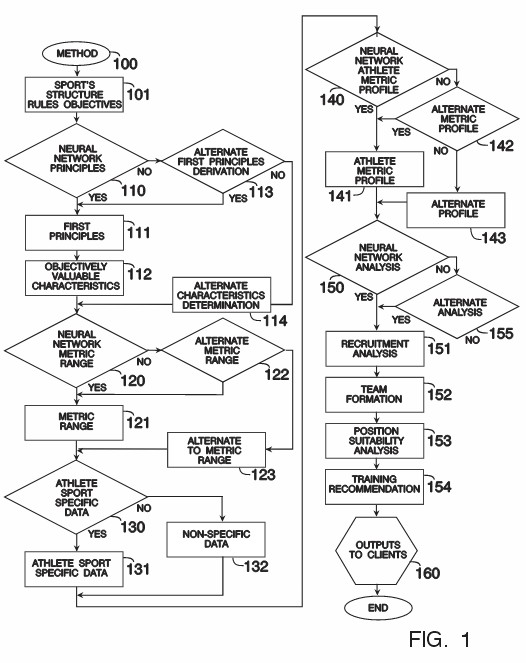
At step 110, a neural network derives first principles 111 and a plurality of objectively valuable characteristics 112 from a sport’s structure, rules, and objectives. The neural network derivation 110 is performed independently of historical athlete performance data. Alternatively, the derivation of first principles 111 and a plurality of objectively valuable characteristics 112 from a sport’s structure, rules, and objectives is not performed by a neural network 113. An alternative to the derivation of objectively valuable characteristics may be implemented 114.
At step 120, a neural network generates a metric range 121 for each objectively valuable characteristic responsive to first principles of human physiology, motor control, and cognitive capabilities and responsive to the sport’s structure, rules, and objectives. Alternatively, a metric range 121 is not generated by a neural network 122. Alternatively, a metric range is not generated 123.
At step 130, sport-specific performance data 131 for an individual athlete or a plurality of individual athletes is acquired. Alternatively, the data acquired is not sport-specific performance data 132. The later would be, for example, the case in an evaluation of young children for suitability in a broad range of sports or in evaluating the design of a new sport, specially an eSport.
At step 140, a neural network generates an individualized metric profile 141 responsive to the acquired sport-specific performance data 131, the plurality of objectively valuable characteristics 112, and the plurality of metric ranges 121. Alternatively, a metric profile 141 is not generated by a neural network 142. In certain, embodiments, and alternate to the metric profile is implemented 143.
At step 150, a neural network performs additional analysis comprising recruitment analysis 151, team formation analysis 152, position suitability analysis 153, and training recommendation generation 154. Alternatively, the analysis is not performed by a neural network 155 and may rely on any metric profiles that may be acquired.
At step 160, an analysis is outputted comprising athlete individualized metric profile 141, sport and position metric ranges 121, recruitment analysis 151, team formation analysis 152, position suitability analysis 153, and training recommendation 154. The output may be displayed on a user interface, transmitted to athletes, recruiter, integrated with a recruiting management system, or integrated with a training management system.
FIG. 2 is a flow chart of a method 200 for deriving first principles and objectively valuable characteristics from a sport’s structure, rules, and objectives. The method 200 is performed by a neural network independently of historical athlete performance data.
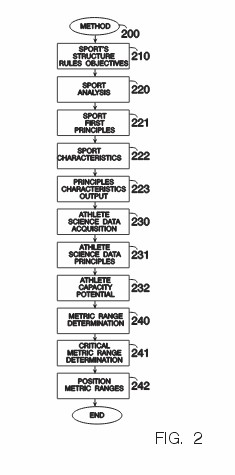
At step 210, the neural network receives sport structure data comprising a sport’s rules, objectives, and constraints. For traditional sports, the sport structure data comprises, for example, FIFA Laws of the Game for soccer, NBA Official Rules for basketball, Official Baseball Rules for baseball, ITF Rules of Tennis, USGA Rules of Golf, NHL Official Rules for hockey, NFL Official Playing Rules for football, FIVB Official Volleyball Rules, and IAAF Competition Rules for track and field. For eSports, the sport structure data comprises, for example, League of Legends game mechanics and ranked play rules, Dota 2 gameplay mechanics and competitive ruleset, Counter-Strike competitive format and game mechanics, Valorant agent abilities and competitive rules, Fortnite Battle Royale mechanics and tournament rules, and Overwatch hero abilities and competitive play structure.
At step 220, the neural network analyzes the sport structure data to identify fundamental requirements inherent to the sport. The analysis examines what the sport structurally rewards, independent of what current athletes do or have done. The analysis identifies causal relationships between athlete capacities and sport success as determined by sport structure rather than correlational patterns observed in athlete populations.
At step 221, the neural network derives first principles from the sport structure data. The first principles comprise fundamental requirements for success in the sport as determined by the sport’s structure. The first principles are derived independently of historical athlete performance data, ensuring that the first principles reflect inherent sport requirements rather than statistical artifacts of particular athlete populations.
At step 222, the neural network derives, from the first principles, a plurality of objectively valuable characteristics evaluative of an athlete’s performance in the sport. The plurality of objectively valuable characteristics comprises readily measured characteristics such as speed, reaction time, accuracy, endurance, acceleration, deceleration, actions per minute, input efficiency, movement speed, targeting precision, and resource management efficiency, and qualitative characteristics such as game intelligence, synergistic team play, competition attitude, position suitability, spatial recognition, anticipation, risk calibration, decision quality, communication effectiveness, and formation maintenance.
In a preferred embodiment, the plurality of objectively valuable characteristics is position-specific. Each position comprises a position-specific plurality of objectively valuable characteristics responsive to the distinct requirements of that designated role. For soccer, positions comprise goalkeeper, defender, midfielder, and forward, with further subdivisions comprising center back, full back, wing back, defensive midfielder, central midfielder, attacking midfielder, and winger. For League of Legends, positions comprise top lane, jungle, mid lane, bot lane, and support.
At step 223, the first principles and the plurality of objectively valuable characteristics are outputted for use in subsequent metric range generation and metric profile generation. The output is stored in a first principles repository accessible by the neural network for metric generation operations.
At step 230, a neural network acquires science data comprising human physiology, motor control, and cognitive capabilities data. The athlete’s science data is analyzed for first principles to arrive at potential performance ranges and potentials 231.
At step 232, a neural network analyzes athlete performance science data to identify limits of an athlete’s capacity for each objectively valuable characteristic under sport conditions, determining the range of potential as constrained by physiology, motor control, and cognition.
At step 240, a neural network generates, responsive to the performance science data and the sport structure data, a metric range for each of the plurality of objectively valuable characteristics. Each metric range comprises a minimum value, a maximum value, and a scale definition, and may comprise, for example, a numeric scale of 0–100, a percentile scale, or a qualitative scale comprising categories such as elite, professional, collegiate, amateur, and novice. In a preferred embodiment, the metric range comprises a standardized scale enabling comparison across objectively valuable characteristics, athletes, positions, and sports.
At step 241, a neural network optionally generates a critical performance range for each sport level. The critical performance range represents the metric range expected for an athlete to perform at the specified sport level.
At step 242, a neural network optionally generates position-specific metric ranges and position-specific critical performance ranges responsive to position-specific demands.
FIG. 3 is a flow chart of a method 300 for acquiring sport-specific performance data. The method 300 may be performed for traditional sports, eSports, or any sport as defined herein.
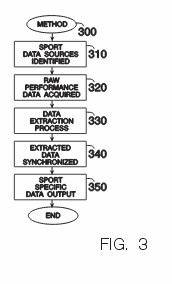
At step 310, available data sources for the sport is identified. For traditional sports, available data sources comprise video recordings of athletic competition, sensor data from wearable devices, audio recordings of athlete and coach communications, and structured statistical records from league or competition databases. For eSports, available data sources comprise game telemetry logs, screen recordings, input device data, and audio recordings of team communications.
At step 320, raw performance data is acquired from the identified data sources. The raw performance data comprises video files, telemetry files, sensor data files, audio files, and structured data records. The acquisition may be performed in real-time during live sport performance or from recorded sport performance.
At step 330, acquired raw performance data is processed to extract athlete actions, movements, decisions, and outputs. For video recordings, processing comprises computer vision analysis to extract athlete positions, movement patterns, ball or object interactions, and spatial relationships. For sensor data from wearable devices, processing comprises extraction of physiological measurements, acceleration data, and workload metrics. For game telemetry logs, processing comprises parsing event sequences, timing data, input actions, resource states, and position coordinates. For audio recordings, processing comprises natural language processing to extract communication patterns, callout content, and coordination indicators. For structured statistical records, processing comprises parsing outcome statistics, event sequences, and match data.
At step 340, extracted data synchronized across multiple data sources where applicable. The synchronization aligns temporal data from video, sensors, telemetry, and audio to enable integrated analysis of athlete performance across data modalities.
At step 350, sport-specific performance data is outputted for use in metric profile generation. The sport-specific performance data comprises processed and synchronized athlete performance information responsive to the data sources available for the sport and the individual athlete.
FIG. 4 is a flow chart of a method 400 for generating an individualized metric profile. The method 400 is performed by a neural network responsive to sport-specific performance data, first principles, the plurality of objectively valuable characteristics, and the corresponding metric ranges.
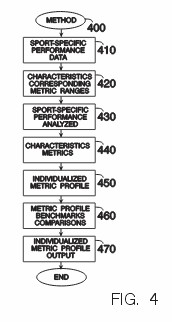
At step 410, sport-specific performance data for an individual athlete is acquired. The sport-specific performance data represents the individual athlete's actions, movements, decisions, and outputs during sport performance.
At step 420, a plurality of objectively valuable characteristics and corresponding metric ranges are acquired. The critical performance ranges corresponding to targeted sport levels and position-specific metric requirements may be acquired.
At step 430, the neural network analyzes the sport-specific performance data to extract measurements corresponding to each objectively valuable characteristic. For readily measured characteristics such as speed, reaction time, accuracy, and endurance, the extraction comprises direct measurement from processed performance data. For qualitative characteristics such as game intelligence, synergistic team play, competition attitude, and position suitability, the extraction comprises pattern analysis across multiple performance indicators.
At step 440, the neural network generates a metric for each objectively valuable characteristic responsive to the extracted measurements and the corresponding metric range. Each metric represents the individual athlete's measured capacity for the corresponding objectively valuable characteristic, quantified within the metric range.
At step 450, the neural network assembles the plurality of metrics into an individualized metric profile for the individual athlete. The individualized metric profile is responsive to the plurality of objectively valuable characteristics and responsive to the plurality of metric ranges.
At step 460, an individualized metric profile is compared against position-specific benchmarks or sport-level benchmarks across athletes, positions, sport levels, and time periods.
At step 470, the individualized metric profile is outputted for use in additional analysis comprising position suitability analysis, recruitment analysis, team analysis, and training recommendation generation. The individualized metric profile may be stored, displayed on a user interface, transmitted to a recruiter, or integrated with recruiting management systems or training management systems.
FIG. 5 illustrates an embodiment of the real-time tactical decision system workflow during ongoing competitive contest. The method 500 begins with accessing metric profile database 510 containing baseline metric profiles for all athletes participating in the competitive contest, including both friendly athletes and opponent athletes. The metric profiles comprise expected performance levels on objectively valuable characteristics derived from sport structure analysis and longitudinal performance tracking across prior competitive contests.
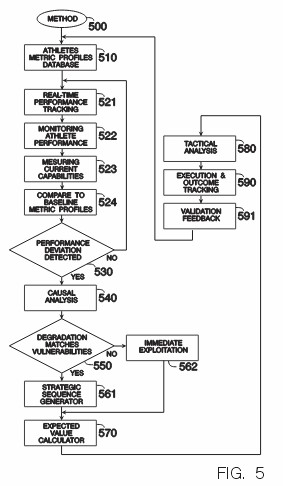
As the competitive contest begins, the system initiates real-time performance tracking 521, monitoring actual athlete performance during the competitive contest 522, and measuring current capability levels 523 on objectively valuable characteristics for all athletes simultaneously. The tracking generates performance measurements that are continuously compared to baseline metric profile expectations 524.
Decision diamond 530 evaluates whether significant performance deviation has been detected. Performance deviations are calculated as differences between baseline metric profile values and measured actual performance. If no significant deviation is detected (NO path from 530), the system continues real-time performance tracking returning to step 521, maintaining continuous monitoring throughout competitive contest duration.
If significant performance deviation is detected (YES path from 530), the system proceeds to causal analysis step 540. The causal analysis identifies relationships between specific competitive actions and observed performance degradation, accessing athlete-specific degradation relationships that quantify expected capability changes following particular action types.
Decision diamond 550 evaluates whether the observed degradation pattern matches historical vulnerability patterns stored in the system's longitudinal database.
If historical vulnerability pattern match is identified (YES path from 550), the system proceeds to strategic sequence generator 561, which creates multi-action tactical sequences including decoy actions designed to deliberately induce additional opponent athlete degradation before decisive exploitation. The strategic sequence approach produces higher cumulative expected value than immediate exploitation by delaying opponent recognition and defensive adjustment.
If no historical pattern match exists (NO path from 550), the system proceeds directly to immediate exploitation option 562, generating tactical configurations targeting the detected degradation without strategic worsening sequence.
Following steps 561 and 562, step 570 implements expected value calculator that computes expected values for candidate tactical configurations. The calculator integrates probability distributions over possible opponent athlete responses, current athlete capability states, predicted future states accounting for planned degradation sequences, and competitive situation factors. The expected value calculation generates probability-weighted predicted outcomes with confidence intervals for each candidate tactical configuration.
Step 580 generates tactical analysis and recommendations presenting the highest expected-value configuration to the decision-maker along with alternative configurations for comparison. The analysis and recommendations include expected values, confidence intervals, key assumptions regarding opponent athlete capability states and response probabilities, and risk assessment appropriate to competitive situation necessity level.
Step 590 implements execution and outcome tracking, monitoring the actual competitive results of the selected tactical configuration as it unfolds during the contest. Upon completion of the tactical sequence, step 591 performs validation feedback by systematically comparing predicted outcomes against observed actual outcomes. This validation process uses the comparison data to refine degradation relationships for specific athletes, update vulnerability pattern statistics including occurrence probabilities and magnitude distributions, and calibrate expected value calculation parameters to reflect observed prediction accuracy.
Following validation step 591, the method returns the updated model parameters to metric profile database 510 for enhanced subsequent evaluations. Throughout the complete workflow, continuous feedback loops operating at multiple timescales enable dynamic adaptation: real-time performance tracking updates capability assessments within ongoing contests, while post-contest validation refines predictive models for future competitions. This multi-layered feedback architecture ensures tactical recommendations remain responsive to current competitive state rather than relying on static pre-competition assumptions, creating an adaptive system that evolves in sophistication through sustained competitive experience.
FIG. 6 illustrates an embodiment of the multi-sport athlete guidance system workflow for youth sport specialization and discovery. The method begins at step 600 and proceeds to current sports assessment 601, which generates metric profiles for each sport the athlete currently practices. Each sport undergoes sport-specific performance evaluation measuring the athlete's capabilities on objectively valuable characteristics derived from that sport's structure, resulting in percentile rankings for competitive achievement level in each current sport.
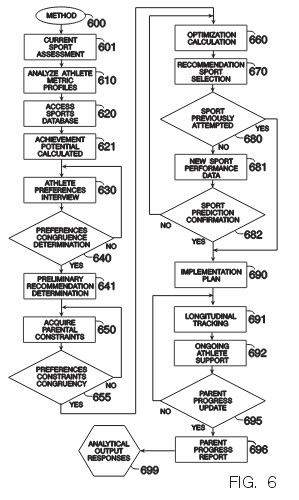
Step 610 analyzes the athlete's metric profiles across all currently practiced sports, comparing performance on objectively valuable characteristics to identify fundamental capabilities that appear consistently across multiple sports. Because the objectively valuable characteristics are derived from universal human physiology, motor control, and cognitive capabilities, capabilities demonstrated in one sport context (such as reaction time or strategic thinking) apply across other sports with similar characteristic requirements. The system compares the athlete's demonstrated capabilities to objectively valuable characteristic requirements in the comprehensive sport database accessed at step 620.
Step 620 accesses comprehensive sport database containing objectively valuable characteristic requirements for a wide range of athletic activities, including sports the athlete currently practices, sports the athlete has considered but not pursued, and sports the athlete has never encountered. The system calculates predicted achievement potential 621 for each sport in the database by matching the athlete's metric profile to that sport's objectively valuable characteristic requirements and weighting patterns. This matching process enables prediction of achievement percentiles in sports the athlete has never attempted, expanding opportunity space beyond familiar options to include optimal matches from the full universe of available sports.
Step 630 conducts multimodal interview incorporating video recording, audio recording, and verbal content capture. The interview explores athlete preferences, motivations, memorable experiences, future aspirations, and satisfaction sources through structured questions designed to elicit both direct preference statements and indirect behavioral signals. The multimodal approach captures visual information (facial expressions, body language, gesture patterns), vocal information (tone, pitch, rhythm, enthusiasm markers), and verbal information (content, word choice, descriptive richness).
Decision diamond 640 implements congruence analysis comparing signals across visual, vocal, and verbal channels. If stated preferences align with emotional engagement indicators (YES path from 640), the system proceeds to initial recommendation step 641. If incongruence exists between verbal statements and emotional engagement signals (NO path from 640), feedback path returns to multimodal interview step 630 with refined questioning designed to resolve the inconsistency and elicit clearer preference expression.
Step 641 generates initial recommendation based solely on the athlete's demonstrated capabilities and genuine sport preferences, presenting the optimal sport selection that maximizes predicted achievement potential and authentic motivation without considering parental constraints. This initial recommendation provides parents with informed context about what the objective analysis suggests is optimal for the athlete's development and satisfaction.
Step 650 acquires parental constraints and priorities through structured assessment of acceptable time commitment, financial capacity, safety requirements, geographic limitations, and primary goals for athletic participation. Parents provide constraints with awareness of the initial recommendation, enabling informed trade-off decisions between optimal athletic match and practical family considerations.
Decision diamond 655 evaluates whether acquired parental constraints align with initial determinations or whether clarification is needed. If constraints are clearly defined and internally consistent, the system proceeds to optimization calculation at step 660. If constraints contain ambiguity or internal inconsistency, feedback path returns to parental constraint acquisition at step 650 with refined questioning to resolve inconsistencies.
Step 660 implements optimization calculation integrating predicted achievement potential, genuine motivation assessment, personality-sport fit evaluation, and constraint satisfaction with weighting aligned to stated priorities. The optimization generates composite scores for each candidate sport, calculating which sport maximizes expected long-term value across combined stakeholder objectives.
Step 670 generates recommendation presenting the optimal sport selection based on optimization calculation along with alternative options and explicit explanation of why alternatives receive lower optimization scores. The recommendation is presented as the objectively optimal choice given all measured data and stated priorities, while acknowledging family agency to select alternative if they prioritize unmeasured factors or reject analytical recommendation.
Decision diamond 680 evaluates whether the optimal recommendation involves a sport the athlete has previously attempted and for which performance data is available. If YES, empirical performance data already validates capability predictions and the system proceeds directly to implementation plan at step 690. If the optimal recommendation involves a sport the athlete has not previously attempted and/or the performance data is inadequate, prediction uncertainty requires empirical validation and the system proceeds to introductory session at step 681.
Step 681 implements introductory session validation, recommending the athlete participate in, for example, a single beginner-level class for the recommended sport while video recording captures performance. The session provides empirical data on skill acquisition rate, natural movement alignment with sport mechanics, genuine engagement during activity, and expert instructor observations of aptitude.
Decision diamond 682 evaluates whether empirical validation confirms prediction. If validation reveals poor natural alignment or lack of genuine engagement, feedback path returns to optimization calculation 660 to revise recommendation based on empirical findings. If validation confirms predicted capability match and genuine engagement, recommendation confidence substantially increases and the system proceeds to implementation plan 690.
Step 690 generates implementation plan specifying trial period duration, continued participation options in other sports during trial, and ongoing performance development framework for the athlete.
Step 691 implements longitudinal tracking through continuous monitoring of the athlete's actual development trajectory, comparing observed performance evolution to predicted patterns across objectively valuable characteristics.
Step 692 generates ongoing performance recommendations for the athlete including specific training focus areas, capability development priorities, technique refinement opportunities, and achievement milestone tracking. These developmental recommendations provide continuous support for athletic improvement regardless of specialization decisions.
Decision diamond 695 evaluates whether a parent has requested either progress update or specialization reassessment. If NO (no parent request), the system continues longitudinal tracking step 691, maintaining continuous developmental support for the athlete. If YES (parent request received), the system proceeds to step 696.
Step 696 generates parent-requested information responsive to the specific request type. For progress update requests, the system generates comprehensive progress report including current performance levels, development trajectory comparison to predictions, achievement milestones reached, and areas showing accelerated or delayed development relative to expectations. For specialization reassessment requests, the system generates updated specialization recommendation incorporating all accumulated longitudinal data, recalculating optimal sport selection based on current capabilities, motivations, and developmental trajectory.
The described method concludes at step 699 following delivery of parent-requested information. Multiple pathways exist depending on family response to the analytical output. For example, if parental constraints have changed based on new information or evolved priorities, the family may re-engage the system at parental constraint acquisition (step 650) to generate revised recommendations incorporating updated constraints. If the athlete's genuine sport preferences have evolved or the athlete reports dissatisfaction with recommended sport despite predicted fit, the family may re-engage at multimodal interview (step 630) to reassess preferences and motivations. If significant developmental changes warrant complete reassessment, the family may re-engage at current sports assessment (step 601) for comprehensive re-evaluation. If the family is satisfied with guidance and implementation is proceeding as predicted, they continue with the recommended specialization path. The system's analytical framework provides objective optimization based on measured data, while the current system's analytical sophistication remains insufficient to fully predict how human preferences, constraints, and self-knowledge evolve through experience and reflection.
System Architecture
System Embodiment Overview. The systems and methods disclosed herein may be implemented as a system comprising integrated hardware and software components configured to quantify athlete performance on objectively valuable characteristics, calculate probabilistic expected values for tactical configurations and multi-sport recommendations, and optimize decisions through systematic integration of quantified performance assessments. In one embodiment, the system is further configured to derive first principles from sport structure and generate objectively valuable characteristics through neural network analysis. In another embodiment, the system is configured to receive objectively valuable characteristics from external sources.
The system receives input data such as sport structure data defining rules, objectives, and competitive frameworks; objectively valuable characteristics derived from first principles and/or from external sources; sport-specific performance data comprising video recordings, game telemetry logs, sensor data, and audio recordings; historical athlete performance data spanning multiple competitive contests; and contextual data including parental constraint data, sport preferences, and competitive state information. The system processes inputs to generate outputs such as quantified metric ranges for objectively valuable characteristics, individualized metric profiles for athletes, real-time tactical recommendations during competitive contests, multi-sport specialization recommendations, and continuous model refinements based on validation against actual outcomes.
The system architecture provides advantages through implementation of systematic quantification frameworks enabling objective athlete assessment, real-time tactical optimization through continuous performance tracking and probabilistic expected value calculations, multi-sport evaluation through transferable capability analysis, and consistent integration of objectively-derived or externally-sourced evaluation criteria across functional applications.
Processing Architecture. The system comprises one or more processing units configured to execute computational operations such as neural network inference, first principles derivation through analysis of sport structure and objective constraints, metric quantification calculations, real-time performance analysis, probabilistic expected value computation, tactical optimization, and multi-sport recommendation generation. The processing units may comprise computational hardware such as central processing units, graphics processing units, tensor processing units, neural network accelerators, application-specific integrated circuits, field-programmable gate arrays, distributed processing nodes, and other processing architectures, configured to execute computational operations responsive to system requirements.
The processing architecture implements operations such as neural network forward propagation for inference during real-time competitive contest analysis, neural network backpropagation for training when refining models based on validation data, parallel processing of multiple candidate tactical configurations for expected value comparison, optimization algorithms for tactical configuration selection, probabilistic calculations integrating uncertainty across opponent athlete response predictions, and continuous learning operations refining predictions through validation against actual competitive outcomes.
Memory Components. The system comprises memory configured to store data such as executable instructions, operational data, trained neural network models, athlete performance data, objectively valuable characteristics, and computational results. The memory may comprise volatile memory providing high-speed access for active computational operations such as current metric profiles for athletes participating in ongoing competitive contests, real-time performance measurements tracked during competition, candidate tactical configurations under evaluation, and intermediate calculation results during expected value computation.
The memory may comprise non-volatile memory providing persistent storage for data such as neural network models, sport structure definitions, historical athlete performance data spanning multiple competitive contests, longitudinal vulnerability pattern data for opponent athletes, objectively valuable characteristic definitions and metric ranges, externally-received objectively valuable characteristics, and validated prediction models refined through continuous learning from actual competitive outcomes.
The memory architecture enables data access during time-critical operations such as real-time tactical decision-making during competitive contests, wherein tactical recommendations are generated within decision timeframes. The system maintains frequently-accessed data in memory such as metric profiles for athletes currently competing, degradation relationships for actions under consideration, and pre-computed probabilistic predictions for anticipated competitive states.
Characteristic Processing Components. The system comprises components configured to process objectively valuable characteristics for athlete evaluation and tactical optimization. In one embodiment, the system comprises a characteristic derivation module configured to analyze sport structure data, derive first principles governing competitive success through analysis independent of historical athlete performance data, and generate objectively valuable characteristics based on the derived first principles. The characteristic derivation module may implement neural network analysis, self-play reinforcement learning wherein a neural network learns sport gameplay through simulated competition, or logical analysis of sport rules and objectives.
In another embodiment, the system comprises a characteristic input interface configured to receive objectively valuable characteristics from external sources such as expert-defined evaluation criteria, statistically-derived characteristics from historical athlete data analysis, third-party evaluation frameworks, legacy scouting systems, or hybrid characteristic sets combining multiple derivation methodologies. The characteristic input interface processes received characteristics into standardized formats compatible with the system's quantification and probabilistic calculation frameworks.
The system comprises a characteristic quantification module configured to generate metric ranges for objectively valuable characteristics, wherein metric ranges may be derived from first principles of human physiology, motor control, biomechanics, and cognitive capabilities, or may be derived from statistical analysis of athlete population data, or may be specified through expert definition. The characteristic quantification module generates individualized metric profiles for athletes responsive to acquired sport-specific performance data and the objectively valuable characteristics, calculates percentile rankings comparing athlete metrics to reference populations, and generates position-specific metric requirements defining capability thresholds for designated positions.
Performance Data Acquisition Components. The system comprises components configured to receive and process sport-specific performance data. For video recordings, the system may implement computer vision processing such as frame extraction, athlete detection and tracking, movement analysis, spatial positioning extraction, and derivation of performance metrics from visual data. For game telemetry logs, the system may implement parsing of structured event data, extraction of athlete action sequences, calculation of timing metrics, and derivation of decision quality assessments. For sensor data, the system may implement signal processing, filtering, calibration, and conversion of raw sensor readings into performance metrics aligned with objectively valuable characteristics.
Real-Time Performance Tracking Components. The system comprises components configured to monitor athlete performance during competitive contests. The system may continuously extract current performance measurements on objectively valuable characteristics from incoming data streams, calculate performance deviations by comparing current measurements to baseline metric profile values, detect statistically significant deviations indicating performance degradation or enhancement, identify degradation relationships between specific competitive actions and subsequent performance changes, and maintain updated capability state estimates for athletes participating in competitive contests.
Probabilistic Calculation Engine. The system comprises a probabilistic calculation engine configured to compute expected values through integration of uncertainty across multiple factors. The probabilistic calculation engine generates probability distributions over possible outcomes, weights outcomes by occurrence probabilities, integrates athlete capability states with opponent athlete response predictions, accounts for measurement uncertainty and temporal variance, and calculates expected values for tactical configurations, multi-sport recommendations, or other decision options requiring probabilistic assessment.
The probabilistic calculation engine implements probabilistic methodologies such as Bayesian inference, Monte Carlo simulation, and analytical probability calculations. The engine accounts for correlations between factors, updates probability estimates responsive to new information during ongoing competitive contests, and generates confidence intervals reflecting prediction uncertainty. The probabilistic calculation engine enables systematic decision optimization under uncertainty by quantifying expected outcomes across multiple possible scenarios.
Precise Quantification Enabling Definitive Real-Time Recommendations. The system's precise quantification of athlete capabilities on objectively valuable characteristics through metric ranges and individualized metric profiles, combined with real-time tracking of current capability states during ongoing competitive contests, enables rigorous probabilistic calculations that generate definitive tactical recommendations at tactical decision points rather than presenting ambiguous options requiring human judgment to select among alternatives. Conventional decision support systems force decision-makers to select among options using subjective judgment under time pressure. The precise quantification framework, continuously updated with real-time performance measurements reflecting current athlete capability states including fatigue, degradation, and performance deviations, enables the probabilistic calculation engine to compute expected values with sufficient mathematical rigor to definitively identify optimal configurations responsive to current competitive conditions. Rather than presenting "Option A, Option B, or Option C, each with trade-offs," the system recommends "execute configuration B at this tactical decision point" based on, for example, calculated expected value superiority accounting for current athlete capability states, opponent response probabilities, detected performance degradations, and competitive context. The precision of metric quantification combined with real-time capability state tracking directly enables the conclusiveness of tactical recommendations delivered during ongoing competition.
Tactical Optimization Components. The system comprises components configured to optimize tactical decisions during competitive contests. The system may generate tactical configurations for tactical decision points, calculate expected values for each configuration through the probabilistic calculation engine integrating opponent athlete response predictions and athlete capability states, identify tactical configurations optimizing expected value subject to risk tolerance constraints, generate strategic tactical sequences comprising multiple coordinated actions such as decoy actions designed to induce opponent athlete degradation, account for temporal dynamics such as degradation accumulation and recovery characteristics, and present ranked tactical recommendations with confidence intervals and key assumptions.
Multi-Sport Guidance Components. The system comprises components configured to provide multi-sport athlete guidance. The system may maintain sport data defining objectively valuable characteristic requirements for multiple sports, extract transferable capability profiles representing fundamental athlete capabilities consistent across sports, calculate capability-requirement alignment scores comparing athlete transferable capabilities to requirements of sports not currently practiced, analyze multimodal preference data to assess genuine sport preferences, integrate parental constraint data defining practical limitations on sport participation, and generate sport specialization recommendations through probabilistic optimization across predicted achievement potential, genuine motivation assessment, personality-sport fit evaluation, and constraint satisfaction.
Data Storage Components. The system comprises data storage components configured to organize and store operational data. The system may comprise storage for metric profiles including quantified values for objectively valuable characteristics, percentile rankings, historical metric trajectories, and confidence intervals. The system may comprise storage for vulnerability patterns including trigger conditions, degradation magnitudes, temporal timelines, occurrence probabilities, and variance characteristics for opponent athletes across multiple competitive contests.
The system may comprise storage for sport structure data including formal definitions of sport rules, objectives, and constraints for multiple sports, derived first principles for each sport, objectively valuable characteristics for each sport, metric ranges, and position-specific requirements. The system may comprise storage for tactical configurations including candidate tactical configurations for competitive situations, pre-computed expected value calculations, historical effectiveness data, opponent athlete response probability distributions, and degradation relationship tables quantifying causal connections between action types and performance changes.
The system may comprise storage for athlete performance data including video recordings, game telemetry logs, sensor data, audio recordings, processed performance measurements extracted from raw data, longitudinal performance tracking across multiple competitive contests, developmental trajectory data, and validation outcomes comparing predicted performance to actual competitive results. The data storage components may be implemented through databases, file systems, distributed storage systems, cloud storage, or other storage architectures.
Computer Vision Subsystem for Real-Time Analysis. The system comprises a computer vision subsystem configured for real-time visual analysis of competitive contests, enabling extraction of performance metrics directly from video during ongoing competition. The computer vision subsystem is configured for in-game tactical decision-making where immediate analysis of visual competitive state informs play-calling and tactical adjustments.
The computer vision subsystem comprises components such as video input interfaces configured to receive video streams from camera angles capturing competitive action, frame processing components implementing analysis of sequential video frames with minimal latency, object detection algorithms identifying athletes, equipment, field boundaries, and environmental features, athlete tracking algorithms maintaining consistent identification of individual athletes across frames, pose estimation algorithms determining athlete body positioning and movement mechanics, and spatial positioning extraction calculating athlete locations relative to field coordinates and opponent athletes.
The computer vision subsystem implements performance metric extraction configured to derive measurements of objectively valuable characteristics directly from visual data. The subsystem may track athlete displacement over time for speed measurement, analyze athlete positioning relative to teammates and opponents for spatial awareness assessment, analyze athlete actions in context of competitive state for decision quality evaluation, and analyze movement patterns, reaction times, and postural indicators for fatigue detection and performance degradation identification.
The computer vision subsystem operates with minimal processing latency, enabling tactical recommendations during ongoing competitive contests at tactical decision points. The subsystem processes video frames during competition, extracts current performance measurements for objectively valuable characteristics, provides measurements for deviation detection and capability state updates, and enables expected value calculations based on current visual competitive state. The processing pipeline ensures tactical recommendations account for current competitive conditions rather than delayed state assessments.
The computer vision subsystem may implement machine learning models trained to recognize sport-specific patterns such as athlete fatigue indicators including reduced movement speed, altered stride mechanics, and postural changes, decision-making patterns including positioning choices and action timing, technical execution quality including ball control precision and movement efficiency, and tactical formation characteristics including spacing, positioning, and coordinated movements. These recognition capabilities enable automated extraction of complex performance characteristics.
Audio Capture and Analysis Subsystem. The system comprises an audio capture and analysis subsystem configured for real-time acoustic analysis of competitive contests, enabling extraction of performance metrics from audio data during ongoing competition. The audio subsystem captures sounds such as athlete vocalizations, breathing patterns, equipment impacts, crowd noise, and team communications that provide indicators of athlete physiological state, psychological state, and tactical execution quality.
The audio capture and analysis subsystem comprises components such as audio input interfaces configured to receive audio streams from microphones positioned to capture athlete sounds, on-body microphones worn by athletes, directional microphones focused on specific field regions, and ambient microphones capturing environmental sounds. Audio processing components implement real-time analysis of audio signals with minimal latency, voice activity detection identifying athlete vocalizations, breathing pattern extraction from respiratory sounds, impact sound analysis quantifying force and precision of equipment contact, and vocal stress analysis detecting psychological pressure indicators.
The audio subsystem implements performance metric extraction configured to derive measurements of objectively valuable characteristics from acoustic data. For fatigue assessment, the subsystem analyzes breathing rate, breathing depth, and respiratory irregularity indicating physical degradation. For psychological state assessment, the subsystem analyzes vocal stress markers such as pitch variation, speaking rate, and voice quality changes indicating pressure response and competition attitude. For decision quality assessment, the subsystem analyzes communication timing, clarity, and coordination indicating game intelligence and synergistic team play. For technical execution assessment, the subsystem analyzes equipment impact sounds indicating precision, power, and technique quality.
The audio subsystem operates in real-time with minimal processing latency, enabling tactical recommendations accounting for current athlete physiological and psychological states. The subsystem processes audio continuously during competition, extracts current performance measurements for objectively valuable characteristics, provides measurements for deviation detection and capability state updates, and enables expected value calculations incorporating athlete fatigue state and psychological pressure response. Audio-derived metrics complement visual metrics from the computer vision subsystem, providing performance indicators not visible through video analysis alone.
Physiological Monitoring Subsystem. The system comprises a physiological monitoring subsystem configured for real-time measurement of athlete physiological parameters during competitive contests through wearable sensors and non-contact measurement technologies. The physiological subsystem measures parameters such as heart rate, breathing rate, body temperature, blood oxygen saturation, lactate accumulation, hydration status, muscle oxygen levels, and other physiological indicators of athlete physical state and capability degradation.
The physiological monitoring subsystem comprises components such as sensor interfaces configured to receive data from wearable sensors including chest strap heart rate monitors, wrist-worn sensors, temperature sensors, accelerometers measuring movement and impact forces, and other sensor types. The subsystem may comprise non-contact measurement technologies such as thermal imaging cameras detecting body temperature distribution, remote photoplethysmography extracting heart rate from video analysis of skin color variation, and other non-invasive measurement methods. Signal processing components implement real-time analysis of physiological data streams, filtering of measurement noise, calibration accounting for individual athlete baseline variations, and detection of physiologically significant changes indicating performance degradation.
The physiological monitoring subsystem implements performance metric extraction configured to derive measurements of objectively valuable characteristics from physiological data. For endurance assessment, the subsystem analyzes heart rate relative to exertion level, heart rate recovery patterns, and breathing efficiency. For fatigue detection, the subsystem analyzes heart rate variability indicating autonomic stress, elevated core temperature indicating thermal stress, lactate accumulation indicating metabolic stress, and hydration status. For injury risk assessment, the subsystem analyzes asymmetric movement patterns, abnormal impact forces, and physiological indicators of compromised movement mechanics. For capability state tracking, the subsystem quantifies current physical capacity accounting for accumulated fatigue, thermal stress, and metabolic demands.
The physiological monitoring subsystem operates continuously during competitive contests, providing real-time updates of athlete physical capability states. The subsystem detects performance deviations before they become visible through behavioral observation, enabling proactive tactical adjustments. When an opponent athlete's heart rate indicates approaching cardiovascular limits, the tactical optimization module can recommend actions designed to increase physical demands and accelerate degradation. When a friendly athlete's physiological indicators show excessive fatigue, the system can recommend tactical configurations reducing physical demands for that athlete or substitution timing.
Environmental Monitoring Subsystem. The system comprises an environmental monitoring subsystem configured for real-time measurement of environmental conditions at competitive venues that affect athlete performance and tactical effectiveness. The environmental subsystem measures conditions such as ambient temperature, humidity, wind speed and direction, altitude, air quality, field surface temperature, surface moisture, surface friction characteristics, lighting conditions, and other environmental factors influencing athletic performance.
The environmental monitoring subsystem comprises components such as weather sensors measuring atmospheric conditions, surface sensors measuring field conditions such as temperature and moisture, friction measurement devices assessing surface characteristics, light meters measuring illumination levels, and other environmental measurement instruments. Data acquisition components receive measurements from fixed sensors positioned around competitive venues, mobile sensors deployed at specific field locations, and external data sources such as weather services providing atmospheric data. Processing components implement real-time analysis of environmental data, detection of condition changes during competitive contests, and prediction of environmental trajectories such as temperature trends and precipitation probability.
The environmental monitoring subsystem implements performance impact analysis configured to quantify how environmental conditions affect athlete performance on objectively valuable characteristics. For speed and acceleration, the subsystem accounts for surface friction, moisture, and temperature affecting traction and movement efficiency. For endurance, the subsystem accounts for temperature and humidity affecting thermal stress and metabolic demands. For precision and accuracy, the subsystem accounts for wind conditions affecting ball flight and equipment control. For injury risk, the subsystem accounts for surface conditions affecting impact forces and slip probability.
The environmental monitoring subsystem provides data enabling context-aware tactical optimization. When surface conditions degrade through moisture or temperature changes, the system adjusts expected values for tactical configurations accounting for reduced traction and altered movement capabilities. When environmental conditions asymmetrically affect athletes with different physiological characteristics, the system recommends tactics exploiting the differential impact. Environmental data integrates with physiological monitoring to assess compound effects such as thermal stress in high temperature and humidity conditions.
Equipment Sensor Subsystem. The system comprises an equipment sensor subsystem configured for real-time measurement of athlete equipment performance and usage patterns during competitive contests through sensors embedded in or attached to athletic equipment. The equipment sensor subsystem measures parameters such as ball impact force and location, racket or bat swing speed and angle, shoe pressure distribution and impact forces, equipment vibration and stress, and other equipment performance indicators providing insights into athlete technical execution and physical capability.
The equipment sensor subsystem comprises components such as sensor interfaces configured to receive data from impact sensors embedded in balls measuring impact force, location, and spin, accelerometers and gyroscopes in rackets or bats measuring swing mechanics, pressure sensors in shoes measuring foot strike patterns and weight distribution, strain gauges in equipment measuring applied forces, and other sensor types. Data transmission components implement wireless communication protocols enabling real-time data transfer from equipment sensors to the system during ongoing competitive action. Processing components implement real-time analysis of equipment sensor data, extraction of performance metrics, and detection of changes indicating athlete capability degradation or technique modifications.
The equipment sensor subsystem implements performance metric extraction configured to derive measurements of objectively valuable characteristics from equipment sensor data. For power assessment, the subsystem analyzes impact forces and swing speeds. For precision assessment, the subsystem analyzes impact location consistency and trajectory control. For technique quality assessment, the subsystem analyzes swing mechanics, timing, and movement patterns. For fatigue detection, the subsystem analyzes degradation in swing speed, reduced impact forces, and altered movement mechanics indicating physical capability decline.
Biomechanical Analysis Subsystem. The system comprises a biomechanical analysis subsystem configured for real-time assessment of athlete movement mechanics, joint kinematics, force production, and movement efficiency during competitive contests. The biomechanical subsystem analyzes movement patterns to assess technical execution quality, detect injury risk factors, identify fatigue-related movement degradation, and quantify movement efficiency affecting speed, power, and endurance.
The biomechanical analysis subsystem comprises components such as motion capture systems using computer vision analysis of athlete joint positions and movement trajectories, inertial measurement units worn by athletes measuring acceleration and rotation, force plates or pressure sensors measuring ground reaction forces, and other biomechanical measurement technologies. Processing components implement real-time kinematic analysis calculating joint angles and movement velocities, kinetic analysis estimating forces and torques, movement pattern recognition identifying technique characteristics, and comparison of current movement mechanics to baseline movement patterns for deviation detection.
The biomechanical analysis subsystem implements performance metric extraction configured to derive measurements of objectively valuable characteristics from biomechanical data. For speed and acceleration assessment, the subsystem analyzes stride mechanics, ground contact time, and force production efficiency. For power assessment, the subsystem analyzes force production and movement velocities. For injury risk assessment, the subsystem analyzes asymmetric loading patterns, excessive joint angles, and movement mechanics associated with injury mechanisms. For fatigue detection, the subsystem analyzes degradation in movement efficiency, altered joint kinematics indicating compensatory patterns, and reduced force production indicating neuromuscular fatigue.
The biomechanical analysis subsystem operates continuously during competitive contests, providing real-time assessment of movement quality and physical capability. The subsystem detects subtle movement degradation indicating early fatigue before performance decline becomes obvious through competitive outcomes. When biomechanical analysis detects altered movement mechanics in an opponent athlete, the tactical optimization module can recommend actions exploiting the movement limitation. When biomechanical analysis detects injury risk patterns in a friendly athlete, the system can recommend tactical configurations reducing injury risk or substitution timing preventing injury occurrence.
Multimodal Data Integration. The system integrates data from multiple real-time acquisition subsystems to generate comprehensive athlete capability state assessments. The computer vision subsystem provides spatial positioning, movement tracking, and visible performance indicators. The audio subsystem provides breathing patterns, vocal stress, and communication quality. The physiological monitoring subsystem provides cardiovascular state, thermal stress, and metabolic demands. The environmental monitoring subsystem provides contextual factors affecting performance. The equipment sensor subsystem provides precise technical execution measurements. The biomechanical analysis subsystem provides movement quality and efficiency assessments.
The integrated multimodal approach enables detection of performance patterns not apparent from any single data source. Declining sprint speed detected by computer vision, combined with elevated heart rate from physiological monitoring, altered stride mechanics from biomechanical analysis, and irregular breathing from audio analysis, provides high-confidence detection of physical fatigue and quantifies degradation magnitude across multiple objectively valuable characteristics. The probabilistic calculation engine integrates measurements across modalities, weights data sources by reliability and relevance, accounts for measurement uncertainties, and generates comprehensive capability state estimates supporting tactical optimization.
Derivation of Qualitative Objectively Valuable Characteristics. The multimodal data acquisition subsystems enable derivation of deeper qualitative objectively valuable characteristics through integrated analysis of patterns across multiple data sources for all athletes participating in competitive contests, including both friendly athletes and opponent athletes. While certain objectively valuable characteristics such as speed and power correspond directly to measurable physical parameters, other objectively valuable characteristics such as game intelligence, competition attitude, synergistic team play, and position suitability require inference from behavioral patterns, contextual responses, and multimodal integration revealing cognitive and psychological attributes not directly observable through any single measurement. For opponent athletes where direct physiological sensor access may be unavailable, the system derives qualitative characteristics primarily through video and audio analysis, identifying behavioral patterns and psychological indicators analogous to recognizing tells in poker - observable behaviors revealing internal states, capability degradation, and enabling prediction of future actions that can be communicated to athletes during ongoing competition for tactical advantage.
Game intelligence assessment integrates data from multiple subsystems to evaluate spatial awareness, anticipation, decision quality, and tactical understanding for all athletes in competitive contests. The computer vision subsystem tracks athlete positioning relative to teammates and opponents, revealing spatial recognition through positioning choices. The audio subsystem captures communication timing and content, revealing anticipation through predictive callouts and coordination effectiveness. The equipment sensor and biomechanical subsystems measure action timing and execution, revealing decision quality through optimal action selection under time pressure. When an athlete consistently positions advantageously before play development becomes obvious, communicates predictive information enabling teammate preparation, and executes technically sound actions with appropriate timing, the integrated pattern indicates high game intelligence independent of physical capability measurements. For opponent athletes, positioning patterns, reaction timing to developing plays, and decision quality under pressure reveal game intelligence levels enabling tactical exploitation of athletes with lower spatial awareness or slower decision-making capabilities.
Competition attitude assessment integrates physiological, audio, and behavioral data to evaluate composure under pressure, consistent effort across game states, and response to adversity for all athletes. The physiological monitoring subsystem measures cardiovascular response to high-pressure situations for friendly athletes equipped with sensors, revealing autonomic stress patterns. The audio subsystem analyzes vocal stress markers and communication consistency during pressure moments for all athletes whose vocalizations can be captured. The computer vision subsystem tracks effort indicators such as sprint frequency and defensive intensity across varying score differentials for all visible athletes. The biomechanical subsystem measures movement quality maintenance under fatigue. For opponent athletes, behavioral tells such as reduced communication frequency when trailing, decreased defensive intensity after mistakes, altered body language indicating frustration, and technique degradation under pressure reveal competition attitude weaknesses exploitable through tactical configurations designed to increase psychological pressure. An opponent athlete demonstrating vocal stress escalation during critical moments, reduced effort intensity when facing deficits, or technique breakdown under sustained pressure provides tactical exploitation opportunities analogous to recognizing psychological tells in poker.
Synergistic team play assessment integrates spatial, communication, and timing data across multiple athletes to evaluate coordinated action, support positioning, formation maintenance, and mutual reinforcement. The computer vision subsystem tracks spatial relationships among teammates, revealing coordinated movement patterns and support positioning. The audio subsystem captures communication timing relative to teammate actions, revealing coordination effectiveness. The equipment sensor subsystem measures action timing across multiple athletes, revealing synchronized execution. This assessment applies to both friendly team coordination analysis and opponent team coordination analysis. When opponent team coordination patterns reveal consistent spacing breakdowns, communication gaps during transitions, or timing failures in coordinated actions, the tactical optimization module identifies exploitation opportunities. Detecting opponent team coordination degradation under sustained pressure or recognizing individual opponent athletes consistently positioned poorly relative to teammates enables tactical configurations attacking the identified coordination weaknesses.
Position suitability assessment integrates capability measurements across multiple objectively valuable characteristics with positional requirement analysis to evaluate athlete-position fit for all athletes in competitive contests. Different positions within sports require different capability profiles across physical, technical, cognitive, and psychological characteristics. The system compares an athlete's measured capabilities across all objectively valuable characteristics to the requirement profile for each position, identifying positions where the athlete's capability pattern aligns with positional demands. For opponent athletes, position suitability analysis identifies athletes playing positions mismatched with their capability profiles, revealing tactical vulnerabilities. An opponent athlete playing a position requiring high spatial awareness but demonstrating behavioral patterns indicating limited spatial recognition, or playing a position requiring sustained high-intensity effort but demonstrating effort degradation patterns, provides tactical exploitation opportunities through configurations targeting the capability-position mismatch.
Opponent Behavioral Pattern Recognition and Tell Identification. The system implements sophisticated opponent athlete analysis identifying behavioral patterns and psychological tells revealing internal states, capability degradation, and tactical vulnerabilities during competitive contests. While friendly athletes may be equipped with comprehensive sensor suites providing physiological and biomechanical data, opponent athletes are evaluated primarily through video and audio analysis, requiring inference of internal states from observable behavioral patterns analogous to recognizing tells in poker that reveal player hands or psychological states.
The system identifies opponent tells such as altered breathing patterns audible through audio capture indicating cardiovascular stress, body language changes visible through computer vision indicating psychological pressure or frustration, communication pattern disruptions indicating coordination breakdown or morale degradation, technique degradation visible through movement analysis indicating physical fatigue or mental pressure, positioning pattern changes indicating tactical confusion or capability decline, and timing variations indicating decision-making degradation or anticipation failure. These behavioral indicators enable real-time assessment of opponent athlete capability states and psychological conditions without direct physiological measurement access.
The tell identification capability provides tactical advantages. When the system detects an opponent athlete's breathing irregularity through audio analysis, body language indicating frustration through video analysis, and positioning errors through spatial tracking, the integrated pattern indicates psychological vulnerability and physical degradation. The tactical optimization module generates configurations designed to target that opponent athlete with additional pressure through sustained physical demands, exploiting the detected vulnerability before recovery occurs. The tell-based opponent evaluation enables proactive tactical adjustments exploiting opponent weaknesses detected through behavioral pattern analysis rather than waiting for obvious performance failures.
The derivation of qualitative objectively valuable characteristics through multimodal integration demonstrates a fundamental system capability: sophisticated pattern recognition enabling evaluation of complex cognitive, psychological, and strategic attributes through integrated analysis of observable behavioral patterns, physiological responses, and contextual performance for all athletes participating in competitive contests. The system does not directly measure game intelligence, competition attitude, or synergistic team play through dedicated sensors. Rather, the system infers these qualitative characteristics through analysis of behavioral patterns across multiple data modalities, revealing cognitive and psychological attributes through their manifestation in observable performance patterns during competitive contests. This inference capability applies symmetrically to friendly athletes where comprehensive sensor data may be available and to opponent athletes where analysis relies primarily on video and audio observation, enabling tactical optimization through exploitation of detected opponent vulnerabilities and psychological tells.
Communication Interfaces. The system comprises communication interfaces configured to receive input data and transmit output information. Input interfaces may receive game telemetry data from eSport servers during ongoing competitive matches, video streams from cameras recording competitive contests, real-time data from wearable sensors monitoring athlete physiological states, objectively valuable characteristics from external sources, historical performance data, sport structure definitions, and parental constraint information through network interfaces, video capture interfaces, sensor interfaces, data import interfaces, or other communication mechanisms.
Output interfaces may present tactical recommendations to coaches during competitive contests, generate detailed athlete evaluation reports for recruiters, provide multi-sport guidance to youth athletes and parents, and export metric profiles and analysis results to external systems through display interfaces, report generation interfaces, recommendation interfaces, data export interfaces, or other communication mechanisms. The communication interfaces implement protocols ensuring data integrity, authentication, and timely delivery responsive to operational requirements such as real-time delivery of tactical recommendations during competitive contests.
System Integration and Data Flow. The system components operate in coordination through data flow pathways. During athlete evaluation operations, performance data acquisition components receive and process sport-specific performance data, characteristic quantification components generate individualized metric profiles responsive to the processed performance data and objectively valuable characteristics, and results are stored for subsequent retrieval and analysis.
During real-time tactical optimization operations, multiple data acquisition subsystems operate concurrently with integrated data flow. The computer vision subsystem processes video of ongoing competitive contests extracting spatial positioning, movement patterns, visible behavioral indicators, and body language signals revealing psychological states. The audio subsystem captures and analyzes vocalizations for vocal stress markers, breathing patterns indicating cardiovascular stress, and communication quality revealing coordination effectiveness. The physiological monitoring subsystem tracks heart rate, breathing rate, body temperature, and other physiological parameters for athletes equipped with sensors, detecting autonomic stress responses and metabolic demands. The environmental monitoring subsystem measures field temperature, surface conditions, wind speed, and other environmental factors affecting athlete performance capabilities. The equipment sensor subsystem captures ball impact forces, swing speeds, and precise technical execution data. The biomechanical analysis subsystem assesses movement quality, joint kinematics, and force production efficiency indicating physical capability states.
Real-time tracking components integrate measurements across all active subsystems, synthesizing multimodal data into comprehensive capability state estimates for all athletes participating in the competitive contest. For friendly athletes, direct sensor measurements combine with behavioral observations to generate high-precision capability assessments. For opponent athletes, behavioral pattern analysis identifies tells analogous to poker tell recognition - observable behaviors revealing internal states such as altered breathing patterns indicating fatigue, body language changes indicating psychological pressure, communication disruptions indicating coordination breakdown, technique degradation indicating physical decline, and positioning errors indicating decision-making degradation. The multimodal integration weights data sources by reliability, accounts for measurement uncertainties, and generates capability state estimates with associated confidence intervals.
Performance deviation detection operates continuously, comparing current capability state estimates to baseline metric profile values across all objectively valuable characteristics. The system detects statistically significant deviations indicating performance degradation such as reduced sprint speed, decreased accuracy, slower reaction time, impaired decision quality, degraded technique execution, or psychological pressure indicators. For opponent athletes, deviation detection identifies vulnerability windows - periods when detected degradation creates tactical exploitation opportunities. The system identifies degradation relationships between specific competitive actions and subsequent performance changes, enabling prediction of how tactical configurations will affect opponent athlete capability states.
The probabilistic calculation engine receives integrated capability state estimates reflecting current conditions across physical, cognitive, and psychological dimensions for all athletes. The engine calculates expected values for tactical configurations accounting for precise quantification of friendly athlete capabilities enabling optimal deployment, detected opponent athlete degradations creating exploitation opportunities, identified opponent tells predicting future actions and vulnerability patterns, environmental conditions affecting performance across different athlete types, and probability distributions over opponent responses accounting for observed behavioral patterns and detected psychological states. The precise quantification framework enables rigorous mathematical differentiation among tactical configurations, identifying optimal configurations with calculated expected value superiority rather than presenting ambiguous options requiring subjective selection.
Tactical recommendations are generated as definitive directives rather than option lists. Rather than presenting "Option A with trade-offs X, Option B with trade-offs Y, Option C with trade-offs Z," the system recommends "execute configuration B at this tactical decision point" based on calculated expected value superiority accounting for current athlete capability states, detected performance degradations, identified opponent vulnerabilities revealed through tell analysis, and competitive context. Recommendations are transmitted through output interfaces to coaches with minimal latency ensuring delivery at tactical decision points during ongoing competition. The recommendations include the optimal tactical configuration, key assumptions underlying the recommendation such as detected opponent tells and predicted responses, confidence intervals reflecting uncertainty in capability state estimates and opponent response predictions, and alternative configurations for consideration if key assumptions prove incorrect during execution.
During multi-sport guidance operations, multi-sport guidance components retrieve athlete metric profiles from multiple practiced sports, extract transferable capability profiles, retrieve sport requirements for unpracticed sports, calculate capability-requirement alignment scores through the probabilistic calculation engine, analyze multimodal preference data, integrate parental constraint data, and generate sport specialization recommendations optimizing across multiple factors.
System Integration and Data Flow. The system components operate in coordination through data flow pathways enabling sophisticated multimodal analysis and real-time decision optimization. During athlete evaluation operations, performance data acquisition components receive and process sport-specific performance data from multiple sources such as video streams, audio captures, physiological sensors, equipment sensors, and biomechanical measurement systems. The characteristic quantification components generate individualized metric profiles responsive to processed performance data and objectively valuable characteristics, integrating measurements across modalities to derive both directly measurable characteristics such as speed and power, and qualitative characteristics such as game intelligence and competition attitude inferred from behavioral patterns. Results are stored with associated confidence levels reflecting measurement reliability and temporal validity for subsequent retrieval and analysis.
During real-time tactical optimization operations, multiple subsystems operate concurrently with integrated data flow. The computer vision subsystem processes video of ongoing competitive contests extracting spatial positioning, movement patterns, and visible behavioral indicators. The audio subsystem captures and analyzes vocalizations, breathing patterns, and communication quality. The physiological monitoring subsystem tracks cardiovascular state, thermal stress, and metabolic demands for athletes equipped with sensors. The environmental monitoring subsystem measures field conditions and atmospheric factors affecting performance. The equipment sensor subsystem captures precise technical execution data. The biomechanical analysis subsystem assesses movement quality and efficiency. Real-time tracking components integrate measurements across all active subsystems, detecting performance deviations from baseline metric profiles through multimodal pattern analysis, identifying opponent tells through behavioral pattern recognition analogous to poker tell identification, and maintaining continuously updated capability state estimates for all athletes reflecting current physical, psychological, and technical conditions.
The probabilistic calculation engine receives integrated capability state estimates and calculates expected values for tactical configurations accounting for precise quantification of current athlete capabilities, detected performance degradations, identified opponent vulnerabilities revealed through tell analysis, environmental impact on performance capabilities, and probability distributions over opponent responses. The tactical optimization module generates configurations optimized for current competitive conditions, accounting for friendly athlete capability states indicating optimal deployment strategies and opponent athlete capability states indicating exploitation opportunities. Definitive tactical recommendations are transmitted through output interfaces to coaches at tactical decision points, with recommendations specifying optimal configurations rather than presenting ambiguous options, enabled by the precise quantification framework supporting rigorous expected value differentiation.
During multi-sport guidance operations, multi-sport guidance components retrieve athlete metric profiles from multiple practiced sports, extract transferable capability profiles representing fundamental capabilities consistent across sports through analysis of performance patterns on objectively valuable characteristics, retrieve sport requirements for unpracticed sports from sport structure storage, calculate capability-requirement alignment scores through the probabilistic calculation engine accounting for measurement uncertainties and developmental trajectories, analyze multimodal preference data distinguishing genuine emotional engagement from stated preferences, integrate parental constraint data defining practical limitations, and generate sport specialization recommendations optimizing across predicted achievement potential, genuine motivation assessment, personality-sport fit evaluation, and constraint satisfaction with calculated confidence intervals reflecting prediction uncertainty.
Continuous Learning and Model Refinement. The integrated data flow enables continuous learning and model refinement across multiple system dimensions. As competitive contests conclude, actual outcomes are compared to predicted outcomes generated by the tactical optimization module, the probabilistic calculation engine, and capability state estimation components. Prediction errors are analyzed to identify model limitations such as insufficient weight assigned to specific data modalities, behavioral pattern misinterpretation, opponent tell reliability variations, or environmental impact underestimation.
System components are refined through iterative optimization responsive to validation data. Multimodal integration weights are adjusted when certain data sources prove more predictive than initially configured. Opponent tell identification patterns are refined as behavioral indicators demonstrate varying reliability across different opponent athletes, competitive contexts, and pressure situations. Qualitative objectively valuable characteristic inference models are enhanced as longitudinal data reveals which behavioral patterns most reliably indicate cognitive and psychological attributes. Precise quantification calibrations are updated as developmental data reveals capability progression patterns differing from initial predictions. Probabilistic calculation parameters are adjusted as actual opponent response distributions diverge from predicted probability distributions.
The continuous learning encompasses learning from successful predictions that validate model accuracy, learning from prediction failures revealing model limitations, learning from novel behavioral patterns not previously encountered, learning from longitudinal athlete development trajectories validating or contradicting capability predictions, and learning from competitive outcome patterns revealing previously unrecognized degradation relationships or vulnerability patterns. Updated models are deployed to improve future prediction accuracy, tell identification reliability, and tactical recommendation effectiveness. This continuous learning cycle progressively enhances system performance as operational data accumulates, with enhancement occurring across pattern recognition sophistication, multimodal integration effectiveness, behavioral inference accuracy, and probabilistic prediction precision.
System Scalability and Deployment Flexibility. The system architecture supports scalable deployment configurations responsive to operational requirements, data availability constraints, and competitive level demands. The modular architecture enables deployment ranging from comprehensive multimodal configurations with full sensor suites providing physiological monitoring, equipment sensors, biomechanical analysis, and environmental tracking, to minimal configurations relying primarily on video and audio analysis when sensor deployment is impractical or prohibited by competitive regulations.
For professional team implementations, the system may deploy comprehensive data acquisition capabilities including wearable physiological sensors on all friendly athletes providing continuous cardiovascular and thermal monitoring, equipment sensors embedded in balls and implements providing precise impact measurement, biomechanical analysis through motion capture systems, environmental sensor arrays measuring field conditions, and multi-angle video capture with high-resolution computer vision processing. For opponent athlete analysis, professional implementations emphasize sophisticated video and audio analysis extracting behavioral tells, movement pattern analysis, and psychological indicators from observable behaviors, compensating for lack of direct sensor access through enhanced inference capabilities.
For youth or amateur implementations, the system may deploy limited sensor configurations such as consumer-grade wearable devices providing basic heart rate monitoring, smartphone-based video capture with computer vision analysis, and audio capture through sideline microphones, while maintaining effective tactical optimization through calibrated confidence adjustments accounting for reduced measurement precision and data modality availability. The probabilistic calculation engine adjusts expected value calculations responsive to available data quality, increasing uncertainty bounds when operating with limited sensor access while maintaining utility for tactical decision support.
Deployment configurations may vary between friendly athlete monitoring and opponent athlete analysis within single implementations. Friendly athletes may be equipped with comprehensive sensor suites providing direct physiological and biomechanical measurement, while opponent athletes are analyzed through video and audio observation. The system architecture accommodates asymmetric data availability, applying direct measurement analysis for friendly athletes where sensor access exists and behavioral inference analysis for opponent athletes where observation-only access exists, with the probabilistic calculation engine integrating capability state estimates derived through different methodological approaches into unified tactical optimization calculations.
The system supports degraded-mode operation maintaining functionality when subsystem failures occur or data sources become unavailable during competitive contests. If physiological sensors lose communication connectivity, the system continues tactical optimization using computer vision, audio analysis, and historical capability state estimates with appropriately increased uncertainty bounds. If video feeds are disrupted, the system continues operation using audio analysis, sensor data, and predicted competitive state progression based on pre-disruption observations. The modular architecture enables graceful degradation rather than complete failure, maintaining decision support capability proportional to available data quality and modality diversity.
The system architecture scales across computational resource availability. High-performance implementations may deploy edge computing infrastructure at competitive venues enabling minimal-latency processing for real-time tactical recommendations, with processing units optimized for parallel video frame analysis, rapid probabilistic calculations, and immediate opponent tell identification. Resource-constrained implementations may deploy cloud-based processing with increased latency tolerance, batch processing of video for post-competition analysis, and simplified opponent analysis focused on high-confidence behavioral patterns. Hybrid architectures may combine edge-based real-time computer vision and audio processing with cloud-based deep pattern analysis, vulnerability pattern learning, and model refinement operations.
Simultaneous Multi-Mode Operations. The system supports multiple simultaneous operational modes with coordinated resource allocation. During live competitive contests, the system executes real-time operations such as multimodal data acquisition across all active subsystems capturing video, audio, physiological data, equipment sensor data, and environmental measurements, continuous integration of incoming data streams generating updated capability state estimates for all athletes with minimal latency, real-time opponent tell identification analyzing behavioral patterns as they manifest during ongoing competition, probabilistic expected value calculations for tactical configurations responsive to current competitive state, and generation of definitive tactical recommendations delivered at tactical decision points within decision timeframes.
Concurrently with real-time competitive operations, the system may execute background operations such as historical video analysis of previous competitive contests against upcoming opponent athletes identifying vulnerability patterns and reliable behavioral tells, longitudinal performance trajectory analysis for friendly athletes tracking developmental progress and validating capability predictions, multi-sport comparative analysis for youth athletes evaluating transferable capability profiles across practiced sports and calculating alignment with unpracticed sport requirements, and model refinement operations incorporating recent validation data to enhance prediction accuracy and inference reliability.
The processing architecture allocates computational resources dynamically across operational modes according to priority hierarchies. Real-time tactical optimization during ongoing competitive contests receives highest priority resource allocation ensuring minimal latency for time-critical recommendations. Athlete evaluation operations generating metric profiles receive moderate priority enabling timely completion without compromising real-time operations. Background analysis operations such as historical pattern learning receive lowest priority, utilizing available excess computational capacity without impacting time-sensitive functions. The dynamic resource allocation enables the system to maintain real-time performance guarantees while maximizing utilization of available computational capacity for enhancement operations.
The simultaneous multi-mode capability enables continuous system operation across competitive cycles. Between competitive contests, the system focuses computational resources on athlete evaluation, historical analysis, vulnerability pattern learning, and model refinement. During competitive contests, the system prioritizes real-time data acquisition, capability state tracking, opponent tell identification, and tactical recommendation generation. The seamless transition between operational modes enables the system to support both preparation phases requiring deep analytical processing and competition phases requiring rapid responsive decision support, with integrated learning ensuring insights from historical analysis inform real-time recommendations and validation from competitive outcomes refine historical analysis methodologies.
System Figure
FIG. 7 illustrates an exemplary embodiment of the system architecture implementing the methods disclosed herein. The system 700 comprises integrated hardware and software components configured to quantify athlete performance on objectively valuable characteristics, perform real-time multimodal analysis during sport, identify opponent behavioral patterns and tells, calculate probabilistic expected values for tactical configurations, and generate definitive tactical recommendations through systematic integration of precise quantification and continuous capability state tracking. The functional components described herein represent functionally distinct operations that may be implemented through discrete software modules with defined interfaces, integrated neural network architectures where functional distinctions emerge through constraint-based learning rather than explicit modular programming, or hybrid implementations combining modular and emergent approaches, with the modular terminology employed facilitating clear functional description without mandating specific implementation architectures.
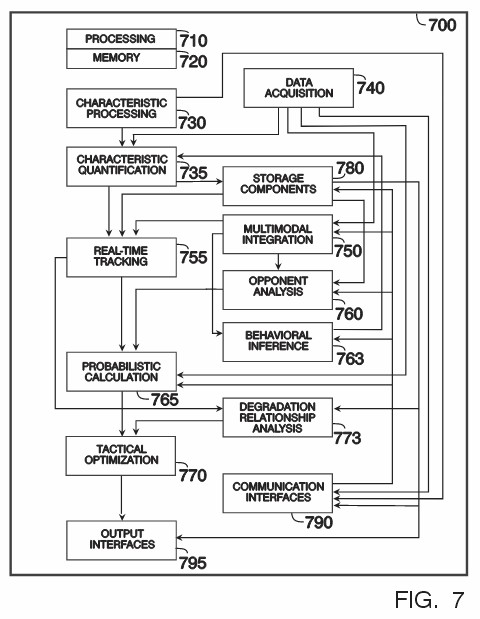
Processing and Memory Components. The system 700 comprises a processing unit 710 configured to execute computational operations such as neural network operations for pattern recognition and constraint analysis, metric quantification calculations, real-time multimodal data integration, probabilistic expected value computation, opponent tell identification, behavioral pattern inference, tactical optimization, and continuous learning operations. The processing unit 710 may comprise multiple processing elements such as central processing units, graphics processing units optimized for parallel video frame analysis and neural network operations, tensor processing units providing specialized acceleration for machine learning operations, and distributed processing nodes enabling scalable computational capacity responsive to workload demands.
The system 700 comprises memory 720 configured to store executable instructions, operational data, neural network models, athlete performance data, objectively valuable characteristics, and computational results. The memory 720 comprises volatile memory providing high-speed access for active computational operations such as current metric profiles for athletes in ongoing sport, real-time performance measurements across multiple data modalities, tactical configurations under evaluation, intermediate probabilistic calculations, and multimodal integration buffers. The memory 720 comprises non-volatile memory providing persistent storage for data such as neural network models, sport structure definitions, historical athlete performance data, longitudinal vulnerability patterns, objectively valuable characteristic definitions and metric ranges, validated prediction models, opponent tell pattern libraries, and multimodal integration weight configurations.
Characteristic Processing Components. The system 700 comprises a characteristic processing subsystem 730 configured to process objectively valuable characteristics for athlete evaluation and tactical optimization. The characteristic processing subsystem 730 may comprise a characteristic derivation module configured to analyze sport structure data, derive first principles governing competitive success through analysis of objective constraints, and generate objectively valuable characteristics based on derived first principles through neural network analysis, self-play reinforcement learning, or logical analysis of sport rules and physics. The characteristic processing subsystem 730 may comprise a characteristic input interface configured to receive objectively valuable characteristics from external sources such as expert-defined evaluation criteria, statistically-derived characteristics, third-party evaluation frameworks, or hybrid characteristic sets, and process received characteristics into standardized formats compatible with the system's quantification frameworks. Data pathways connect the characteristic processing subsystem 730 to the characteristic quantification module 735 described below, transmitting objectively valuable characteristics for metric range generation and metric profile creation regardless of characteristic derivation methodology.
The system 700 comprises a characteristic quantification module 735 configured to generate metric ranges for objectively valuable characteristics and individualized metric profiles for athletes. The characteristic quantification module 735 generates metric ranges derived from first principles of human physiology, motor control, and cognitive capabilities, or derived from statistical analysis, or specified through expert definition. The module 735 generates individualized metric profiles responsive to acquired sport-specific performance data received through data pathways from the performance data acquisition subsystems 740 described below, calculates percentile rankings, generates position-specific metric requirements, and implements quantification enabling rigorous probabilistic calculations and definitive tactical recommendations. Data pathways transmit generated metric profiles from the characteristic quantification module 735 to storage components 780 for persistent storage and to real-time tracking components 755 for performance deviation detection during ongoing sport.
Multimodal Data Acquisition Subsystems. The system 700 comprises performance data acquisition subsystems 740 configured for real-time capture and analysis of sport data across multiple modalities. The performance data acquisition subsystems 740 comprise a computer vision subsystem comprising video input interfaces configured to receive video streams from multiple camera angles, frame processing components configured to analyze video frames in real-time with minimal latency, athlete tracking algorithms configured to maintain consistent athlete identification across frames, pose estimation algorithms configured to determine athlete body positioning and movement mechanics, and performance metric extraction algorithms configured to derive measurements of objectively valuable characteristics from visual data such as speed, spatial positioning, body language indicators, and visible behavioral patterns.
The performance data acquisition subsystems 740 comprise an audio capture subsystem configured to capture acoustic patterns through directional microphones, parabolic microphones, and boundary microphones positioned at field locations, and audio processing components implementing voice activity detection, breathing pattern extraction, impact sound analysis, and vocal stress analysis to derive measurements such as breathing rate indicating cardiovascular stress, vocal stress markers indicating psychological pressure, communication quality indicating coordination effectiveness, and equipment impact characteristics indicating technical execution quality.
The performance data acquisition subsystems 740 comprise a physiological monitoring subsystem configured to receive data from wearable sensors such as heart rate monitors, temperature sensors, and accelerometers through sensor interfaces, and from non-contact measurement technologies such as thermal imaging cameras and remote photoplethysmography systems, implementing signal processing components for real-time physiological data analysis, filtering, and calibration to derive measurements such as cardiovascular state, thermal stress, metabolic demands, fatigue indicators, and injury risk factors.
The performance data acquisition subsystems 740 comprise an environmental monitoring subsystem configured to receive data from weather sensors, surface sensors measuring temperature and moisture, friction measurement devices, and light meters positioned around competitive venues, implementing environmental data analysis and condition change detection to quantify how conditions such as temperature, humidity, wind, surface friction, and surface moisture affect athlete performance across objectively valuable characteristics including speed, endurance, precision, and injury risk.
The performance data acquisition subsystems 740 comprise an equipment sensor subsystem configured to receive data from impact sensors in balls, accelerometers and gyroscopes in rackets or bats, pressure sensors in shoes, and strain gauges in equipment through sensor interfaces, implementing wireless communication components for real-time data transfer and equipment metric extraction algorithms to derive measurements such as impact force, swing speed, impact location precision, and technique quality from equipment sensor data.
The performance data acquisition subsystems 740 comprise a biomechanical analysis subsystem utilizing computer vision analysis of joint positions and movement trajectories, inertial measurement unit interfaces receiving data from wearable motion sensors, and force measurement interfaces receiving ground reaction force data, implementing kinematic and kinetic analysis calculations and biomechanical metric extraction algorithms to derive measurements such as movement efficiency, force production quality, technique characteristics, fatigue-related movement degradation, and injury risk indicators. Data pathways connect the performance data acquisition subsystems 740 to the multimodal integration engine 750 described below, transmitting real-time measurements across all modalities with synchronized timestamps enabling temporal alignment for integrated analysis.
Real-Time Analysis and Integration Components. The system 700 comprises a multimodal integration engine 750 configured to synthesize data across multiple acquisition subsystems into unified athlete metric states. The multimodal integration engine 750 receives measurements from the performance data acquisition subsystems 740 through data pathways, weights data sources by reliability and relevance for each objectively valuable characteristic, accounts for measurement uncertainties across modalities, resolves conflicts when measurements suggest divergent conclusions, and generates comprehensive athlete metric states for all athletes with associated confidence intervals reflecting multi-modal measurement quality and temporal validity. Data pathways connect the multimodal integration engine 750 to the real-time tracking module 755 and opponent analysis module 760 described below, transmitting integrated athlete metric states for deviation detection and behavioral pattern analysis.
The system 700 comprises a real-time tracking module 755 configured to monitor athlete performance continuously during sport. The real-time tracking module 755 receives integrated athlete metric states from the multimodal integration engine 750, compares current measurements to baseline metric profile values retrieved through data pathways from storage components 780, detects statistically significant performance deviations indicating degradation or enhancement, maintains updated athlete metric states accounting for detected deviations and temporal dynamics such as fatigue accumulation and recovery, and provides current athlete metric states to the probabilistic calculation engine 765 and tactical optimization module 770 through data pathways for tactical decision support.
The system 700 comprises an opponent analysis module 760 configured to identify behavioral patterns and psychological tells in opponent athletes during sport. The opponent analysis module 760 analyzes observable behaviors from video and audio data received through data pathways from the multimodal integration engine 750, implementing tell identification algorithms recognizing patterns such as breathing pattern irregularities, body language changes, communication disruptions, technique degradation, and positioning errors that reveal internal states such as fatigue, psychological pressure, capability degradation, and tactical confusion. The opponent analysis module 760 accesses opponent tell pattern libraries through data pathways to storage components 780, matches observed opponent behaviors against validated tell patterns, generates opponent athlete metric states and vulnerability assessments, and transmits results through data pathways to the probabilistic calculation engine 765 enabling tactical exploitation of detected opponent weaknesses.
The system 700 comprises a behavioral inference module 763 configured to derive qualitative objectively valuable characteristics such as game intelligence, competition attitude, synergistic team play, and position suitability through integrated analysis of behavioral patterns. The behavioral inference module 763 receives multimodal data through data pathways from the multimodal integration engine 750, analyzes spatial positioning patterns revealing spatial awareness, communication timing and content revealing anticipation and coordination, action timing and execution revealing decision quality, physiological stress responses revealing composure under pressure, and effort consistency across game states revealing competition attitude. The module 763 infers cognitive and psychological attributes from their manifestation in observable performance patterns rather than through direct measurement of mental states, transmitting inferred qualitative characteristic assessments through data pathways to the characteristic quantification module 735 for integration into comprehensive metric profiles.
Probabilistic and Tactical Optimization Components. The system 700 comprises a probabilistic calculation engine 765 configured to compute expected values through integration of uncertainty across multiple factors. The probabilistic calculation engine 765 receives athlete metric states from the real-time tracking module 755 and opponent analysis module 760 through data pathways, implements probabilistic methodologies such as Bayesian inference, Monte Carlo simulation, and analytical probability calculations, generates probability distributions over possible outcomes, weights outcomes by occurrence probabilities, accounts for measurement uncertainties and temporal variance, and calculates expected values for tactical configurations integrating friendly athlete capability states, opponent athlete capability states including detected degradations and tells, environmental conditions received through data pathways from performance data acquisition subsystems 740, and opponent response probability distributions. Data pathways connect the probabilistic calculation engine 765 to the tactical optimization module 770, transmitting calculated expected values for configuration evaluation and recommendation generation.
The system 700 comprises a tactical optimization module 770 configured to generate and evaluate tactical configurations for tactical decision points during sport. The tactical optimization module 770 generates tactical configurations responsive to current competitive state, receives expected values for each configuration through data pathways from the probabilistic calculation engine 765, identifies configurations optimizing expected value subject to risk tolerance constraints, generates strategic tactical sequences comprising coordinated actions such as decoy actions designed to induce opponent degradation followed by exploitation actions, accounts for temporal dynamics such as degradation accumulation and recovery characteristics, and generates definitive tactical recommendations specifying optimal configurations enabled by precise quantification supporting rigorous expected value differentiation. Data pathways connect the tactical optimization module 770 to output interfaces 795 for transmission of tactical recommendations to coaches or athletes during ongoing sport.
The system 700 comprises a degradation relationship analyzer 773 configured to identify and quantify causal connections between competitive action types and subsequent performance changes in objectively valuable characteristics. The degradation relationship analyzer 773 analyzes historical performance data retrieved through data pathways from storage components 780 and real-time observations received through data pathways from the real-time tracking module 755 to identify patterns where specific actions cause predictable capability degradation, quantifies degradation magnitudes and temporal timelines, maintains athlete-specific degradation profiles accounting for individual response variations, and provides degradation relationship data through data pathways to the tactical optimization module 770 for generating tactical sequences designed to deliberately induce opponent degradation before exploitation.
Storage Components. The system 700 comprises storage components 780 organized for efficient access during operational modes. The storage components 780 comprise metric profile storage maintaining individualized metric profiles for athletes including quantified values for objectively valuable characteristics, percentile rankings, historical metric trajectories, and confidence intervals, with separate storage for baseline capabilities, current sport capabilities accounting for real-time deviations, and longitudinal developmental trajectories. The storage components 780 comprise vulnerability pattern storage maintaining longitudinal opponent athlete analysis results including trigger conditions, degradation magnitudes, temporal timelines, occurrence probabilities, and variance characteristics. The storage components 780 comprise opponent tell pattern storage maintaining behavioral pattern libraries including observable behavioral indicators, associated internal states, reliability metrics, and athlete-specific tell profiles. The storage components 780 comprise sport structure storage maintaining formal sport definitions including rules, objectives, derived first principles, objectively valuable characteristics, metric ranges, position-specific requirements, and environmental factor models. The storage components 780 comprise tactical configuration storage maintaining tactical configuration libraries, pre-computed expected value calculations, historical effectiveness data, opponent response probability distributions, and degradation relationship tables. The storage components 780 comprise athlete performance storage maintaining comprehensive performance data including acquired sport-specific data, processed performance measurements, longitudinal tracking, validation outcomes, and multimodal integration metadata. Data pathways connect storage components 780 bidirectionally to all system modules enabling retrieval of operational data during active operations and storage of updated data as operational data accumulates and continuous learning enhances system capabilities.
Communication Interfaces. The system 700 comprises input interfaces 790 configured to receive data from multiple sources. The input interfaces 790 receive sport-specific performance data through network interfaces, video capture interfaces, sensor communication interfaces, and data import interfaces. The input interfaces 790 receive objectively valuable characteristics from external sources. The input interfaces 790 receive contextual data such as sport structure definitions, parental constraint information, and athlete sport preferences. Data pathways connect input interfaces 790 to performance data acquisition subsystems 740, characteristic processing subsystem 730, and storage components 780, transmitting received data for processing, analysis, and persistent storage.
The system 700 comprises output interfaces 795 configured to transmit information to external users and systems. The output interfaces 795 transmit tactical recommendations to coaches during sport through display interfaces presenting definitive configuration recommendations, key assumptions, confidence intervals, and alternative configurations, with data pathways connecting from the tactical optimization module 770 to output interfaces 795 enabling minimal latency delivery at tactical decision points. The output interfaces 795 generate detailed athlete evaluation reports through data pathways retrieving metric profiles from storage components 780. The output interfaces 795 provide multi-sport guidance recommendations through data pathways receiving recommendations from multi-sport guidance components. The output interfaces 795 export metric profiles, analysis results, and validation data to external systems through data export interfaces and application programming interfaces.
Continuous Learning and System Integration. Data pathways implement continuous learning feedback loops connecting actual competitive outcomes received through input interfaces 790 to model refinement components including the behavioral inference module 763, opponent analysis module 760, multimodal integration engine 750, and probabilistic calculation engine 765. The feedback pathways enable iterative optimization where prediction errors trigger model parameter adjustments, multimodal integration weight refinements, tell pattern reliability updates, and probabilistic calculation calibrations, progressively enhancing system performance as validation data accumulates. Data pathways connect all system modules to storage components 780 enabling retrieval of operational data during active operations and storage of updated data including current metric profiles, newly identified vulnerability patterns, validated tell patterns, and refined model parameters as operational data accumulates and continuous learning enhances system capabilities.
The integrated architecture enables the system 700 to implement the disclosed methods for athlete evaluation through precise quantification of capabilities on objectively valuable characteristics, real-time tactical optimization through multimodal athlete metric state tracking and probabilistic expected value calculation, opponent analysis through behavioral pattern recognition and tell identification, and multi-sport guidance through transferable capability analysis and integrated multi-factor optimization, with all functions supported by sophisticated data acquisition, integration, and analysis capabilities operating in coordination through defined information flow pathways.
The functional components described herein represent functionally distinct operations that may be implemented through discrete software modules with defined interfaces, integrated neural network architectures where functional distinctions emerge through constraint-based learning rather than explicit modular programming, or hybrid implementations combining modular and emergent approaches, with the modular terminology employed facilitating clear functional description without mandating specific implementation architectures. Throughout this description, references to "engines" and "modules" denote functional capabilities that may manifest as discrete software components or as emergent capabilities within integrated neural network architectures.
Sport Specific. In one specific exemplary embodiment, the neural network is configured for evaluation of athlete performance in soccer. The neural network derives first principles from soccer’s structure, rules, and objectives as represented in the FIFA Laws of the Game, including requirements relating to ball control with the feet while in motion, accurate ball propulsion under defensive pressure, and anticipation of the movement of teammates, opponents, and ball within the field of play.
Responsive to these first principles, the neural network derives a plurality of objectively valuable characteristics evaluative of an athlete’s performance in soccer. The plurality of objectively valuable characteristics comprises speed, reaction time, accuracy, endurance, acceleration, deceleration, actions per minute where applicable, input efficiency where applicable, game intelligence, synergistic team play, competition attitude, position suitability, spatial recognition, anticipation, risk calibration, decision quality, communication effectiveness, and formation maintenance.
Responsive to first principles of human physiology, motor control, and cognitive capabilities and responsive to soccer’s structure, rules, and objectives, the neural network generates a metric range for each objectively valuable characteristic. Acceleration and deceleration metric ranges are derived from biomechanical limits of sprinting and change of direction; endurance metric ranges are derived from physiological limits of sustained workload; spatial recognition and anticipation metric ranges are derived from visual processing and cognitive limits.
Acquiring sport-specific performance data for each of a plurality of individual soccer athletes comprises computer vision analysis of video recordings, processing sensor data from wearable devices, and parsing structured statistical records. The computer vision analysis extracts positions, movement patterns, ball interactions, and spatial relationships; the sensor processing extracts workload and movement dynamics; the structured record parsing extracts outcome statistics and event sequences.
Generating an individualized metric profile for each individual soccer athlete comprises generating a metric for each objectively valuable characteristic responsive to the corresponding metric range and assembling the metrics into an individualized metric profile, wherein each metric may be expressed as a percentile ranking with respect to a position-specific and sport-level-specific benchmark. The individualized metric profile is responsive to the plurality of objectively valuable characteristics and responsive to the plurality of metric ranges.
Position Specific. In another embodiment, the plurality of objectively valuable characteristics is position-specific. For soccer, positions comprise goalkeeper, defender, midfielder, and forward, with further subdivisions comprising center back, full back, wing back, defensive midfielder, central midfielder, attacking midfielder, and winger. For each position, the neural network derives a position-specific plurality of objectively valuable characteristics responsive to the distinct requirements of that designated role.
The metric profile and the metric ranges are responsive to the position-specific objectively valuable characteristics. The neural network performs a position suitability analysis by comparing an athlete’s metric profile to a position’s metric requirements, and may further generate a position recommendation identifying an optimal position for the athlete responsive to the metric profile. The neural network may also generate an athlete’s individualized training recommendation responsive to the athlete’s metric profile and a corresponding critical performance range.
Recruitment. In another embodiment, recruitment analysis is performed. A recruiter specifies a recruiter required minimum metric profile representing the minimum metric values required for recruitment. The neural network compares each individualized metric profile to the recruiter required minimum metric profile and identifies individual athletes whose metric profiles are responsive to the recruiter required minimum metric profile.
The neural network generates a ranked list of individual athletes selected from the plurality of individual athletes whose metric profiles satisfy or exceed the recruiter required minimum metric profile. The ranked list may be displayed on a user interface, transmitted to a recruiter, or integrated with a recruiting management system.
Individual Athlete. In another embodiment, the method is applied to an individual athlete. The neural network derives first principles from a sport’s structure, rules, and objectives and derives from the first principles a plurality of objectively valuable characteristics evaluative of an athlete’s performance in the sport. The neural network generates a metric range for at least one of the plurality of objectively valuable characteristics responsive to first principles of human physiology, motor control, and cognitive capabilities, and the sport’s structure, rules, and objectives.
The system acquires the individual athlete’s sport-specific performance data and generates at least one metric responsive to at least one objectively valuable characteristic and responsive to a corresponding metric range. The metric may further be responsive to a sport level and to a critical performance range. The neural network may generate a position suitability analysis, a position recommendation, and an individualized training recommendation for the individual athlete responsive to the at least one metric and a position’s metric requirement.
eSport. In another embodiment, the method is applied to an eSport. For example, the neural network derives first principles from an eSport’s structure, rules, and objectives, including game mechanics, resource constraints, victory conditions, map geometry, avatar abilities, and competitive rulesets. From these first principles, the neural network derives a plurality of objectively valuable characteristics evaluative of an athlete’s performance in the eSport.
The plurality of objectively valuable characteristics for an eSport comprises game intelligence, synergistic team play, competition attitude, position suitability, spatial recognition, anticipation, risk calibration, decision quality, communication effectiveness, actions per minute, input efficiency, and resource management efficiency. Responsive to first principles of human physiology, motor control, and cognitive capabilities and responsive to the eSport’s structure, rules, and objectives, the neural network generates a metric range for each of the plurality of objectively valuable characteristics, reflecting motor-cognitive latency, perceptual processing limits, and physical input constraints.
Acquiring eSport-specific performance data for each of a plurality of individual athletes comprises parsing a game telemetry log and natural language processing of an audio recording. The game telemetry log parsing extracts event sequences, timing data, input actions, and resource management actions; the natural language processing of audio recordings extracts communication patterns, callout accuracy, and coordination indicators.
Generating an individualized metric profile for each individual eSport athlete comprises generating a metric for each objectively valuable characteristic responsive to the corresponding metric range and assembling the metrics into an individualized metric profile. The individualized metric profile is responsive to the plurality of objectively valuable characteristics and responsive to the plurality of metric ranges, and may further be responsive to an eSport level comprising youth recreational, youth competitive, high school, collegiate, semi-professional, and professional.
In position-based eSports such as League of Legends, Dota 2, Counter-Strike, Valorant, Fortnite, and Overwatch, positions comprise, for example, top lane, jungle, mid lane, bot lane, and support, or analogous roles defined by the game. The plurality of objectively valuable characteristics is position-specific, and the metric profiles and metric ranges are responsive to the position-specific objectively valuable characteristics. The neural network may generate a position suitability analysis responsive to the metric profile and a position’s metric requirements and may generate a team athlete composition, an athlete position recommendation, and an athlete’s individualized training recommendation responsive to each athlete’s metric profile and a corresponding critical performance range.
Multi-Sport. The systems and methods described herein may support multi-sport evaluation wherein first principles and objectively valuable characteristics are derived for a plurality of sports and metric profiles are generated for an individual athlete across the plurality of sports. Objectively valuable characteristics that are common across sports enable cross-sport comparison, while sport-specific objectively valuable characteristics enable sport-specific evaluation. An athlete's metrics for common characteristics provide cross-sport comparison, while sport-specific characteristics indicate relative advantage in particular sports. The multi-sport evaluation enables identification of sport suitability, determining which sports best match the athlete's objectively valuable characteristics. The neural network may adapt first principles and metric ranges as sport rules, objectives, or constraints change over time.
Temporal Analysis. In real-time embodiments, the system acquires sport-specific performance data during live sport performance and generates metric updates in real-time. The real-time evaluation enables live feedback to coaches, real-time tactical adjustments, and immediate performance assessment. The real-time embodiment comprises a streaming data architecture wherein performance data flows continuously from acquisition systems through metric generation to display systems.
In longitudinal embodiments, sport-specific performance data is acquired at a plurality of time intervals. Metric profiles are generated for each time interval, enabling tracking of changes, comparison of current and prior metric profiles, and generation of development rates responsive to changes in the metric profile over time. The longitudinal tracking enables development rate calculation, trajectory projection, and intervention effectiveness assessment. The comparison of current metric profiles to prior metric profiles identifies improvement, regression, and plateau patterns. The comparison may be visualized as development curves showing metric progression over time. Training recommendations may be updated responsive to observed development gaps and development trajectories.
In predictive embodiments, the system generates predictions of future sport level achievement responsive to current metric profiles and development trajectories. The predictive analysis estimates probability of achieving targeted sport levels based on current capacities and the athlete's trajectory toward the capacities required at each sport level.
Benchmarking and Athlete Ranking. The system generates benchmarks for each metric from two sources. First-principles-derived benchmarks are generated from the neural network's analysis of human physiology, motor control, and cognitive capabilities, representing the range of human potential for each objectively valuable characteristic under sport conditions. Population-derived benchmarks are generated from sport-specific performance data acquired from a plurality of athletes at a specified position and sport level.
Athlete metrics within a population distribute according to a bell curve. The system generates a percentile ranking for each metric of the individualized metric profile, indicating where the individual athlete's metric falls within the distribution. The percentile ranking may be calculated with respect to first-principles-derived benchmarks, population-derived benchmarks, or both.
The system identifies exceptional metrics, comprising metrics significantly above benchmark values, and deficient metrics, comprising metrics significantly below benchmark values, within the individualized metric profile. The identification of exceptional and deficient metrics facilitates targeted development and recruitment decisions.
Team analysis evaluates a plurality of individualized metric profiles as a group to identify complementary and deficient objectively valuable characteristics within the group and may generate team composition recommendations.
Reporting and Integration. In reporting embodiments, the system generates reports comprising metric profiles and analysis results, displays metric profiles on a user interface, transmits metric profiles to recruiters, and generates visual representations of metric profiles, including comparative charts, radar plots, and performance distributions. The system may integrate with third-party data providers, recruiting management systems, training management systems, and league data systems. The integration enables automated data flow between the evaluation system and operational systems used by teams, leagues, and training organizations. The system may comprise application programming interfaces enabling third-party systems to request metric profiles, submit performance data, and receive analysis results.
Validation. In validation and feedback embodiments, the system validates objectively valuable characteristics and metric ranges responsive to athlete outcomes over time. The validation confirms that the derived objectively valuable characteristics are predictive of success and identifies characteristics whose metrics correlate with subsequent success. The system refines objectively valuable characteristics, updates metric ranges, and retrains neural components responsive to additional acquired sport-specific performance data. Objectively valuable characteristics not validated by athlete outcomes may indicate incomplete first principles analysis requiring revision.
Alternative Domain Embodiments
Extension to Non-Sports Performance Evaluation and Optimization Domains. The core innovations disclosed herein apply to performance evaluation and decision optimization domains beyond athletic competition. These innovations comprise quantified capability assessment on objectively valuable characteristics, multi-modal behavioral analysis, real-time performance tracking and deviation detection, opponent or counterpart behavioral tell identification, probabilistic optimization under uncertainty, and team composition optimization through complementary capability matching. This section describes exemplary applications in professional, organizational, and interpersonal contexts where the fundamental methodologies adapt to domain-specific structures while maintaining consistent conceptual frameworks for capability quantification, behavioral inference, and probabilistic decision support.
The system processes objectively valuable characteristics either derived through first principles analysis of domain structure analogous to sport structure analysis, or received from external sources comprising domain expert evaluation frameworks, organizational psychology research, leadership assessment methodologies, or hybrid characteristic sets combining multiple sources. The characteristic quantification module establishes metric ranges and generates individualized metric profiles for individuals in any domain where performance can be observed, measured, or inferred through behavioral patterns. The multi-modal data acquisition, behavioral tell identification, performance deviation detection, and probabilistic optimization functions operate identically whether applied to athletic performance during competitive contests or to professional performance during business operations, collaborative work, negotiations, crisis management, or interpersonal interactions.
Executive and Board Member Assessment. Executive Leadership Capability Evaluation Through Multimodal Performance Analysis. For executive leadership positions requiring complex decision-making under uncertainty, strategic thinking capability, crisis management effectiveness, and sustained performance under organizational pressure, the system derives objectively valuable characteristics from analysis of leadership role requirements or receives characteristics from executive assessment frameworks developed through organizational psychology research. Objectively valuable characteristics for executives comprise decision quality under time constraints and incomplete information, strategic thinking capability for long-term planning while managing immediate demands, communication effectiveness across diverse stakeholder groups, composure maintenance during organizational crisis, adaptive leadership through changing competitive environments, and team coordination capability for cross-functional initiatives.
Multimodal data acquisition for executive assessment comprises computer vision analysis of video recordings from board meetings and strategic planning sessions extracting body language indicators and engagement patterns, audio analysis of communication during high-pressure situations detecting vocal stress markers and decision confidence indicators, analysis of decision documentation and email communication patterns revealing decision-making processes and strategic thinking, physiological monitoring during crisis simulations or high-stakes presentations when candidates consent to sensor-based assessment, and behavioral observation during collaborative work sessions identifying leadership emergence patterns and team coordination capabilities. For historical performance assessment, the system analyzes archives of recorded meetings, decision documentation, and communication records. For prospective assessment when historical data is limited, the system may utilize structured assessment scenarios including crisis management simulations, strategic decision exercises, and collaborative problem-solving sessions enabling standardized performance observation across candidates.
Behavioral tell identification for executives operates analogously to opponent athlete analysis in sports contexts. Observable behavioral patterns during high-pressure situations reveal internal capability states. Vocal stress patterns indicate psychological pressure and decision confidence. Body language changes during challenging questions indicate defensive reactions or composure maintenance. Communication pattern alterations during crisis situations reveal stress responses and adaptive capability. Decision timing patterns reveal analytical depth versus impulsive responses. The system maintains tell pattern libraries validated across multiple executives, identifying which behavioral indicators reliably predict performance outcomes such as successful crisis navigation, strategic decision quality, and sustained effectiveness under organizational pressure.
Board Composition Optimization Through Complementary Capability Analysis. For board member selection and board composition optimization, the system generates metric profiles for candidate board members and existing board members on objectively valuable characteristics relevant to board effectiveness such as domain expertise depth, strategic thinking capability, risk assessment capability, questioning effectiveness during oversight functions, collaborative discussion contribution, and independence of judgment resistant to groupthink pressure. The system identifies complementary capability patterns where board members with different strength profiles create synergistic board composition. Probabilistic calculation evaluates alternative board compositions by predicting board decision quality through integration of individual member capabilities, interaction patterns, and decision-making dynamics, generating board composition recommendations optimizing across expertise coverage, cognitive diversity, collaborative effectiveness, and oversight capability.
Mergers and Acquisitions Analysis. Acquisition Target Company Capability Assessment and Cultural Compatibility Analysis. For merger and acquisition decisions requiring assessment of target company capabilities and prediction of post-merger integration success, the system derives objectively valuable characteristics from analysis of business operational requirements or receives characteristics from M&A due diligence frameworks. Objectively valuable characteristics for companies comprise operational efficiency, innovation capability, market adaptation responsiveness, organizational resilience under stress, leadership quality, employee capability depth, cultural characteristics affecting integration, and strategic alignment with acquiring company objectives.
Multi-modal data acquisition for company assessment comprises analysis of operational performance data including financial metrics and productivity indicators, communication pattern analysis from internal emails and collaboration platforms revealing organizational coordination quality and decision-making effectiveness, leadership assessment through analysis of executive communication and decision documentation, employee capability assessment through performance review data and collaborative output analysis, and cultural characteristic inference from observable organizational behaviors including meeting dynamics, communication patterns, and response patterns to organizational challenges. The system generates capability profiles for the target company quantifying expected performance on relevant characteristics, identifies capability gaps or degradation patterns suggesting operational vulnerabilities, and assesses cultural compatibility by comparing behavioral patterns and organizational norms between acquiring and target companies.
Integration Risk Assessment and Synergy Probability Calculation. The probabilistic calculation engine computes expected value for acquisition decisions by integrating target company capability assessments with predicted post-merger integration dynamics. The calculation accounts for cultural compatibility scores predicting integration friction, capability complementarity patterns predicting synergistic benefits, leadership compatibility analysis predicting executive team effectiveness, employee retention probability based on cultural alignment assessment, and operational integration complexity based on system compatibility and process alignment analysis. The system generates probabilistic predictions for post-merger performance including confidence intervals reflecting assessment uncertainty, identifies highest-risk integration factors requiring mitigation planning, and calculates expected value for the acquisition accounting for purchase price, predicted synergies, integration costs, and probability-weighted risk factors. Alternative scenarios are evaluated including different integration approaches, leadership structure options, and cultural integration strategies, with expected values compared to identify optimal post-merger strategies.
Special Operations Team Selection and Composition. Special Operations Personnel Assessment Through High-Pressure Performance Analysis. For special operations team member selection requiring assessment of performance capability under extreme stress, decision quality during life-threatening situations, team coordination under chaotic conditions, and sustained effectiveness during extended high-intensity operations, the system derives objectively valuable characteristics from analysis of operational requirements or receives characteristics from military assessment frameworks. Objectively valuable characteristics for special operations personnel comprise decision quality under extreme time pressure and life-threatening stress, physical capability for sustained high-intensity operations, situational awareness in complex dynamic environments, communication effectiveness during chaos and noise, adaptive tactical thinking responsive to rapidly changing situations, composure maintenance under psychological pressure and physical danger, and recovery capability between high-intensity operations.
Multi-modal data acquisition for special operations assessment comprises computer vision analysis during training exercises and assessment scenarios tracking movement patterns and tactical positioning decisions, audio analysis capturing communication effectiveness and vocal stress patterns during high-pressure scenarios, physiological monitoring through wearable sensors measuring cardiovascular response, thermal stress, and recovery patterns during intensive physical and psychological challenges, decision quality assessment through analysis of tactical choices during scenario-based evaluations, and performance tracking across extended training periods identifying capability consistency and degradation patterns under sustained stress. When historical operational data exists for experienced personnel, longitudinal performance analysis identifies individual capability patterns including stress response characteristics, decision quality degradation patterns under specific operational stressors, and recovery characteristics between operations.
Behavioral tell identification for special operations contexts recognizes that individuals demonstrate distinguishable stress response patterns under extreme pressure. Some individuals maintain baseline decision quality and communication effectiveness under severe stress, while others exhibit measurable degradation in specific capabilities when psychological or physical pressure exceeds individual thresholds. Observable behavioral indicators including breathing pattern changes, vocal stress markers, communication pattern alterations, movement characteristic changes, and decision timing variations reveal internal capability states during high-stress scenarios. The system identifies individual-specific patterns through longitudinal observation, enabling prediction of operational performance based on detected behavioral tells during mission-critical moments.
Special Operations Team Composition Optimization Through Stress Response Complementarity. Team composition optimization for special operations recognizes that effective teams comprise members with complementary stress response patterns and capability profiles. The system generates metric profiles for candidates on objectively valuable characteristics, identifies individual stress response patterns including which capabilities remain robust under stress and which capabilities degrade predictably, analyzes team interaction patterns during collaborative training scenarios identifying communication effectiveness and coordination quality, and evaluates alternative team compositions through probabilistic calculation. The optimization accounts for complementary capability patterns where team members with different strength profiles create comprehensive team capability, stress response diversity where some members maintain specific critical capabilities when others experience degradation in those areas, communication compatibility based on observed interaction patterns, and role-specific requirements for different operational contexts. The system generates team composition recommendations optimizing probability of mission success across diverse operational scenarios requiring different capability combinations.
Diplomatic Negotiator Assessment and Negotiation Team Composition. Diplomatic Negotiator Capability Assessment Through Multi-Party Negotiation Analysis. For diplomatic negotiator selection requiring assessment of strategic negotiation capability, cultural adaptation effectiveness, composure under political pressure, communication effectiveness across cultural contexts, and sustained performance during extended negotiations, the system derives objectively valuable characteristics from analysis of diplomatic negotiation requirements or receives characteristics from diplomatic training frameworks. Objectively valuable characteristics for diplomatic negotiators comprise strategic thinking for multi-party negotiation dynamics, cultural intelligence enabling effective cross-cultural communication, deception detection capability identifying adversarial negotiation tactics, composure maintenance under political pressure and deadline stress, adaptive communication responsive to changing negotiation dynamics, and collaborative relationship building enabling trust development across cultural barriers.
Multi-modal data acquisition for negotiator assessment comprises video analysis of negotiation sessions or negotiation training scenarios extracting body language patterns and engagement indicators, audio analysis capturing vocal patterns revealing stress responses and communication adaptation across cultural contexts, communication content analysis assessing strategic message framing and adaptive language use, behavioral pattern analysis during simulated multi-party negotiations identifying decision-making approaches and influence tactics, and longitudinal observation across multiple negotiation contexts revealing consistency characteristics and capability development. For assessment scenarios when historical negotiation data is limited, the system utilizes structured multi-party negotiation simulations with progressively increasing complexity, cultural diversity, conflicting interests, and time pressure, enabling standardized capability observation and behavioral tell identification across candidates.
Behavioral Tell Identification for Negotiation Contexts. Negotiation scenarios provide rich environments for behavioral tell identification analogous to poker tell recognition where observable behaviors reveal internal states and tactical intentions. Vocal stress patterns indicate psychological pressure during adversarial negotiation exchanges. Body language indicators reveal confidence levels in stated positions versus bluffing tactics. Communication timing patterns reveal strategic thinking depth versus reactive responses. Concession patterns reveal negotiation strategy and pressure tolerance. Cultural adaptation indicators reveal genuine cultural intelligence versus superficial cultural knowledge. The system maintains tell pattern libraries validated across diplomatic contexts, identifying which behavioral indicators reliably predict negotiation outcomes including successful agreement achievement, relationship preservation during disagreement, and effective crisis de-escalation. Deception detection through behavioral pattern analysis identifies when counterpart negotiators employ misleading tactics, enabling strategic response adjustments.
Negotiation Team Composition for Multi-Party Diplomatic Contexts. For complex multi-party negotiations requiring diverse capabilities including technical expertise, cultural knowledge, strategic thinking, and relationship management, team composition optimization evaluates alternative negotiation team configurations. The system generates metric profiles for team candidates on relevant objectively valuable characteristics, analyzes complementary expertise patterns ensuring comprehensive capability coverage across negotiation requirements, evaluates communication compatibility based on observed collaboration patterns during team exercises, assesses role specialization opportunities where different team members handle different negotiation functions, and computes expected value for alternative team compositions through probabilistic calculation accounting for negotiation complexity, cultural diversity, adversarial dynamics, and temporal constraints. The optimization generates negotiation team recommendations maximizing probability of achieving negotiation objectives while preserving diplomatic relationships.
Research Team Composition and Collaborative Innovation Optimization. Research Team Member Assessment and Team Composition for Collaborative Discovery. For research team composition requiring complementary expertise, collaborative problem-solving capability, and innovative thinking, the system derives objectively valuable characteristics from analysis of research domain requirements or receives characteristics from scientific assessment frameworks. Objectively valuable characteristics for researchers comprise domain expertise depth, analytical thinking capability, creative problem-solving for novel challenges, collaborative contribution during team research, communication effectiveness for interdisciplinary work, persistence during research obstacles, and adaptive thinking responsive to unexpected findings.
Multi-modal assessment for researchers comprises analysis of publication records and research output quality, collaborative work pattern analysis from co-authored publications and research project participation, communication effectiveness assessment through presentation analysis and teaching evaluation, problem-solving capability evaluation through structured research challenges or historical project analysis, and collaborative behavior observation during team research activities. The system generates metric profiles quantifying researcher capabilities, identifies complementary expertise patterns for interdisciplinary research requiring diverse knowledge domains, evaluates collaborative compatibility through analysis of communication patterns and work style preferences, and computes expected value for alternative team compositions predicting research output quality, innovation probability, and collaborative effectiveness.
Research team composition optimization recognizes that breakthrough research often emerges from teams combining diverse thinking approaches, complementary expertise domains, and collaborative synergy. The probabilistic calculation evaluates alternative research team configurations accounting for expertise coverage across research domain requirements, cognitive diversity balancing convergent analytical thinking with divergent creative thinking, collaborative compatibility enabling effective communication and coordination, role specialization patterns where team members contribute different capabilities to research processes, and predicted research output based on historical patterns for researchers with similar capability profiles. The system generates research team recommendations optimizing probability of research breakthrough, publication quality, and sustained collaborative productivity.
Relationship Compatibility Assessment and Partnership Optimization. Interpersonal Relationship Compatibility Analysis Through Behavioral Pattern Assessment. For interpersonal relationship contexts including romantic partnerships, business partnerships, or long-term collaborative relationships requiring sustained compatibility and conflict resolution capability, the system derives objectively valuable characteristics from analysis of relationship requirements or receives characteristics from relationship psychology frameworks. Objectively valuable characteristics for relationship compatibility comprise communication effectiveness during disagreement, conflict resolution capability maintaining relationship quality through disputes, emotional regulation during stress, behavioral consistency across varying contexts, value alignment on critical life decisions, and collaborative decision-making capability for shared responsibilities.
Multi-modal assessment for relationship compatibility comprises video analysis of interaction patterns during structured conversation scenarios including both low-stress and deliberately induced disagreement topics, audio analysis capturing vocal patterns revealing emotional states and communication approaches, communication content analysis assessing dialogue quality and conflict resolution strategies, behavioral observation across multiple interaction contexts revealing consistency characteristics, and preference analysis through multimodal interview methodology distinguishing genuine compatibility from superficial attraction or socially desirable responses. For relationship simulations when limited historical interaction data exists, the system utilizes structured scenarios progressively introducing common relationship stressors including financial decision conflicts, lifestyle preference differences, family obligation conflicts, and time allocation disagreements, enabling observation of conflict resolution patterns and communication effectiveness under relationship stress.
Behavioral tell identification for relationship contexts recognizes that individuals demonstrate characteristic behavioral patterns during interpersonal conflict revealing internal emotional states and relationship capability. Communication pattern changes during disagreement reveal conflict avoidance versus constructive engagement. Vocal stress patterns indicate emotional regulation capability versus escalation tendency. Body language indicators reveal defensiveness versus openness during difficult conversations. Behavioral consistency across contexts reveals genuine characteristics versus context-dependent behavioral adaptation. The system identifies individual behavioral patterns and evaluates compatibility by analyzing interaction dynamics, conflict resolution effectiveness, communication pattern complementarity, and behavioral consistency, generating probabilistic predictions for long-term relationship sustainability accounting for compatibility across multiple dimensions and predicted capability for navigating relationship challenges.
General Framework for Domain Adaptation and Simulation-Based Assessment. Domain-Agnostic Core Innovations Enabling Cross-Domain Application. The transfer of core innovations across domains from athletic performance to professional and interpersonal contexts demonstrates the fundamental nature of the underlying methodologies. Quantified capability assessment through metric profiles and individualized quantification applies to any domain where performance can be observed and capabilities inferred. Multi-modal data acquisition synthesizing information across visual, vocal, physiological, and behavioral channels operates identically whether assessing athletic performance during competitive contests or professional performance during business operations. Behavioral tell identification inferring internal states from observable patterns functions equivalently in recognizing athlete fatigue tells, executive stress indicators under crisis pressure, or relationship conflict resolution patterns. Probabilistic optimization under uncertainty through expected value calculation applies to tactical configuration selection in sports, team composition decisions in organizational contexts, and partnership compatibility assessment in interpersonal domains.
The characteristic quantification module implements identical quantification frameworks across domains regardless of whether objectively valuable characteristics originate from first principles domain structure analysis or from external expert frameworks. The multi-modal integration engine synthesizes measurements across data sources using consistent weighting, conflict resolution, and confidence interval generation methodologies. The probabilistic calculation engine computes expected values through identical mathematical frameworks integrating capability assessments with uncertainty across multiple factors. The optimization modules generate recommendations through consistent decision frameworks accounting for situational factors, risk tolerance, and probability-weighted outcomes. This domain-agnostic architecture enables the system to provide decision support across fundamentally different domains through adaptation of data sources, characteristic definitions, and domain-specific contextual factors while maintaining consistent core analytical methodologies.
Simulation-Based Assessment as Exemplary Data Acquisition Methodology. In domains where historical performance data is limited for new candidates or where standardized assessment scenarios enable more reliable capability comparison, simulation-based assessment provides exemplary data acquisition methodology. Simulations create controlled environments where candidates face equivalent challenges enabling direct capability comparison, progressive stress induction reveals degradation patterns and behavioral tells under increasing pressure, multi-modal data acquisition during simulations captures comprehensive performance information across visual, vocal, physiological, and decision quality dimensions, and repeatable assessment enables capability development tracking and validation of assessment reliability. Simulation scenarios are designed to replicate critical performance demands of the target domain, such as crisis management scenarios for executive assessment replicating time pressure and incomplete information characteristic of organizational crises, tactical scenarios for special operations assessment replicating physical demands and life-threatening stress of operational environments, negotiation scenarios for diplomatic assessment replicating multi-party dynamics and cultural complexity of international negotiations, or conflict resolution scenarios for relationship assessment replicating common interpersonal stressors and disagreement patterns.
Simulation design incorporates domain-specific requirements while maintaining multi-modal data acquisition capability. Simulations progress through increasing complexity and stress levels enabling observation of capability degradation patterns and performance sustainability under cumulative pressure. Collaborative simulations involving multiple candidates enable team dynamics observation and interaction pattern analysis. Simulations incorporate realistic environmental factors, time constraints, information uncertainty, and consequence structures creating psychological pressure analogous to real-world performance contexts. The system tracks performance across simulation progression identifying baseline capabilities, stress response patterns, degradation relationships quantifying how specific stressors affect specific capabilities, recovery characteristics between high-stress intervals, and learning patterns revealing capability development responsiveness. Simulation-based assessment complements historical performance analysis, real-world observation, and interview methodologies, providing controlled standardized data acquisition when other sources are limited or when comparative assessment across candidates requires equivalent performance observation.
Domain Agnostic Architecture
The system architecture disclosed herein demonstrates domain-agnostic applicability across fundamentally different performance evaluation contexts. The core innovations comprise quantified capability assessment on objectively valuable characteristics, multimodal behavioral analysis, real-time performance tracking, behavioral tell identification, probabilistic optimization under uncertainty, and team composition optimization through complementary capability matching. These innovations operate with consistent computational methodologies across diverse domains including athletic competition, executive leadership assessment, organizational team composition, company acquisition analysis, special operations team selection, diplomatic negotiator evaluation, research team composition, and interpersonal relationship compatibility assessment. Domain adaptation occurs through three primary instantiation points while maintaining identical core analytical frameworks: input data acquisition methodologies responsive to available data sources in each domain, objectively valuable characteristic definitions derived from domain structure analysis or received from domain expert frameworks, and output recommendation formats tailored to decision contexts in each domain.
The core analytical components comprise characteristic quantification, multimodal integration, behavioral pattern analysis, performance deviation detection, probabilistic calculation, and optimization. These components implement consistent information processing methodologies regardless of domain context. Characteristic quantification operates identically whether quantifying athletic speed, executive decision quality under pressure, company innovation capability, or operator situational awareness, implementing precise measurement frameworks enabling rigorous probabilistic calculations. Multimodal integration synthesizes data across available acquisition sources consistently whether integrating video and physiological data during athletic competition, meeting recordings and communication patterns during executive assessment, or operational data and cultural indicators during company evaluation. Behavioral pattern analysis identifies tells revealing internal states equivalently whether detecting athlete fatigue from breathing irregularities, executive stress from vocal patterns, or cultural integration risk from organizational communication norms. Probabilistic calculation computes expected values through identical mathematical frameworks whether optimizing tactical configurations during sport, board compositions for governance, acquisition decisions for corporate strategy, or team compositions for operational missions.
This architectural consistency across fundamentally different domains establishes that the disclosed inventions provide a general-purpose platform for performance evaluation and decision optimization. The system enables systematic capability assessment where performance can be observed, precise quantification where capabilities can be measured or inferred, multimodal synthesis where multiple data sources provide complementary information, behavioral inference where observable patterns reveal internal states, and probabilistic optimization where decisions must integrate uncertainty across multiple factors. Applications extend across any domain requiring these capabilities, with domain-specific instantiation of inputs, characteristics, and outputs enabling specialized application while maintaining consistent core methodologies. The following detailed architecture for mergers and acquisitions analysis demonstrates exemplary domain-specific implementation maintaining full consistency with the general system architecture while adapting to the specific requirements of company capability assessment, cultural compatibility analysis, and acquisition decision optimization.
FIG. 8 illustrates an exemplary embodiment of the system architecture adapted for mergers and acquisitions analysis, company capability assessment, cultural compatibility evaluation, and post-merger integration planning. The system 800 comprises integrated hardware and software components configured to quantify company performance on objectively valuable characteristics relevant to acquisition decisions, perform real-time analysis of organizational operations and cultural patterns, identify behavioral indicators revealing organizational capabilities and integration risks, calculate probabilistic expected values for acquisition decisions accounting for integration complexity and synergy potential, and generate definitive acquisition recommendations through systematic integration of precise quantification and comprehensive risk assessment. The functional components described herein represent functionally distinct operations that may be implemented through discrete software modules with defined interfaces, integrated neural network architectures where functional distinctions emerge through constraint-based learning rather than explicit modular programming, or hybrid implementations combining modular and emergent approaches, with the modular terminology employed facilitating clear functional description without mandating specific implementation architectures. Throughout this description, references to "engines" and "modules" denote functional capabilities that may manifest as discrete software components or as emergent capabilities within integrated neural network architectures.
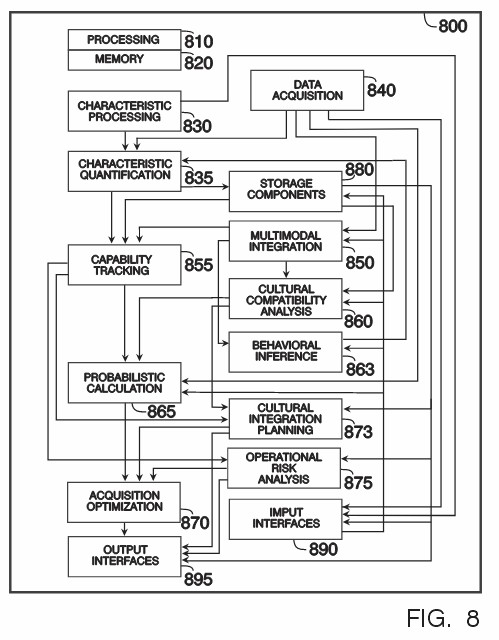
Processing and Memory Components. The system 800 comprises a processing unit 810 configured to execute computational operations such as neural network operations for organizational pattern recognition and business constraint analysis, metric quantification calculations for company capabilities, real-time multimodal data integration across operational and cultural data sources, probabilistic expected value computation for acquisition decisions, cultural compatibility assessment, behavioral pattern inference for organizational analysis, acquisition optimization accounting for integration complexity, and continuous learning operations refining models through validation of actual post-merger outcomes. The processing unit 810 may comprise multiple processing elements such as central processing units, graphics processing units optimized for parallel processing of large-scale organizational data and neural network operations, tensor processing units providing specialized acceleration for machine learning operations, and distributed processing nodes enabling scalable computational capacity responsive to analysis demands.
The system 800 comprises memory 820 configured to store executable instructions, operational data, neural network models, company performance data, objectively valuable characteristics for business operations, and computational results. The memory 820 comprises volatile memory providing high-speed access for active computational operations such as current metric profiles for target companies under evaluation, real-time operational measurements across multiple data modalities, acquisition configurations under evaluation, intermediate probabilistic calculations for synergy assessment, and multimodal integration buffers. The memory 820 comprises non-volatile memory providing persistent storage for data such as neural network models, business domain structure definitions, historical company performance data, longitudinal cultural pattern libraries, objectively valuable characteristic definitions and metric ranges for business capabilities, validated acquisition outcome models, organizational behavioral pattern libraries, and multimodal integration weight configurations.
Characteristic Processing Components. The system 800 comprises a characteristic processing subsystem 830 configured to process objectively valuable characteristics for company evaluation and acquisition optimization. The characteristic processing subsystem 830 may comprise a characteristic derivation module configured to analyze business operational requirements, derive first principles governing company success through analysis of market constraints and competitive dynamics, and generate objectively valuable characteristics based on derived principles through neural network analysis, business case studies, or logical analysis of operational requirements and strategic positioning. The characteristic processing subsystem 830 may comprise a characteristic input interface configured to receive objectively valuable characteristics from external sources such as M&A due diligence frameworks, organizational psychology research, business strategy frameworks, private equity evaluation criteria, or hybrid characteristic sets, and process received characteristics into standardized formats compatible with the system's quantification frameworks. Data pathways connect the characteristic processing subsystem 830 to the characteristic quantification module 835 described below, transmitting objectively valuable characteristics for metric range generation and metric profile creation regardless of characteristic derivation methodology.
The system 800 comprises a characteristic quantification module 835 configured to generate metric ranges for objectively valuable characteristics and individualized metric profiles for companies. The characteristic quantification module 835 generates metric ranges derived from first principles of organizational dynamics, market analysis, and operational efficiency, or derived from statistical analysis across comparable companies, or specified through expert M&A frameworks. The module 835 generates individualized metric profiles for target companies responsive to acquired operational performance data received through data pathways from the performance data acquisition subsystems 840 described below, calculates industry percentile rankings, generates sector-specific capability requirements, and implements quantification enabling rigorous probabilistic calculations and definitive acquisition recommendations. Data pathways transmit generated metric profiles from the characteristic quantification module 835 to storage components 880 for persistent storage and to real-time tracking components 850 for capability assessment during due diligence processes.
Multimodal Data Acquisition Subsystems. The system 800 comprises performance data acquisition subsystems 840 configured for comprehensive capture and analysis of company operational data, organizational behavioral data, and cultural indicators across multiple modalities. The performance data acquisition subsystems 840 comprise a financial and operational data acquisition module comprising interfaces to financial reporting systems, operational metrics databases, productivity tracking systems, and business intelligence platforms, and data processing components implementing time series analysis, trend detection, efficiency calculations, and performance metric extraction algorithms to derive measurements such as revenue growth patterns, operational efficiency indicators, profit margin stability, resource utilization effectiveness, and financial resilience indicators.
The performance data acquisition subsystems 840 comprise an organizational communication analysis module configured to access internal communication platforms such as email systems, collaboration tools, instant messaging archives, and meeting scheduling systems through secure interfaces with appropriate access permissions, and communication analysis components implementing natural language processing, communication network analysis, interaction frequency measurement, and collaboration pattern extraction to derive measurements such as cross-functional coordination effectiveness, decision-making speed, information flow efficiency, organizational silos identification, and communication culture characteristics.
The performance data acquisition subsystems 840 comprise a meeting and interaction analysis module configured to analyze video recordings of organizational meetings, executive presentations, and team interactions when available through secure access protocols, implementing computer vision analysis of engagement patterns, participation distribution, decision-making dynamics, and leadership interaction styles, and audio analysis of meeting communications detecting discussion quality, conflict resolution patterns, idea generation dynamics, and collaborative effectiveness to derive measurements such as meeting productivity, leadership communication effectiveness, team collaboration quality, and organizational decision-making patterns.
The performance data acquisition subsystems 840 comprise a cultural assessment module configured to acquire data revealing organizational culture through analysis of employee surveys when available, organizational structure documentation, policy and procedure documents, performance review data, employee retention patterns, and publicly available cultural indicators such as employer review platforms and social media presence, implementing cultural indicator extraction algorithms and behavioral pattern recognition to derive measurements such as organizational values alignment, cultural consistency across locations, employee satisfaction patterns, cultural adaptability, and integration compatibility indicators.
The performance data acquisition subsystems 840 comprise a leadership evaluation module configured to analyze executive communication patterns, strategic decision documentation, crisis response records, and leadership team interaction patterns through document analysis, email pattern analysis when accessible, and public executive communication such as earnings calls and investor presentations, implementing leadership capability assessment algorithms and decision quality analysis to derive measurements such as strategic thinking capability, crisis management effectiveness, communication effectiveness, decision quality under pressure, and leadership team coordination. Data pathways connect the performance data acquisition subsystems 840 to the multimodal integration engine 850 described below, transmitting real-time measurements across all modalities with synchronized timestamps enabling temporal alignment for integrated analysis.
Real-Time Analysis and Integration Components. The system 800 comprises a multimodal integration engine 850 configured to synthesize data across multiple acquisition subsystems into unified company capability profiles. The multimodal integration engine 850 receives measurements from the performance data acquisition subsystems 840 through data pathways, weights data sources by reliability and relevance for each objectively valuable characteristic, accounts for measurement uncertainties across modalities and data access limitations, resolves conflicts when measurements suggest divergent conclusions about company capabilities, and generates comprehensive company metric states with associated confidence intervals reflecting multimodal measurement quality and data completeness. Data pathways connect the multimodal integration engine 850 to the capability tracking module 855 and cultural compatibility analysis module 860 described below, transmitting integrated company capability assessments for comparative analysis and integration risk evaluation.
The system 800 comprises a capability tracking module 855 configured to monitor company capabilities across the due diligence process and post-acquisition integration period. The capability tracking module 855 receives integrated company metric states from the multimodal integration engine 850, compares current measurements to industry benchmarks and comparable company profiles retrieved through data pathways from storage components 880, detects capability gaps or exceptional strengths relative to acquisition criteria, maintains updated company metric states accounting for discovered information and temporal dynamics such as market condition changes and competitive positioning shifts, and provides current company metric states to the probabilistic calculation engine 865 and acquisition optimization module 870 through data pathways for acquisition decision support.
The system 800 comprises a cultural compatibility analysis module 860 configured to assess integration risk through comparison of acquiring and target company cultural patterns. The cultural compatibility analysis module 860 analyzes organizational behavioral patterns from communication data, decision-making processes, meeting dynamics, and cultural indicators received through data pathways from the multimodal integration engine 850, implementing cultural pattern recognition algorithms identifying characteristics such as communication norms including formality levels and transparency expectations, decision-making styles including centralized versus distributed authority and risk tolerance, conflict resolution patterns, innovation culture indicators, and work-life balance norms. The cultural compatibility analysis module 860 compares acquiring company cultural patterns retrieved through data pathways from storage components 880 with target company cultural patterns, calculates compatibility scores across multiple cultural dimensions, identifies high-risk cultural mismatches predicting integration friction, and generates cultural compatibility assessments transmitted through data pathways to the probabilistic calculation engine 865 for integration risk quantification.
The system 800 comprises a behavioral inference module 863 configured to derive qualitative company capabilities such as innovation capability, organizational agility, strategic thinking quality, and competitive positioning effectiveness through integrated analysis of behavioral patterns. The behavioral inference module 863 receives multimodal data through data pathways from the multimodal integration engine 850, analyzes operational decision patterns revealing strategic thinking, product development patterns revealing innovation capability, market response patterns revealing organizational agility, communication patterns revealing coordination effectiveness, and employee retention patterns revealing organizational health. The module 863 infers organizational capabilities from their manifestation in observable operational patterns rather than through direct measurement, transmitting inferred qualitative capability assessments through data pathways to the characteristic quantification module 835 for integration into comprehensive company metric profiles.
Probabilistic and Acquisition Optimization Components. The system 800 comprises a probabilistic calculation engine 865 configured to compute expected values for acquisition decisions through integration of uncertainty across multiple factors. The probabilistic calculation engine 865 receives company capability assessments from the capability tracking module 855 and cultural compatibility analysis module 860 through data pathways, implements probabilistic methodologies such as Bayesian inference accounting for data quality limitations, Monte Carlo simulation for synergy realization scenarios, and analytical probability calculations for integration outcome distributions, generates probability distributions over possible post-merger performance outcomes, weights outcomes by occurrence probabilities accounting for integration success rates and market condition uncertainties, accounts for measurement uncertainties and incomplete information limitations inherent in due diligence processes, and calculates expected values for acquisition decisions integrating target company capabilities, acquiring company capabilities retrieved through data pathways from storage components 880, cultural compatibility scores predicting integration friction probability, market conditions and competitive dynamics, and synergy realization probability distributions. Data pathways connect the probabilistic calculation engine 865 to the acquisition optimization module 870, transmitting calculated expected values for acquisition decision evaluation and recommendation generation.
The system 800 comprises an acquisition optimization module 870 configured to generate and evaluate acquisition configurations including purchase price negotiations, integration approach strategies, and organizational structure decisions. The acquisition optimization module 870 generates acquisition configurations responsive to strategic objectives and constraint sets such as budget limitations and regulatory requirements, receives expected values for each configuration through data pathways from the probabilistic calculation engine 865, identifies configurations optimizing expected value subject to risk tolerance constraints and strategic fit requirements, generates integration sequences comprising phased integration approaches accounting for cultural compatibility considerations and operational priority optimization, accounts for temporal dynamics such as market timing and competitive response probability, and generates definitive acquisition recommendations specifying optimal configurations enabled by precise capability quantification supporting rigorous expected value differentiation. Data pathways connect the acquisition optimization module 870 to output interfaces 895 for transmission of acquisition recommendations to decision-makers during due diligence processes and integration planning.
The system 800 comprises a cultural integration planner 873 configured to provide detailed cultural integration planning beyond compatibility scoring. The cultural integration planner 873 receives cultural pattern data through data pathways from the cultural compatibility analysis module 860, identifies specific integration friction points such as conflicting decision-making norms or incompatible communication styles, generates cultural integration strategies such as phased cultural blending, targeted change management for high-friction areas, or preservation of target company culture in specific functions, estimates cultural integration timelines accounting for change management complexity, and provides cultural integration recommendations through data pathways to the acquisition optimization module 870 for incorporation into comprehensive integration planning.
The system 800 comprises an operational risk analyzer 875 configured to identify and quantify operational integration risks beyond cultural factors. The operational risk analyzer 875 analyzes system compatibility data, process alignment data, geographic distribution complexity, regulatory compliance requirements across jurisdictions, and key personnel retention risk retrieved through data pathways from the capability tracking module 855 and storage components 880, implements risk quantification algorithms calculating probability and impact of integration challenges such as technology integration failures, key employee departures, customer disruption, or regulatory complications, and generates integration risk assessments with mitigation strategy recommendations transmitted through data pathways to the acquisition optimization module 870 for comprehensive risk-adjusted decision support.
Storage Components. The system 800 comprises storage components 880 organized for efficient access during acquisition evaluation and integration planning. The storage components 880 comprise metric profile storage maintaining individualized metric profiles for companies including quantified values for objectively valuable business characteristics, industry percentile rankings, historical capability trajectories, and confidence intervals, with separate storage for target company profiles under evaluation, acquiring company baseline capabilities, and comparable company benchmarks. The storage components 880 comprise cultural pattern storage maintaining organizational behavioral pattern libraries including communication norms, decision-making styles, conflict resolution patterns, innovation culture indicators, and work-life balance characteristics for acquiring company culture and industry-specific cultural benchmarks. The storage components 880 comprise integration outcome storage maintaining historical acquisition integration results including integration success rates, synergy realization patterns, cultural friction manifestations, timeline data, and post-merger performance trajectories enabling validation and continuous learning. The storage components 880 comprise business domain storage maintaining formal business operational models including industry dynamics, competitive frameworks, regulatory requirements, market structure definitions, and objectively valuable characteristic definitions for various business sectors. The storage components 880 comprise acquisition configuration storage maintaining acquisition strategy libraries, pre-computed valuation models, integration approach templates, risk mitigation strategies, and synergy calculation frameworks. The storage components 880 comprise company performance storage maintaining comprehensive operational data including acquired financial data, processed operational measurements, communication pattern analysis results, cultural assessment data, and leadership evaluation results. Data pathways connect storage components 880 bidirectionally to all system modules enabling retrieval of operational data during active acquisition evaluations and storage of updated data as due diligence progresses and continuous learning enhances system capabilities through validation of actual integration outcomes.
Communication Interfaces. The system 800 comprises input interfaces 890 configured to receive data from multiple sources. The input interfaces 890 receive company operational data through secure network interfaces to financial systems, operational databases, and business intelligence platforms. The input interfaces 890 receive organizational communication data through secure access to email systems, collaboration platforms, and meeting archives with appropriate permissions. The input interfaces 890 receive objectively valuable characteristics from external M&A frameworks, business strategy consultants, or industry evaluation standards. The input interfaces 890 receive contextual data such as market conditions, regulatory requirements, and strategic objectives. Data pathways connect input interfaces 890 to performance data acquisition subsystems 840, characteristic processing subsystem 830, and storage components 880, transmitting received data for processing, analysis, and persistent storage.
The system 800 comprises output interfaces 895 configured to transmit information to acquisition decision-makers and integration teams. The output interfaces 895 transmit acquisition recommendations to executives and board members through secure display interfaces presenting definitive recommendations with expected value calculations, confidence intervals, key assumptions, risk factors, and alternative configuration comparisons, with data pathways connecting from the acquisition optimization module 870 to output interfaces 895 enabling timely delivery during due diligence milestones and board decision points. The output interfaces 895 generate detailed company capability assessment reports through data pathways retrieving metric profiles from storage components 880, providing comprehensive evaluation documentation for due diligence processes. The output interfaces 895 provide cultural compatibility analysis reports through data pathways receiving assessments from the cultural integration planner 873, documenting integration risks and mitigation strategies. The output interfaces 895 provide integration planning recommendations through data pathways receiving strategies from the operational risk analyzer 875, supporting post-acquisition execution. The output interfaces 895 export company profiles, analysis results, and acquisition outcome data to external systems through data export interfaces and application programming interfaces.
Continuous Learning and System Integration. Data pathways implement continuous learning feedback loops connecting actual post-merger integration outcomes and performance results received through input interfaces 890 to model refinement components including the behavioral inference module 863, cultural compatibility analysis module 860, multimodal integration engine 850, and probabilistic calculation engine 865. The feedback pathways enable iterative optimization where prediction errors trigger model parameter adjustments such as cultural compatibility scoring calibrations based on actual integration friction patterns, synergy realization probability refinements based on actual post-merger performance, integration timeline adjustments based on actual integration completion data, and risk factor weighting optimizations based on observed integration challenges. Data pathways connect all system modules to storage components 880 enabling retrieval of operational data during active acquisition evaluations and storage of updated data including current company profiles, newly validated cultural patterns, refined integration risk models, and calibrated valuation frameworks as operational data accumulates and continuous learning enhances system capabilities through validation of actual acquisition outcomes.
The integrated architecture enables the system 800 to implement the disclosed methods for company evaluation through precise quantification of capabilities on objectively valuable business characteristics, acquisition optimization through multimodal company capability assessment and probabilistic expected value calculation accounting for integration complexity, cultural compatibility analysis through organizational behavioral pattern recognition, and integration planning through comprehensive risk assessment and strategy optimization, with all functions supported by sophisticated data acquisition, integration, and analysis capabilities operating in coordination through defined information flow pathways. The modular functional components described may be implemented through conventional software architectures with discrete modules, through integrated neural network systems where functional capabilities emerge through constraint-based learning without explicit modular boundaries, or through hybrid architectures combining modular and emergent approaches, with the functional descriptions supporting claims to systems achieving the described capabilities regardless of specific implementation architecture. The M&A-specific architecture demonstrates exemplary domain adaptation while maintaining complete consistency with the general system architecture disclosed in FIG. 7, illustrating the domain-agnostic nature of the core innovations and their applicability across fundamentally different performance evaluation and optimization contexts.
The comparative architecture demonstrates that adaptation across domains occurs through domain-specific instantiation of three primary components: input data acquisition methodologies responsive to available data sources in each domain, objectively valuable characteristic definitions derived from domain structure analysis or received from domain expert frameworks, and output recommendation formats tailored to decision contexts in each domain. The core analytical components, such as characteristic quantification, multimodal integration, behavioral tell identification, performance deviation detection, probabilistic calculation, and optimization, operate through identical methodologies across all domains, establishing the fundamental and domain-agnostic nature of the disclosed innovations. This architecture enables the system to provide decision support across fundamentally different performance evaluation contexts including athletic competition, executive leadership assessment, organizational team composition, company acquisition analysis, special operations team selection, diplomatic negotiator evaluation, research team composition, and interpersonal relationship compatibility assessment through consistent application of quantified capability assessment, multimodal behavioral analysis, and probabilistic optimization methodologies.
While elements of the inventions have been described with reference to specific embodiments, it is evident that many alternatives, modifications, and variations are possible.